
Retail, quants drive DEX adoption as institutions stick with CEXs: Bitget

Decentralized exchanges (DEXs) are rapidly gaining traction among retail traders and quants, while institutions continue to favor centralized platforms, according to Bitget Wallet’s chief marketing officer Jamie Elkaleh.
Elkaleh told Cointelegraph that the strongest adoption of platforms like Hyperliquid is “coming from retail traders and semi-professional quants.” Retail users are drawn in by airdrop cultures and points systems, while quants favor “low fees, fast fills, and programmable strategies,” he said.
However, institutional desks still rely on centralized exchanges (CEXs) due to their support for fiat rails, compliance services and prime brokerage offerings.
Elkaleh noted that the execution quality gap between DEXs and CEXs is closing fast. “Order-book based DEXs such as Hyperliquid, dYdX v4, or GMX are now delivering latency and depth that used to be exclusive to CEXs,” he explained.
Related: Bitwise files for spot Hyperliquid ETF amid perp DEX wars
DEXs seek to deliver CEX-speed trading with onchain transparency
Hyperliquid, one of the leading perpetual DEX platforms, runs on its own chain and offers an onchain central limit order book. “Every order, cancellation, and fill is fully auditable,” said Elkaleh. “It’s performance without compromising on decentralization.”
The platform achieves sub-second finality without charging gas fees per trade, aiming to combine CEX-like speed with self-custody. However, competition is heating up. On BNB Chain, Aster has emerged as a top challenger.
“Aster’s incentive campaigns recently pushed its daily perp volume to record levels, even overtaking Hyperliquid on certain days,” Elkaleh said. Over the past day, Aster has registered around $47 billion in perp volume, more than double Hyperliquid’s $17 billion volume, according to data from DefiLlama.
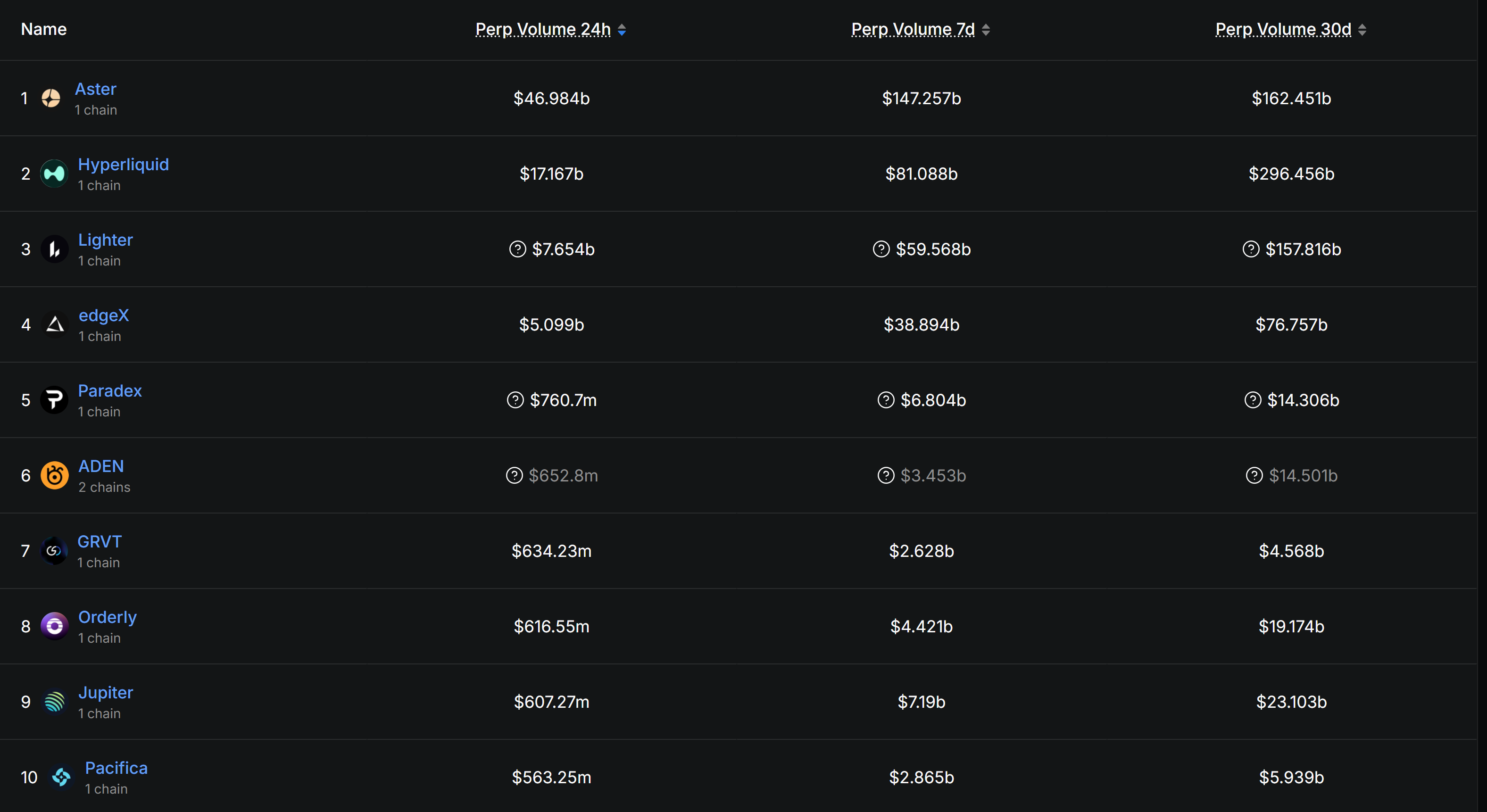
The growth of BNB- and Solana-based DEXs is notable. BNB perp protocols recently hit $60–70 billion in daily turnover, while Drift and Jupiter Perps have steadily gained traction. These ecosystems, Elkaleh said, are benefiting from fast settlement, smooth onboarding and incentives.
Still, DEXs face well-known risks. Elkaleh pointed to concerns around validator or sequencer centralization, faulty oracles, exploitable upgrade keys and bridge vulnerabilities. He also flagged the challenges of maintaining reliable liquidation engines during times of volatility.
On Friday, Aster reimbursed traders affected by a glitch in its Plasma (XPL) perpetual market, which briefly spiked prices to nearly $4 due to a hard-coded index error. The price surge led to unexpected liquidations and fees.
Related: Aster can flip HYPE by market cap and rally another 480%: Analyst
DEXs and CEXs to co-exist
Looking ahead, Elkaleh said he doesn’t see a zero-sum outcome. “DEXs are undoubtedly the future of crypto-native trading rails,” he said. “At the same time, CEXs remain essential for fiat liquidity and onboarding.”
“Over the next decade, we could see hybrid models that blend the strengths of both, creating a balanced ecosystem where coexistence, not displacement, drives the next phase of crypto markets,” he concluded.
Magazine: 7 reasons why Bitcoin mining is a terrible business idea
Disclaimer: The content of this article solely reflects the author's opinion and does not represent the platform in any capacity. This article is not intended to serve as a reference for making investment decisions.
You may also like
Decentralized Finance (DeFi) and the Emergence of DASH Aster DEX
- DASH Aster DEX combines AMM and CEX features, reducing slippage by 40% and attracting $1.399B TVL by Q3 2025. - Cross-chain interoperability and yield-bearing collateral address liquidity gaps, while dual-mode trading caters to both retail and institutional users. - Privacy tools like ZKPs and decentralized governance mitigate regulatory risks, though challenges persist under MiCA and CLARITY Act frameworks. - With 70% perpetual derivatives market share and Aster Chain's 2026 launch, it aims to redefine

Empowering Crypto Traders: How FlipsideAI Simplifies Technical Analysis with Natural Language

Exploring the Opportunities and Challenges of Decentralized Exchanges After Regulatory Changes
- Global DeFi regulation (GENIUS Act, MiCA, FATF) forces platforms to balance compliance with decentralization, reshaping innovation and investment viability. - Aster DEX (19.3% DEX market share) integrates AI surveillance, MiCA-compliant tools, and 1:1 stablecoin reserves to align with 2025 regulatory benchmarks. - The platform bridges TradFi and DeFi via Aster Chain (Q1 2026), offering institutional-grade privacy features and tokenized real-world assets to attract traditional investors. - Proactive compl

ZK Technology's 2025 Price Increase: An In-Depth Analysis of On-Chain Integration and Protocol Enhancements
- ZK technology surged 170% in Q3 2025 due to protocol upgrades and institutional adoption. - ZKsync's 15,000 TPS Atlas upgrade and StarkNet's $150M TVL validated scalability breakthroughs. - Goldman Sachs , Nike , and 35+ institutions adopted ZK for confidential transactions and NFT authentication. - ZKP market reached $1.5B in 2025, projected to hit $7.59B by 2033 at 22.1% CAGR. - 230% developer growth and $3.3B TVL across ZK Rollups signal maturing blockchain infrastructure.

Trending news
MoreCrypto prices
More





