
Tether Defends Its Reserves After Lowest Rating By S&P

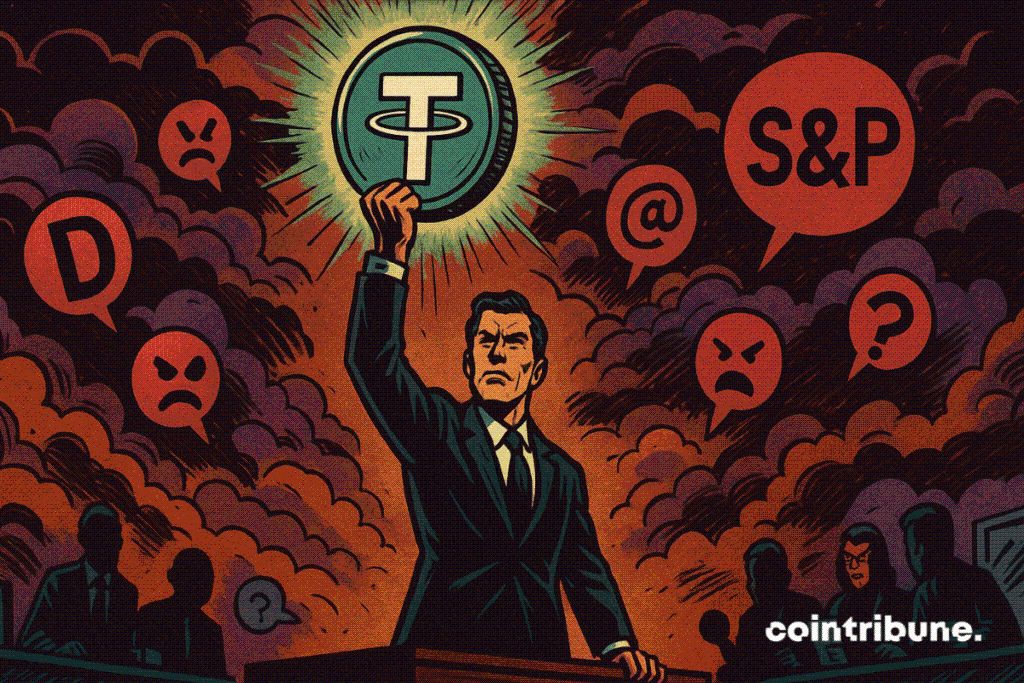
The stability of the market’s largest stablecoin is questioned. On November 29, the S&P agency downgraded USDT’s ability to maintain its peg to the dollar. Tether, through its CEO Paolo Ardoino, denounces a biased analysis and defends its figures. This confrontation between a central crypto player and a major financial institution reignites the debate on the solidity of reserves and trust in the ecosystem.
In Brief
- On November 29, S&P Global downgraded the stablecoin USDT’s ability to maintain its dollar peg.
- Tether, through its CEO Paolo Ardoino, denounces an incomplete analysis and defends the solidity of its reserves.
- Ardoino mentions 7 billion $ in excess equity and 500 million $ in monthly profits from Treasuries.
- This debate reignites questions on transparency, stablecoin resilience, and the crypto market’s dependence on USDT.
S&P downgrades USDT, Tether fights back with its figures
On November 29, S&P Global Ratings lowered the reliability rating of USDT , the stablecoin issued by Tether, to its lowest level.
The agency justifies this decision by Tether’s exposure to assets considered too volatile, notably bitcoin and gold, to guarantee absolute stability against the dollar. This rating immediately sparked a wave of criticism and doubts about the strength of the Tether model, already closely scrutinized by authorities and market players.
Tether’s CEO Paolo Ardoino responded quickly and fiercely. He firmly rejects S&P’s conclusions, stating that the agency’s analysis omits essential elements.
“S&P made the same mistake by not taking into account the group’s additional equity, nor the some 500 million dollars in monthly profits generated solely by returns on U.S. Treasury bonds“, he said.
He believes the rating is based on an incomplete view of Tether group’s consolidated accounts. Here are the main figures presented by Paolo Ardoino, based on the attestation report for the third quarter of this year :
- Total assets of the Tether group : approximately 215 billion dollars ;
- Stablecoin-related liabilities : approximately 184.5 billion dollars ;
- Excess equity : approximately 7 billion dollars ;
- Retained earnings included in equity : approximately 23 billion dollars ;
- Recurring monthly profits related to U.S. Treasury bonds: approximately 500 million dollars.
According to Ardoino, these figures show that Tether is largely over-collateralized, and the methodology used by S&P does not accurately reflect the consolidated financial reality of the group, notably its internal revenue and operating structure.
Analysts Divided : Should We Worry About Tether’s Strategy ?
Beyond the quarrel between Tether and S&P, this situation has sparked a strategic debate among sector analysts on the investment choices of the stablecoin issuer.
Arthur Hayes, founder of the BitMEX platform, has expressed concerns about the gold and bitcoin reserves held by Tether. According to him, these volatile assets could pose a risk in the event of a market downturn.
“A drop of about 30 % in the gold and BTC position would wipe out their equity, making USDT, in theory, insolvent“, he warned. Hayes assumes that the purchase of these assets serves to offset an anticipated drop in revenue from Treasury bonds, in anticipation of monetary easing by the U.S. Federal Reserve.
However, this view is far from unanimous. Joseph Ayoub, former senior crypto analyst at Citi, has rejected Hayes’ projections. He claims to have spent “hundreds of hours analyzing Tether” when he worked at Citi, and defends a very different position.
For him, Tether holds assets beyond what it publicly declares, operates an extremely profitable activity thanks to interest on Treasury bonds, while functioning with a lean structure of only 150 employees. He even states that Tether is “better collateralized than traditional banks“, and that its critics largely underestimate the strength of the model.
Tether targets a valuation of 500 billion dollars . However, the controversy with S&P highlights tensions between ambition and transparency. Between institutional distrust and meteoric growth, the stablecoin’s future will depend as much on its financial strength as its ability to convince beyond its adoption target.
Disclaimer: The content of this article solely reflects the author's opinion and does not represent the platform in any capacity. This article is not intended to serve as a reference for making investment decisions.
You may also like
Timeless Investment Principles: How Insights from 1927 Continue to Influence Today’s Crypto and Stablecoin Approaches
- McNeel and Buffett's 1920s investment principles combat modern crypto volatility through emotional discipline and intrinsic value focus. - The 2025 Binance crash exposed market fragility, with panic selling and FOMO-driven rebounds amplifying $19B in 24-hour liquidations. - Risk management tools like stop-loss orders and diversified portfolios reduced losses by 37%, underscoring enduring relevance of timeless strategies. - Stablecoin vulnerabilities highlighted by USDC's 2023 depegging and 2025 liquidity

Zcash Halving and Its Impact on Cryptocurrency Market Trends
- Zcash's 2028 halving will cut block rewards to 0.78125 ZEC, continuing its deflationary supply model to reduce annual inflation to 2%. - Historical data shows halvings trigger extreme volatility, with ZEC surging 1,172% in 2025 but collapsing 96% within 16 days. - Institutional adoption grows via $137M Grayscale Zcash Trust, yet EU's MiCA regulations challenge privacy coins' compliance with transparency rules. - Future success depends on balancing privacy features with regulatory adaptability as Zcash's

Emerging Prospects for Industrial Real Estate in Webster, NY
- Webster , NY, is transforming its industrial real estate through the $9.8M FAST NY Grant, upgrading infrastructure on a 300-acre Xerox brownfield into a high-tech hub. - The initiative aims for a 2% industrial vacancy rate by 2025, boosting residential property values by 10.1% and attracting projects like the $650M fairlife® dairy facility. - Xerox campus reconfiguration and 600 Ridge Road redevelopment, supported by state programs, create shovel-ready spaces with modern infrastructure for advanced manuf
Why Solana's Latest Plunge Highlights Underlying Weaknesses in the Crypto Market
- Solana's 57% price crash in Nov 2025 exposed systemic crypto vulnerabilities, including psychological biases, excessive leverage, and fragile infrastructure. - Token unlocks from Alameda/FTX estates and $30M selling pressure triggered the downturn, yet $101.7M in institutional inflows highlighted market paradoxes. - Fed rate cuts drove $417M into Solana ETFs, but uncertainty caused 14% price drops, revealing crypto's growing integration with traditional finance. - $19B in liquidations during the Oct 11 "
Trending news
MoreCrypto prices
More





