
South Korea Warns Asset Managers to Cut Exposure to Crypto ETF Holdings

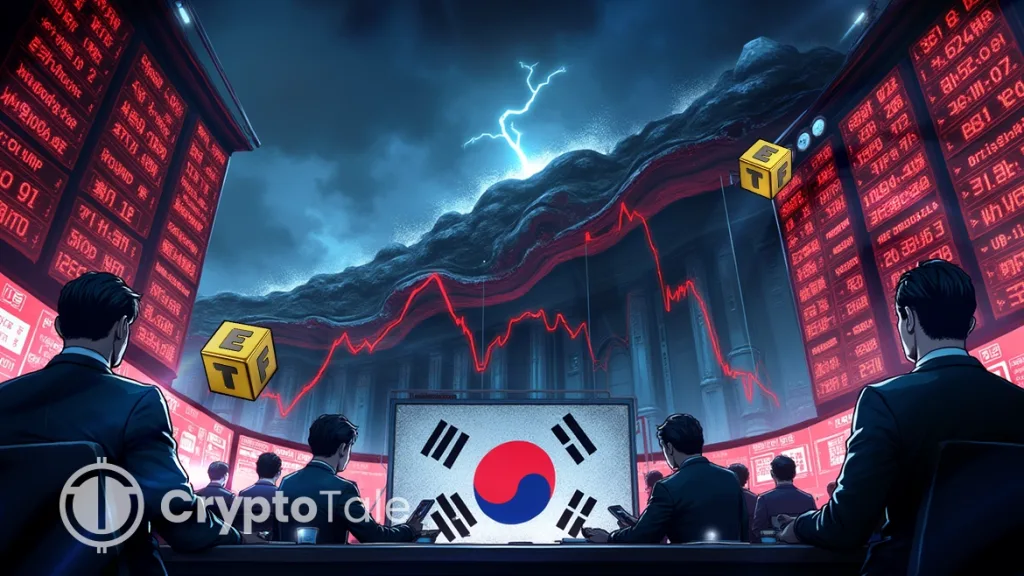
- South Korea warns firms to reduce crypto ties in their ETF investments right away.
- The rule conflicts with the government’s plans to introduce digital asset reforms.
- Investors and companies now face mixed signals and rising uncertainty this season.
South Korea’s financial regulator has directed asset managers to limit exposure to crypto-linked companies in ETFs despite pro-crypto political reforms. The Financial Supervisory Service (FSS) issued verbal instructions earlier this month, requiring compliance with a 2017 guideline that bars institutional investments in digital assets. This sudden move disrupts earlier plans backed by the administration of President Lee Jae Myung, signaling a growing disconnect between political rhetoric and regulatory policy.
JUST IN:
— ChainDesk July 23, 2025South Korea’s financial regulator urges asset managers to limit exposure to crypto-linked firms like Coinbase and MicroStrategy.
Asset Managers Told to Cut Crypto Exposure
According to The Korea Herald, the FSS gave verbal orders to local asset managers earlier this month to revise their ETF holdings. These directions were based on longstanding Financial Services Commission (FSC) guidelines.
The move affects companies with indirect stakes in crypto-heavy stocks such as Coinbase and Strategy. While these ETFs do not directly hold cryptocurrencies, their exposure to crypto-related firms is now under scrutiny.
An FSS official told The Korea Herald that asset managers must comply with current rules even if both U.S. and South Korean regulators are updating their policies. The official added, “We are fully aware that passive ETFs cannot be excluded at the discretion of the asset management company because their structure directly follows the underlying index.”
Institutional Frustration and Legal Gaps
The FSS’s decision has triggered backlash from local asset managers who argue the policy creates an unfair playing field. Retail investors are still allowed to access U.S.-listed ETFs with high crypto exposure, yet local institutions face stricter constraints.
The disparity has caused confusion in financial circles as firms adjust their portfolios amid inconsistent regulatory messaging. Despite not being a formal written order, the verbal directive holds weight due to the FSS’s supervisory authority.
In response, affected firms are reassessing their ETF designs to meet compliance expectations. Those exceeding the recommended thresholds must now consider corrective actions to avoid penalties. While this directive is not legally binding, its implications are being taken seriously within the industry.
Reform Pledges Clash With Regulatory Stance
South Korea’s move contrasts sharply with recent political efforts aimed at loosening restrictions on digital assets. President Lee Jae Myung has supported introducing local spot crypto ETFs and local stablecoin innovation. Earlier this year, South Korea began phasing out its effective ban on institutional crypto trading.
However, even after such political evolutions, the FSS remains firm in defining the institutional risk attributable to indirect exposure to crypto. The conflict between politics and regulatory enforcement discloses an even more pronounced friction in the field of financial policy in the country.
Related: South Korea Halts CBDC Trials as Banks Embrace Stablecoin Shift
The measures by the FSS are indications of a conservative mindset to avoid market instability in a changing market. The regulator added that its aim was to help firms design ETF products till the time new systems are put in place. The strategy is indicative of a transient suspension of crypto participation until a regulatory framework is established.
With political promises piling up following the maturation of the crypto market and with more and more asset managers considering entering the crypto sphere, a balancing act is difficult. They need to be nimble, yet still comply and be ready to reform. The verbal instructions by the FSS have created a debate nationally in the South Korean investment world, raising questions about the future of crypto investment in the country.
The post South Korea Warns Asset Managers to Cut Exposure to Crypto ETF Holdings appeared first on Cryptotale.
Disclaimer: The content of this article solely reflects the author's opinion and does not represent the platform in any capacity. This article is not intended to serve as a reference for making investment decisions.
You may also like
The Dark Side of Altcoins
Why is it said that almost all altcoins will go to zero, with only a few exceptions?

On the night of the Federal Reserve rate cut, the real game is Trump’s “monetary power grab”
The article discusses the upcoming Federal Reserve interest rate cut decision and its impact on the market, with a focus on the Fed’s potential relaunch of liquidity injection programs. It also analyzes the Trump administration’s restructuring of the Federal Reserve’s powers and how these changes affect the crypto market, ETF capital flows, and institutional investor behavior. Summary generated by Mars AI. This summary was produced by the Mars AI model, and the accuracy and completeness of the generated content are still being iteratively updated.

When the Federal Reserve is politically hijacked, is the next bitcoin bull market coming?
The Federal Reserve announced a 25 basis point rate cut and the purchase of $40 billion in Treasury securities, resulting in an unusual market reaction as long-term Treasury yields rose. Investors are concerned about the loss of the Federal Reserve's independence, believing the rate cut is a result of political intervention. This situation has triggered doubts about the credit foundation of the US dollar, and crypto assets such as bitcoin and ethereum are being viewed as tools to hedge against sovereign credit risk. Summary generated by Mars AI. The accuracy and completeness of this summary are still in the process of iterative updates.
x402 V2 Released: As AI Agents Begin to Have "Credit Cards", Which Projects Will Be Revalued?
Still waters run deep, subtly reviving the narrative thread of 402.
Trending news
MoreCrypto prices
More





