
Institutional Investors Express Rising Confidence in Stocks Amid Increased Bearishness on the US Dollar: Goldman Sachs Survey

There’s a growing divergence between institutional investors’ expectations for US stocks and the dollar, according to a new survey conducted by the financial giant Goldman Sachs.
Goldman’s survey indicates investors are expressing increased bullishness on US stocks, particularly on Tesla, Meta, Alphabet, Amazon, Apple, Microsoft and Nvidia, the large tech firms that make up the “Magnificent Seven.”
Conversely, the same institutional investors are demonstrating a surge in bearishness on the dollar amid US fiscal issues.
Oscar Östlund, a managing director at Goldman, notes that dollar bears now outnumber bulls by a ratio of more than 7:1.
“One of the most important paradigm shifts over the last couple of months has been the decoupling of the dollar and US equities.”
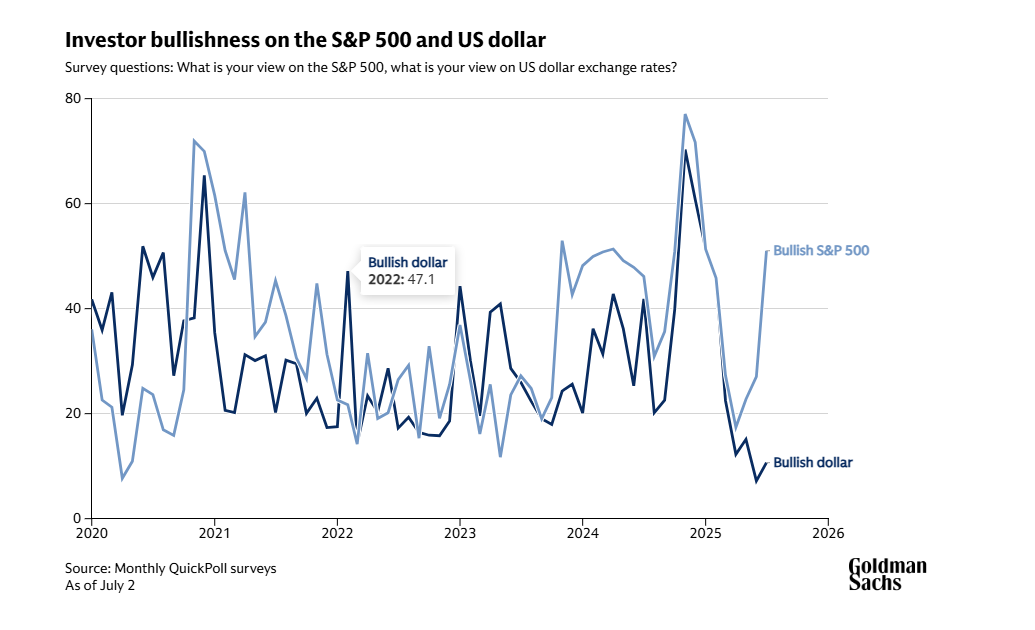 Source: Goldman Sachs
Goldman’s investor survey has only clocked bearish dollar sentiment next to a bullish view on US stocks three times in the past 9.5 years.
In terms of stocks, 51% of Goldman’s respondents were bullish on the S&P 500, while 32% were bearish.
Östlund says that equity bullishness could suggest market vulnerability to a reversal.
“A very one-sided position is a sign of a stretched market. In itself, a very strong consensus is not a reason for the market to turn, but it makes for a market that’s susceptible to relatively sudden changes based on even minor catalysts.”
Generated Image: Midjourney
Disclaimer: The content of this article solely reflects the author's opinion and does not represent the platform in any capacity. This article is not intended to serve as a reference for making investment decisions.
You may also like
Stunning 80,000 ETH Transferred: Whale’s $226 Million Move to Beacon Depositor Revealed
Charles Hoskinson: Trump Crypto Ventures Have Been 'Frustrating'—But Others Won't Talk About It
XRP Technical Analysis: Bullish Pattern Emerges Amid Market Weakness
Synthetix Returns to Ethereum Mainnet: A Triumphant Homecoming for DeFi Derivatives
Trending news
MoreCrypto prices
More





