
US Treasury weighs digital ID verification in DeFi to tackle illicit finance

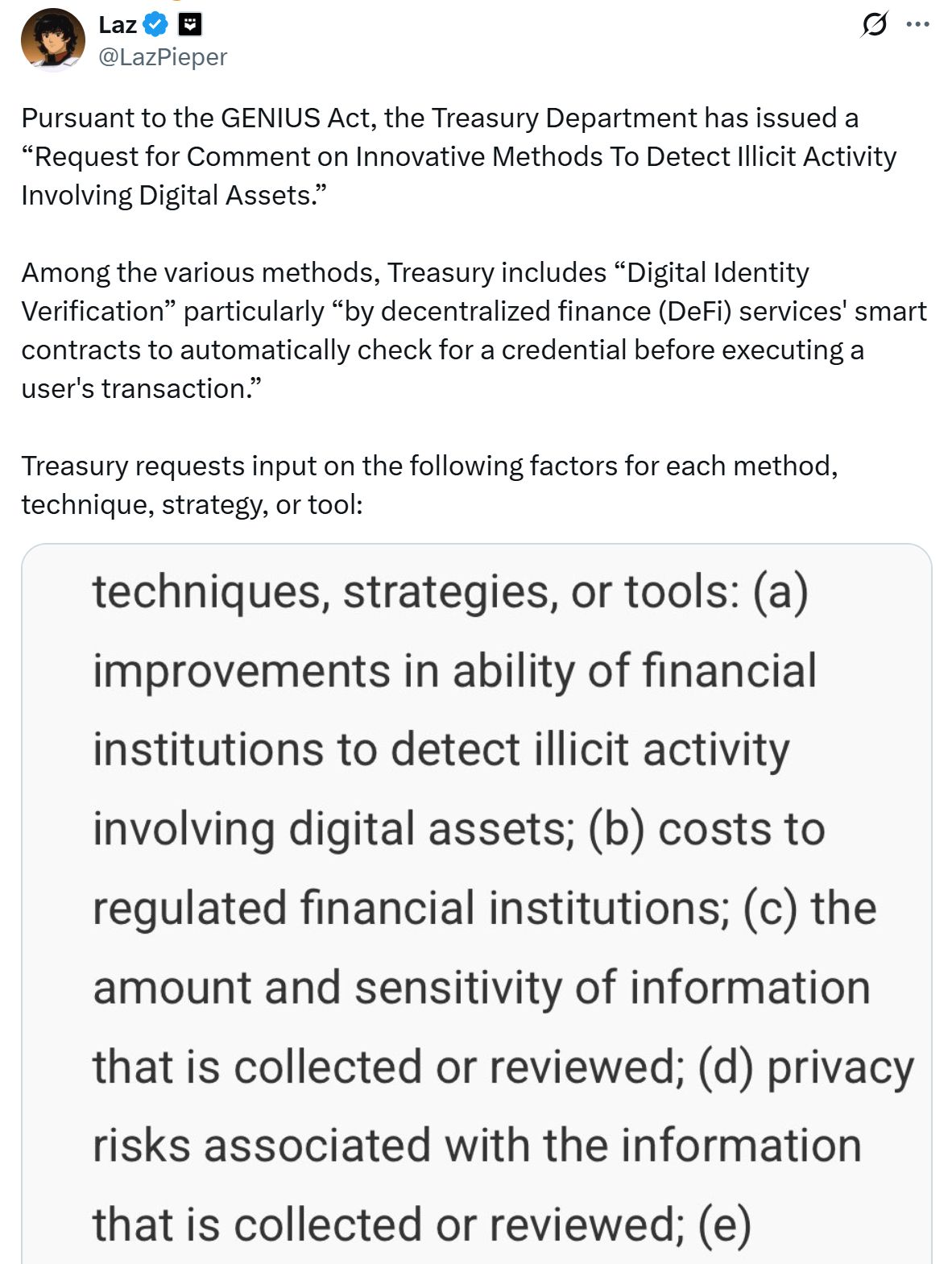
The US Department of the Treasury is seeking public feedback on how digital identity tools and other emerging technologies could be used to fight illicit finance in crypto markets, with one option being embedding identity checks into decentralized finance (DeFi) smart contracts.
The consultation, published this week, stems from the newly enacted Guiding and Establishing National Innovation for US Stablecoins Act (GENIUS Act), signed into law in July.
The Act, which sets out a regulatory framework for payment stablecoin issuers, directs the Treasury to explore new compliance technologies, including application programming interfaces (APIs), artificial intelligence, digital identity verification and blockchain monitoring.
One of the ideas in the request for comment is the potential for DeFi protocols to integrate digital identity credentials directly into their code. Under this model, a smart contract could automatically verify a user’s credential before executing a transaction, effectively building Know Your Customer (KYC) and Anti-Money Laundering (AML) safeguards into blockchain infrastructure.
Related: GENIUS Act to spark wave of ‘killer apps’ and new payment services: Sygnum
Treasury: digital IDs could cut compliance costs
According to Treasury, digital identity solutions, which may include government IDs, biometrics or portable credentials, could reduce compliance costs while strengthening privacy protections.
They could also make it easier for financial institutions and DeFi services to detect money laundering, terrorist financing, or sanctions evasion before transactions occur.
Treasury also acknowledged potential challenges, including data privacy concerns and the need to balance innovation with regulatory oversight. “Treasury welcomes input on any matter that commenters believe is relevant to Treasury’s efforts,” the agency wrote.
Public comments are open until Oct. 17, 2025. Following the consultation, Treasury will submit a report to Congress and may issue guidance or propose new rules based on the findings.
Related: GENIUS Act yield ban may push trillions into tokenized assets — ex-bank exec
US banks warn against stablecoin yield loophole
Last week, several major US banking groups, led by the Bank Policy Institute (BPI), urged Congress to tighten rules under the GENIUS Act, warning that a loophole could let stablecoin issuers bypass restrictions on paying interest.
In a letter sent Tuesday, BPI said the gap could allow issuers to partner with exchanges or affiliates to offer yields, undermining the intent of the law. The group cautioned that unchecked growth of yield-bearing stablecoins could trigger up to $6.6 trillion in deposit outflows from traditional banks, threatening credit access for businesses.
Magazine: Bitcoin vs stablecoins showdown looms as GENIUS Act nears
Disclaimer: The content of this article solely reflects the author's opinion and does not represent the platform in any capacity. This article is not intended to serve as a reference for making investment decisions.
You may also like
Weekly Hot Picks: The Fed Cuts Rates and Indirectly "Injects Liquidity"! Silver Replaces Gold as the New Favorite?
The Federal Reserve is cutting interest rates and starting bond purchases, while Japan and other regions may turn to rate hikes. Silver repeatedly hits record highs, SpaceX is set for a 1.5 trillion IPO, and Oracle becomes the litmus test for the AI bubble. The Russia-Ukraine peace process is stuck on territorial issues, the US seizes a Venezuelan oil tanker... What exciting market events did you miss this week?

Key Highlights to Watch at Solana Breakpoint 2025
How does Solana seize market share in an increasingly competitive landscape?

Crucial Alert: ZRO Leads This Week’s $100M+ Token Unlocks – What Investors Must Know
Revealed: Why Tether’s $1.1 Billion Juventus Acquisition Bid Was Rejected
Trending news
MoreCrypto prices
More





