
[Long English Thread] From Sony to Toyota, why are they all building their own blockchains?

Chainfeeds Guide:
Traditional companies are beginning to build their own Layer1 or Layer2 blockchains, either by developing their technology stack from scratch or by leveraging existing frameworks to bring their user base on-chain.
Source:
Author:
blocmates.
Opinion:
blocmates.: The term "enterprise chain" was once an unimaginable concept in the crypto space, but it is now becoming a reality. Here, enterprise chains do not refer to traditional IT internal company networks, but rather to Layer1/Layer2 blockchains directly developed or led by large traditional companies. Unlike the almost cyberpunk-style crypto-native chains (which emphasize decentralization, censorship resistance, and transparency), enterprise chains focus more on scalability, compliance, and control, mainly serving institutions and existing user bases. 2026 may become the year when this trend explodes. Currently, several giants have already entered the field: Sony has launched Soneium, an Ethereum L2 based on OP Stack, aiming to bring its massive gaming, music, finance, and entertainment users on-chain, and is fostering a developer ecosystem through an incubator; Stripe, in partnership with Paradigm, is building the EVM L1 Tempo, focusing on global payments and stablecoin settlements to reduce costs and accelerate settlements; Google Cloud and CME Group are co-developing GCUL (Google Cloud Universal Ledger), a permissioned ledger based on Python smart contracts, serving collateral management and settlement flows; Circle, after its IPO, has launched the Arc public chain, using USDC as the native gas token, supporting sub-second settlements, built-in forex clearing, and private transfers, with the goal of fully on-chaining stablecoin payments. In addition, FIFA is building its own chain within an Avalanche subnet, J.P. Morgan has launched the Kinexys blockchain and deposit stablecoin, and Toyota is using Avalanche to develop the Mobility Orchestration Network (MON). The common logic behind these projects is that enterprises are no longer satisfied with renting public chains, but want to control the technology stack, user channels, and data flows by building their own chains, thereby achieving long-term competitive advantages. Why do traditional enterprises want to build their own chains? First, existing public chains cannot fully meet their needs—speed, security, fee volatility, and uncertainty in economic models are significant pain points. For example, Ethereum's gas prices fluctuate greatly with the price of ETH, which is too risky for enterprise-level applications. Second, building their own chain means enterprises have complete control over user entry points and data flows, which are highly valuable derivative assets. Compared to renting infrastructure on public chains, enterprises prefer to control the infrastructure themselves. Finally, customization is a core demand: enterprise chains can have built-in compliance modules, dedicated economic incentive mechanisms, and high-performance architectures, avoiding technical or governance compromises imposed by public networks. Looking ahead, enterprise chains are likely to present a hybrid ecosystem: on one hand, maintaining highly compliant, permissioned chains to serve institutions and sensitive businesses; on the other, interoperating with public crypto networks to gain liquidity and user value. More importantly, enterprises have a natural advantage in user experience—decades of traditional business experience, strong capital, and mature operational models make them more likely to provide user-friendly application entry points compared to crypto-native chains. Although this means compromising on decentralization and openness, for end users, the ability to obtain a fast, trustworthy, and low-friction experience is often more important than technical ideology. The rise of enterprise chains marks the gradual penetration of crypto technology into global infrastructure, and also means "we are no longer that early." Of course, this trend comes with trade-offs: compliance, efficiency, and control often take precedence over decentralization, which may weaken the spirit of permissionless innovation in the crypto world. However, if mainstream adoption is the goal, these compromises may be necessary. With the participation of institutions such as FIFA, Toyota, and J.P. Morgan, the boundary between crypto-native and enterprise-native ecosystems will become increasingly blurred in the future. In fact, even within public chains, there are many debates about the number of validators, architectural design, and the degree of decentralization, but end users do not seem to care whether transactions land on public L1, consortium chains, or enterprise subnets—as long as the application experience is smooth, secure, and reliable. From this perspective, the emergence of enterprise chains is actually a validation of the maturity of crypto technology, telling us that blockchain has evolved from a niche geek experiment into an underlying infrastructure that global institutions and enterprises are willing to rely on. In the next 2-3 years, we are likely to witness a hybrid world: both decentralized, censorship-resistant public chains and enterprise chains serving compliance and scale, interconnected through cross-chain and interoperability layers, forming a larger and more complex global on-chain economic system. [Original article in English]
Source![[Long English Thread] From Sony to Toyota, why are they all building their own blockchains? image 0](https://img.bgstatic.com/multiLang/image/social/ea2d6ba2d0af4cdb03f60ee9b20c34a51756863006717.png)
Disclaimer: The content of this article solely reflects the author's opinion and does not represent the platform in any capacity. This article is not intended to serve as a reference for making investment decisions.
You may also like
"Validator's Pendle" Pye raises $5 million, enabling SOL staking yields to be tokenized
There are truly no creative bottlenecks in the financialization of Web3.

DiDi has become a digital banking giant in Latin America
DiDi has successfully transformed into a digital banking giant in Latin America by addressing the lack of local financial infrastructure, building an independent payment and credit system, and achieving a leap from a ride-hailing platform to a financial powerhouse. Summary generated by Mars AI. This summary was produced by the Mars AI model, and its accuracy and completeness are still being iteratively improved.

Fed rate cuts in conflict, but Bitcoin's "fragile zone" keeps BTC below $100,000
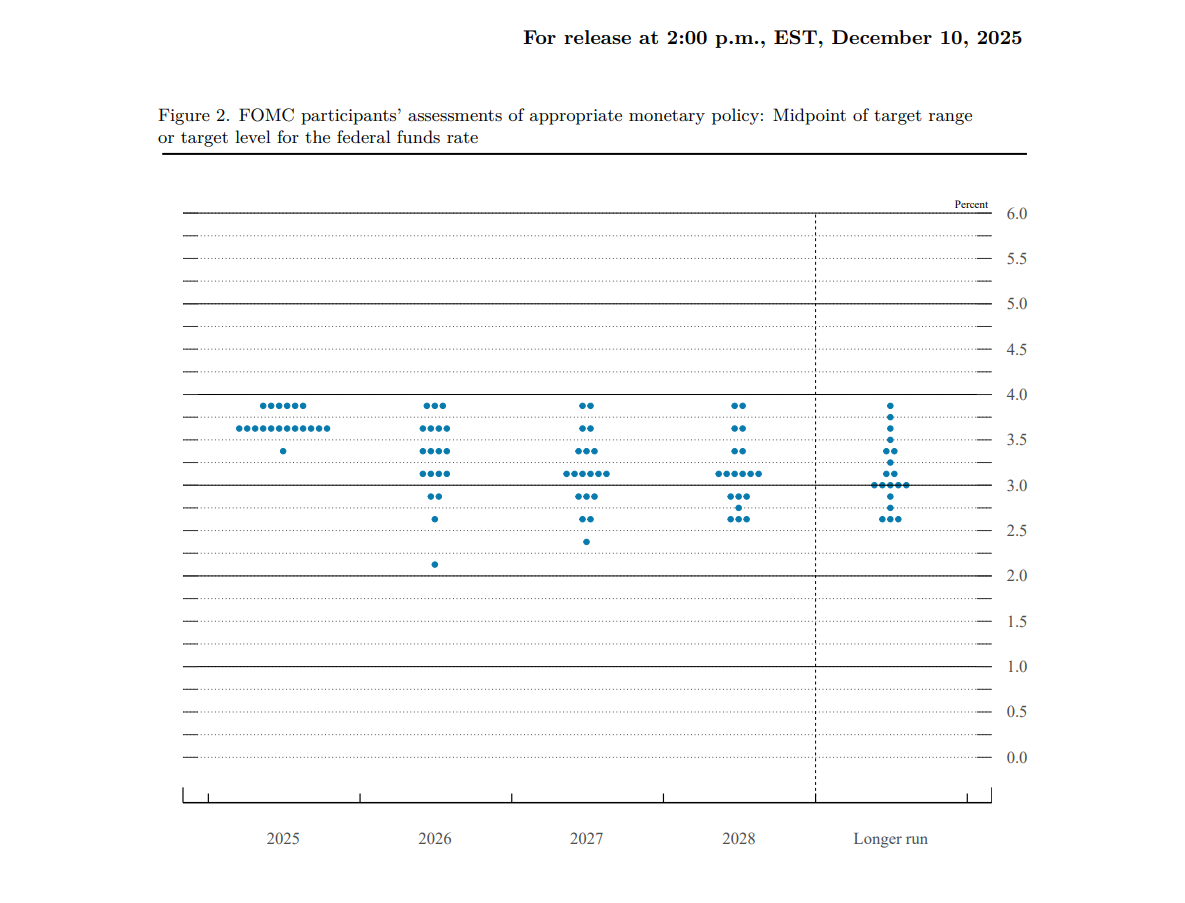
The Federal Reserve cut interest rates by 25 basis points, but the market interpreted the move as hawkish. Bitcoin is constrained by a structurally fragile range, making it difficult for the price to break through $100,000. Summary generated by Mars AI This summary was generated by the Mars AI model, and the accuracy and completeness of its content are still being iteratively updated.

Full text of the Federal Reserve decision: 25 basis point rate cut, purchase of $4 billion in Treasury bills within 30 days
The Federal Reserve cut interest rates by 25 basis points with a 9-3 vote. Two members supported keeping rates unchanged, while one supported a 50 basis point cut. In addition, the Federal Reserve has restarted bond purchases and will buy $40 billion in Treasury bills within 30 days to maintain adequate reserve supply.
Trending news
MoreCrypto prices
More





