
Legal expert affirms public blockchains remain regulatory standard despite corporate L1 launches

Variant Fund chief legal officer Jake Chervinsky maintains that decentralized public blockchains remain the regulatory standard for product development, despite recent announcements of corporate-controlled layer-1 (L1) networks.
Chervinsky argued on X that many new L1s built by companies for product-specific reasons are “unnecessary” and “unhelpful” from a regulatory perspective.
He noted that no US regulator has demanded permissioned validator sets or built-in compliance tools, and no serious legislative effort in Congress has contemplated such requirements.
Chervinsky added:
“If you have a great commercial reason to build (or build on) a product-specific L1, have at it. If not, and you’re just vaguely worried about compliance issues, decentralized public blockchains remain the standard.”
Circle recently announced its own L1 called Arceeee last month, followed by Stripe revealing Tempo, a payment-focused L1 network built in collaboration with Paradigm.
Corporate L1s as regulatory arbitrage
Venture capitalist Revaz Shmertz offered a contrasting view in response to Chervinsky’s remarks, arguing that corporate L1s represent a form of regulatory arbitrage.
Shmertz contended that regulatory agencies may act unilaterally through enforcement actions and guidance letters, regardless of congressional inaction.
He argued:
“Corporate L1s represent regulatory arbitrage, with companies building blockchain infrastructure that preemptively satisfies compliance requirements rather than fighting for protocol-level neutrality.”
Shmertz suggested this approach creates a “bifurcated adoption” where compliant corporate chains serve institutional use cases while neutral protocols handle retail and DeFi applications.
He further assessed that the structural reality is that when traditional finance companies can build blockchain rails with familiar regulatory frameworks, they avoid the need to lobby for crypto-friendly legislation.
Chervinsky’s position emphasizes maintaining base layer neutrality principles rather than compromising on decentralization for perceived regulatory benefits that regulators have not explicitly requested.
The ongoing corporate blockchain launches will test whether regulatory compliance concerns or commercial control ultimately drives institutional blockchain adoption.
At the same time, lobbyist groups are advocating for a flexible approach towards decentralization to the Securities and Exchange Commission (SEC).
Five core principles
The DeFi Education Fund (DEF) submitted a letter to the SEC on April 18 proposing five core principles for creating a “token safe harbor” framework supporting decentralized finance initiatives.
DEF emphasized that any safe harbor should adopt technology-agnostic approaches addressing activity risks rather than prescribing rules for specific blockchain models.
The group advocated for broad eligibility criteria allowing already-distributed tokens to qualify, provided they meet decentralization goals, rather than evaluating status only at genesis.
Chervinsky’s position emphasizes maintaining base layer neutrality principles rather than compromising on decentralization for perceived regulatory benefits that regulators have not explicitly requested.
The ongoing corporate blockchain launches will test whether regulatory compliance concerns or commercial control ultimately drives institutional blockchain adoption.
The post Legal expert affirms public blockchains remain regulatory standard despite corporate L1 launches appeared first on CryptoSlate.
Disclaimer: The content of this article solely reflects the author's opinion and does not represent the platform in any capacity. This article is not intended to serve as a reference for making investment decisions.
You may also like
Mars Morning News | The crypto market rebounds across the board, Bitcoin rises above $94,500; The "CLARITY Act" draft is expected to be released this week
The crypto market has fully rebounded, with bitcoin surpassing $94,500 and US crypto-related stocks rising across the board. The US Congress is advancing the CLARITY Act to regulate cryptocurrencies. The SEC chairman stated that many ICOs are not securities transactions. Whales are holding a large number of profitable ETH long positions. Summary generated by Mars AI. The accuracy and completeness of the content generated by the Mars AI model is still being iteratively updated.

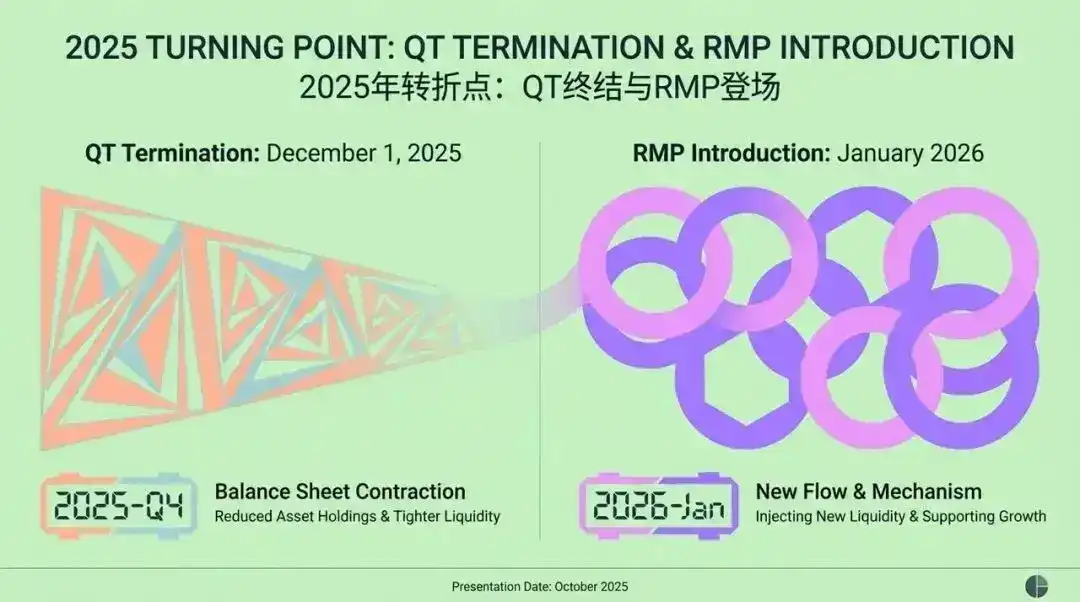
Federal Reserve’s Major Shift: From QT to RMP, How Will the Market Transform by 2026?
The article discusses the background, mechanism, and impact on financial markets of the Federal Reserve's introduction of the Reserve Management Purchases (RMP) strategy after ending Quantitative Tightening (QT) in 2025. RMP is regarded as a technical operation aimed at maintaining liquidity in the financial system, but the market interprets it as a covert easing policy. The article analyzes RMP's potential effects on risk assets, the regulatory framework, and fiscal policy, and provides strategic recommendations for institutional investors. Summary generated by Mars AI This summary was generated by the Mars AI model, and the accuracy and completeness of its content are still in the process of iterative improvement.
Rate Hike in Japan: Will Bitcoin Resist Better Than Expected?

Crucial Decision: Trump’s Final Interviews for Federal Reserve Chair Could Reshape Markets
Trending news
MoreCrypto prices
More





