I. Project Introduction
Mira Network is an infrastructure project focused on
verifiable AI, aiming to make AI outputs and behaviors verifiable on-chain. It addresses the current deficiencies of AI in
transparency, traceability, and trustworthiness.
The project is committed to building a
trusted verification layer for AI outputs to improve the reliability, transparency, and accuracy of intelligent reasoning. By leveraging a distributed network that aggregates collective intelligence, Mira processes up to
300 million tokens of data per day, achieving
96% verification accuracy.
Mira abandons the traditional centralized AI training and inference path, instead emphasizing a
trustless verification mechanism for outputs. Built on
Base (Ethereum Layer 2), Mira is compatible with mainstream chains such as Bitcoin, Ethereum, and Solana, supporting smart contracts, DApps, and DAO governance. It aims to solve critical issues such as AI bias and hallucination while enabling user-driven governance and avoiding single-point trust risks.
Its core methodology includes:
Claim Decomposition: Breaking down AI responses or outputs into multiple sub-claims.
Distributed Verification: These sub-claims are distributed to Mira’s Verifier Nodes, where each node independently checks their validity.
Consensus & Aggregation: Nodes validate and aggregate results through mechanisms such as Proof-of-Verification, outputting a final “verified result.”
Additionally, Mira has already partnered with and deployed within the
Base ecosystem, reflecting not only a technical experiment but also an emphasis on integration with existing ecosystems to reduce barriers for developers and users.
II. Project Highlights
Large-Scale User Base & Superior AI Performance
Mira Network currently attracts
4–5 million users, processing
19 million queries weekly, demonstrating strong real-world applicability. Its core innovation—the
AI Verification Layer—has increased AI output accuracy to
96% and reduced hallucination rates by
90%. Proprietary products such as the
Klok chatbot and
Astro search tool already boast
over 500,000 users, showcasing Mira’s effectiveness in enhancing AI trustworthiness.
Advanced Decentralized AI Verification Architecture
Built on Base, Mira operates as a
Layer 1 verification network utilizing a
multi-model consensus mechanism. It integrates
over 110 AI models and leverages distributed nodes for verification, effectively reducing single-point failures and hallucinations. This system is comparable to
“multi-party proctoring and decentralized auditing”, significantly improving the reliability of outputs and providing a solid trust foundation for AI applications.
Top-Tier Backing & Experienced Team
Thanks to its innovation and technological strength, Mira has secured investments from
BITKRAFT Ventures, Framework Ventures, Accel, Mechanism Capital, and the
founder of Polygon. The project raised
$9 million in seed funding and
$850,000 from community node sales, evidencing strong market recognition of its “Blockchain + AI” model. The team brings extensive experience in AI and blockchain product development and operations, laying the groundwork for long-term infrastructure growth.
Robust Tokenomics & Ecosystem Expansion
The
MIRA token serves as the core of the Mira ecosystem, with a
fixed total supply of 1 billion and
19.12% circulating supply at TGE. Tokens are used for AI verification, governance, staking, and ecosystem incentives. This includes a
6% airdrop and
16% validator rewards, reinforcing decentralization and long-term network security.
In
August 2025, Mira launched an independent foundation and a
$10 million Builder Fund to expand the ecosystem and foster partnerships, including with
Kaito, furthering the adoption of AI infrastructure and supporting long-term value creation.
III. Tokenomics
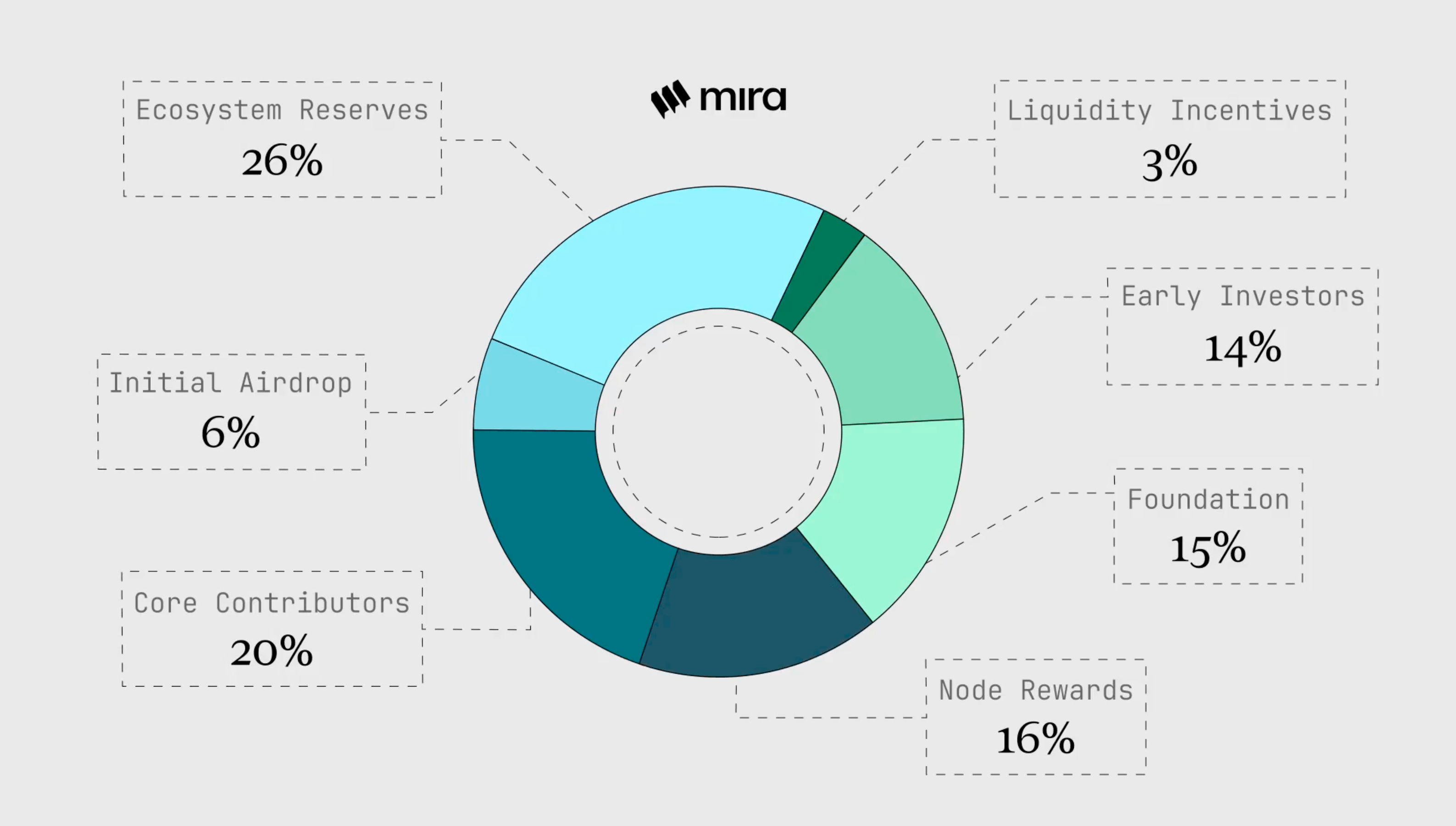
Total Supply: 1,000,000,000 MIRA
Initial Circulating Supply: 191,200,000 MIRA (19.12%)
Distribution:
6% Initial Airdrop: Distributed to early ecosystem participants, including Klok and Astro users, node delegators, Kaito community members, Kaito stakers, and active Discord contributors.
16% Validator Rewards: Programmatically released to verifiers performing honest reasoning.
26% Ecosystem Reserve: For developer grants, partnerships, and growth incentives.
20% Core Contributors: Allocated to current and future team members, locked for 12 months, then linearly vested over 36 months.
14% Early Investors: Strategic partners providing early capital; locked for 12 months, vested over 24 months.
15% Foundation: For protocol development, governance, research, and treasury. Locked for 6 months, vested over 36 months.
3% Liquidity Incentives: For market-making, exchange listings, and liquidity programs.
Utility:
API Access & Value Capture: Payment for AI verification APIs.
Node Staking: Staking requirement for verifier nodes to earn rewards.
Governance: Participation in protocol upgrades, fund allocation, and ecosystem decisions.
Ecosystem Incentives: Rewards for developers, partners, and community contributors.
Other Innovative Use Cases: Content incentives within Kaito, charitable initiatives, and beyond.
IV. Team & Fundraising
Team Background:
Karan Sirdesai (CEO) – Former Accel & BCG, led investments in Polygon and Nansen, Chartered Accountant (India).
Siddhartha Doddipalli (CTO) – Former architect at FreeWheel, ex-CTO of Stader Labs, IIT & Columbia background, AI & blockchain specialist.
Ninad Naik (COO) – Former GM at Amazon Alexa, ex-Uber product lead, MBA from Columbia University.
Funding History:
Seed Round (July 2024): $9 million, led by
BITKRAFT Ventures and
Framework Ventures, with participation from
Accel, Crucible, Folius Ventures, Mechanism Capital, SALT Fund, among others. Proceeds support global expansion, team growth, and development of Mira Network & ecosystem apps (e.g., Klok).
Node Sales:
1st Round (Dec 17–18, 2024): ~$250,000
2nd Round (Jan 16–17, 2025): ~$600,000
Total Raised: $9.85 million
V. Risk Factors
The
decentralized AI infrastructure sector is still nascent, lacking a mature business model. A decline in industry momentum could affect Mira’s ecosystem activity and token liquidity, pressuring $MIRA’s secondary market performance.
Unlocking Schedule: Initial circulating supply is 19.12%.
End of Year 1: ~33% unlocked
End of Year 2: ~61% unlocked
End of Year 3: ~83% unlocked
End of Year 7: 100% unlocked
Short-Term (TGE–3 months): Major sell pressure from the airdrop and partial ecosystem reserve unlocks.
Mid-Term (Year 2+): Unlocks from core contributors and early investors could trigger significant volatility.
Long-Term (>3 years): Unlocking stabilizes, shifting risks toward fundamentals and adoption.
VI. Official Links
Disclaimer: This report was generated by AI and human-verified for accuracy. It is not intended as investment advice.