
World Chain Connects Blockchains to Create a Global DeFi Ecosystem Without Borders
- World Chain integrates Chainlink CCIP to enable secure cross-chain transfers of WLD between its Layer 2 network and Ethereum via the CCT standard. - The partnership combines CCIP with Chainlink Data Streams for sub-second financial data latency, enhancing DeFi liquidity and institutional-grade cross-chain applications. - By bridging 20+ blockchains and collaborating with protocols like Across, World Chain aims to reduce liquidity fragmentation and establish a borderless DeFi ecosystem.

World Chain has implemented Chainlink’s Cross-Chain Interoperability Protocol (CCIP), allowing for secure and efficient transfers of its native asset
By adopting CCIP, World Chain is taking a major step toward global market connectivity, as the protocol supports token movements, message exchanges, and cross-chain operations across more than 20 blockchains. Steven Smith, World Chain’s VP of Engineering, noted that this integration enables “secure cross-chain development” and accelerates the ecosystem’s growth. With the combination of CCIP and reliable market data, World Chain aims to serve institutional-level DeFi markets and cross-chain solutions World Chain Adopts Chainlink CCIP and the Cross-Chain Token (CCT) Standard for WLD and Data Streams for High-Quality Market Data [ 1 ].
Chainlink’s CCIP has already processed over $18 trillion in on-chain transactions, relying on its robust infrastructure to maintain safety and dependability World Chain Integrates Chainlink for Enhanced Cross-Chain Interoperability [ 3 ]. Its layered security design, secure asset transfers, and programmable cross-chain instructions support World Chain’s mission to build a decentralized financial system. This collaboration also mirrors a wider movement in the blockchain industry, where projects are focusing on interoperability to connect isolated networks and deliver smooth user experiences World Chain Enhances Cross-Chain Transfer Capabilities with Chainlink CCIP [ 4 ].
Alongside Chainlink, World Chain has also partnered with the interoperability protocol Across to facilitate rapid, low-fee cross-chain transfers. This partnership broadens World Chain’s presence in the Ethereum Layer 2 space, letting users move ETH, wETH,
Bringing in cross-chain technologies has significant effects on stablecoin settlements and DeFi. By providing instant data feeds and secure asset transfers, platforms like World Chain can lower entry barriers for both developers and users. For example, Chainlink Data Streams offer real-time price updates for WLD, which is essential for smart contracts to carry out trades, loans, and other financial actions with minimal delay WLD / USD Data Stream | Chainlink [ 5 ]. This feature is especially important for stablecoin settlements, where speed and precision are crucial.
Industry analysts point out the increasing significance of cross-chain compatibility in solving liquidity fragmentation. Projects such as
World Chain’s forward-thinking partnerships and technical improvements are in line with the goal of a more unified blockchain environment. By focusing on interoperability, instant data, and secure transfers, the platform is paving the way for a future where stablecoin settlements and DeFi services can function across multiple blockchains without sacrificing speed or safety. As more users join, these innovations could transform how value is exchanged and managed in decentralized finance.
Disclaimer: The content of this article solely reflects the author's opinion and does not represent the platform in any capacity. This article is not intended to serve as a reference for making investment decisions.
You may also like
Investment Prospects in STEM Learning and Workforce-Ready Talent Streams: Linking with Astar 2.0
- Global STEM education demand surges as AI, blockchain, and biotech reshape industries, creating workforce skill gaps. - Astar 2.0's DeFi innovations (ZK Rollups, interoperability) indirectly support STEM through blockchain infrastructure and cross-chain collaboration. - U.S. and Singapore prioritize tech-integrated workforce strategies, aligning with Astar 2.0's potential to bridge DeFi and STEM education via scalable tools. - Investors can leverage Astar 2.0's $1.399B TVL and hybrid AMM-CEX model to fun

The ZK Transformation: Evaluating How Zero-Knowledge Technology Influences the Future Development of Blockchain
- ZK-rollups scale blockchain networks by bundling transactions, achieving 43,000 TPS and 30% lower gas fees, attracting institutions like Goldman Sachs and JPMorgan . - ZK technology resolves privacy-scalability paradox by enabling verifiable transactions without data exposure, adopted by EU regulators and enterprises like Nike and Sony . - Challenges persist: ZK-SNARKs require heavy computation, trusted setup risks exist, and privacy conflicts with AML regulations in some jurisdictions. - $725M+ VC inves

The Influence of Vitalik Buterin's Support for ZKsync on the Advancement of Scalable Blockchain Technologies: Evaluating the Prospects for Long-Term Investment in Pr
- Vitalik Buterin's 2025 endorsement of ZKsync accelerated its rise as a scalable Ethereum Layer-2 solution with 30,000 TPS and $3.3B TVL. - ZKsync's EVM compatibility and institutional partnerships contrast with StarkNet's quantum-resistant STARK proofs and Aztec's privacy-first architecture. - Analysts project ZK token prices at $0.40–$0.60 by 2025, while StarkNet faces adoption barriers and Aztec navigates regulatory challenges in privacy-focused DeFi. - The $7.59B ZKP market (2033 forecast) hinges on b
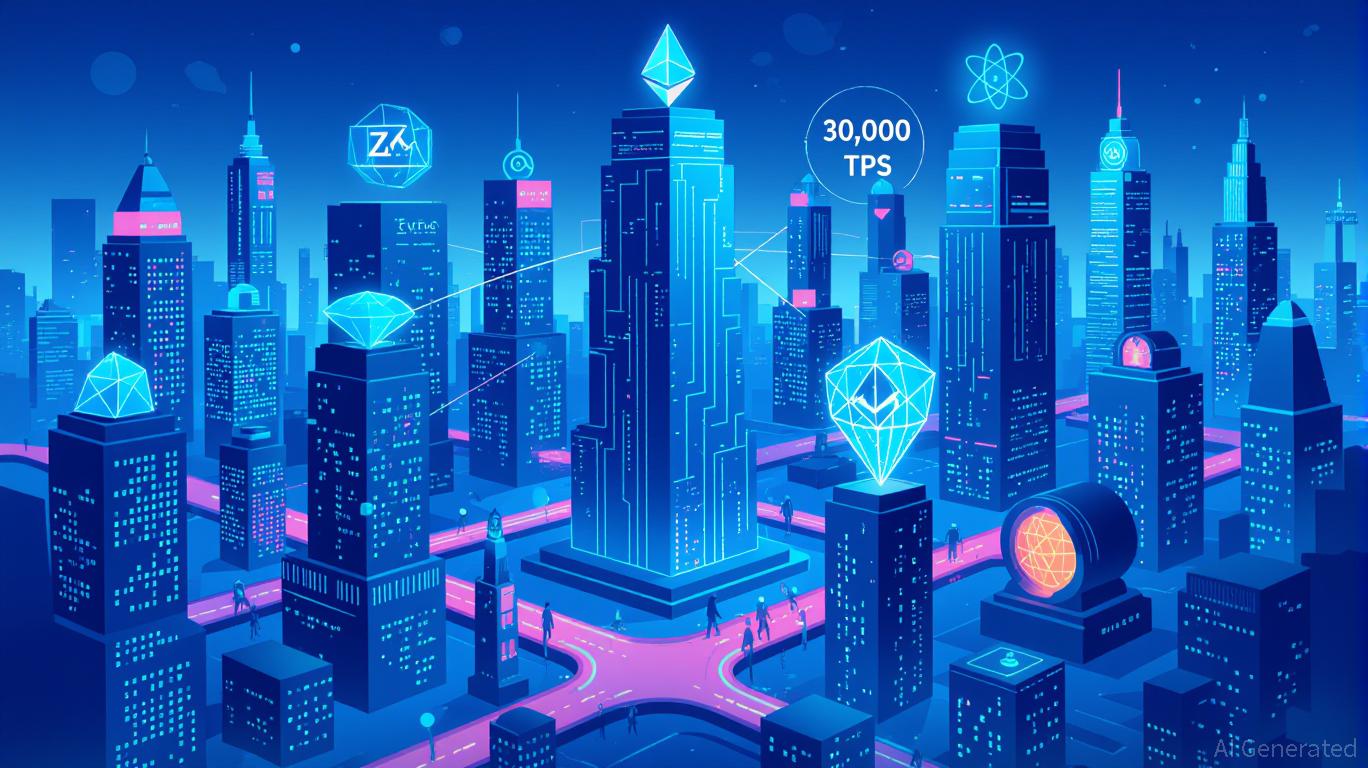
ZK Atlas Enhancement: Transforming Blockchain Scalability and Paving the Way for Institutional Integration
- ZKsync’s 2025 Atlas Upgrade achieves 15,000–43,000 TPS with $0.0001/transaction costs, boosting blockchain scalability for institutions. - Deutsche Bank , Sony , and Citi adopt ZKsync for tokenized assets and privacy-driven transactions, citing compliance and efficiency gains. - Market forecasts predict 60.7% CAGR for ZK Layer-2 solutions through 2031, with Fusaka upgrade targeting 30,000 TPS to solidify ZKsync’s leadership.
Trending news
MoreCrypto prices
More





