
Ethereum’s Fusaka Update: Enhancing Scalability While Maintaining Security
- Ethereum's Fusaka Upgrade (Dec 3, 2025) introduces PeerDAS to enhance L2 scalability via probabilistic data verification, reducing transaction costs and processing times. - Phased blob capacity expansion (6→15→21 per block) balances scalability with network stability, supported by 11 EIPs including spam resistance and gas limit adjustments. - The upgrade aims to attract developers to Ethereum's ecosystem by lowering L2 fees, while addressing revenue challenges through DeFi integration and testnet validat

Ethereum’s forthcoming Fusaka Upgrade, set to go live on December 3, 2025, represents a major milestone in the network’s ongoing efforts to improve scalability. This upgrade will introduce PeerDAS (Peer Data Availability Sampling), an innovative method that allows nodes to confirm data integrity without needing to download entire blocks, thereby improving data availability for Layer 2 (L2) solutions. By addressing a key scaling challenge, PeerDAS enables rollups and other L2 technologies to function more efficiently, leading to lower transaction fees and faster processing. The Fusaka Upgrade is a central part of Ethereum’s 2025 strategy, which focuses on foundational improvements to support the expanding needs of decentralized finance (DeFi), gaming, and asset tokenization.
One of the main features of the Fusaka Upgrade is the gradual increase in Ethereum’s blob capacity, which refers to the storage of data packets essential for rollups. The network will initially support six blobs per block, with two subsequent Blob Parameter Only (BPO) upgrades planned to raise this limit to 15 and then 21 blobs per block. This step-by-step process is designed to enhance scalability while maintaining network reliability, ensuring that the core layer can manage increased transaction loads without sacrificing security. Vitalik Buterin,
The Fusaka Upgrade encompasses 11 Ethereum Improvement Proposals (EIPs) aimed at boosting efficiency and scalability. Notably, EIP-7594 (PeerDAS) and EIP-7917 (Deterministic Proposer Lookahead) are considered key changes. EIP-7825 introduces mechanisms to resist spam and prevent network slowdowns, while EIP-7935 modifies the gas limit to support greater transaction volume. Developers have thoroughly tested these changes on testnets such as Holesky and Sepolia in October 2025, and a $2 million bug bounty program has been launched to encourage security reviews. The Ethereum community is taking a careful approach to deployment, timing the mainnet launch with the Devconnect conference in November 2025 to ensure all stakeholders are aligned.
The Fusaka Upgrade is expected to have a significant economic impact. By reducing gas fees on L2s, it is likely to draw more developers to the Ethereum ecosystem, spurring innovation in DeFi, gaming, and tokenized assets. For example, projects like
Looking forward, the Fusaka Upgrade is expected to pave the way for Ethereum to reach a theoretical throughput of 12,000 transactions per second by 2026, making it a strong contender for high-volume applications. However, the ultimate success of the upgrade will depend on effective testnet performance and ongoing refinements after launch. Developers are also preparing for future enhancements, such as potentially reducing block times to six seconds, which could further improve user experience. As the blockchain industry evolves, Ethereum’s commitment to gradual, security-focused upgrades highlights its importance as a core platform for Web3 development.
Disclaimer: The content of this article solely reflects the author's opinion and does not represent the platform in any capacity. This article is not intended to serve as a reference for making investment decisions.
You may also like
Investment Prospects in STEM Learning and Workforce-Ready Talent Streams: Linking with Astar 2.0
- Global STEM education demand surges as AI, blockchain, and biotech reshape industries, creating workforce skill gaps. - Astar 2.0's DeFi innovations (ZK Rollups, interoperability) indirectly support STEM through blockchain infrastructure and cross-chain collaboration. - U.S. and Singapore prioritize tech-integrated workforce strategies, aligning with Astar 2.0's potential to bridge DeFi and STEM education via scalable tools. - Investors can leverage Astar 2.0's $1.399B TVL and hybrid AMM-CEX model to fun

The ZK Transformation: Evaluating How Zero-Knowledge Technology Influences the Future Development of Blockchain
- ZK-rollups scale blockchain networks by bundling transactions, achieving 43,000 TPS and 30% lower gas fees, attracting institutions like Goldman Sachs and JPMorgan . - ZK technology resolves privacy-scalability paradox by enabling verifiable transactions without data exposure, adopted by EU regulators and enterprises like Nike and Sony . - Challenges persist: ZK-SNARKs require heavy computation, trusted setup risks exist, and privacy conflicts with AML regulations in some jurisdictions. - $725M+ VC inves

The Influence of Vitalik Buterin's Support for ZKsync on the Advancement of Scalable Blockchain Technologies: Evaluating the Prospects for Long-Term Investment in Pr
- Vitalik Buterin's 2025 endorsement of ZKsync accelerated its rise as a scalable Ethereum Layer-2 solution with 30,000 TPS and $3.3B TVL. - ZKsync's EVM compatibility and institutional partnerships contrast with StarkNet's quantum-resistant STARK proofs and Aztec's privacy-first architecture. - Analysts project ZK token prices at $0.40–$0.60 by 2025, while StarkNet faces adoption barriers and Aztec navigates regulatory challenges in privacy-focused DeFi. - The $7.59B ZKP market (2033 forecast) hinges on b
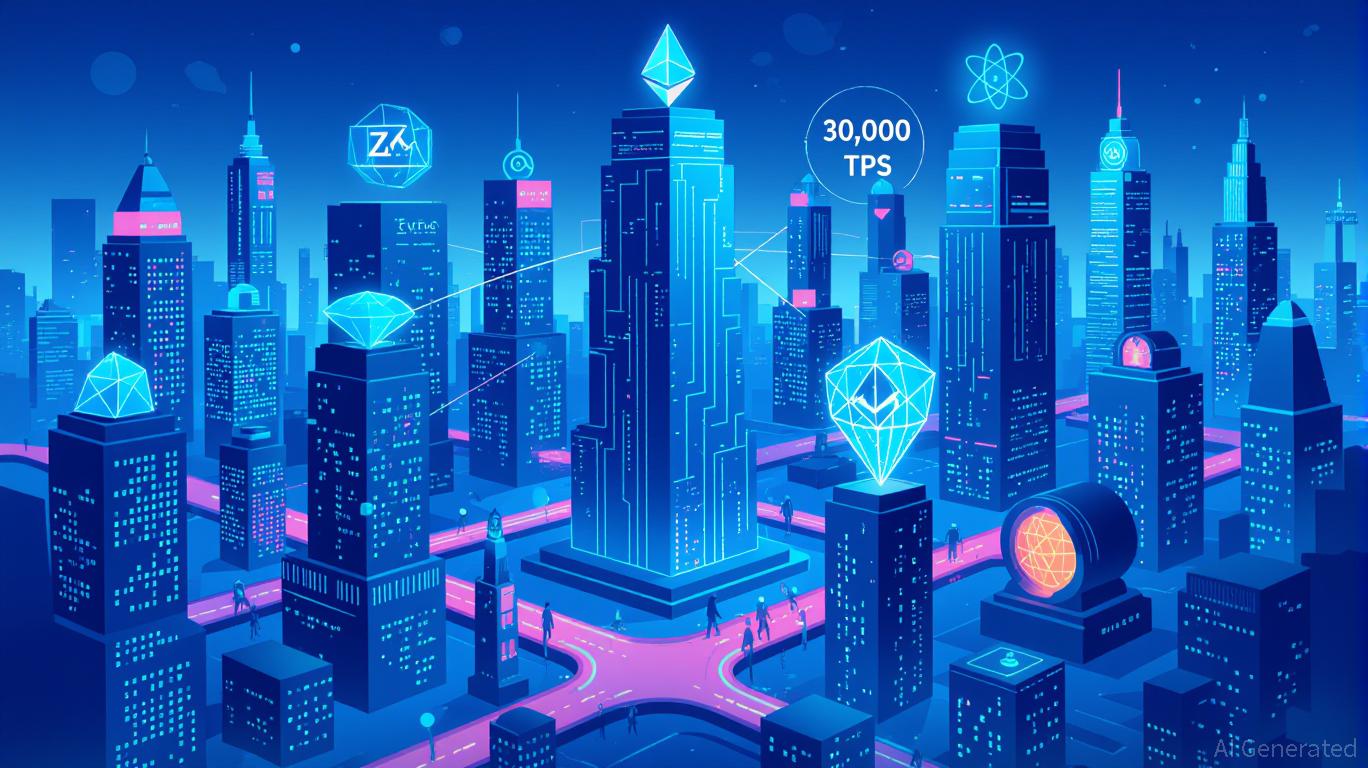
ZK Atlas Enhancement: Transforming Blockchain Scalability and Paving the Way for Institutional Integration
- ZKsync’s 2025 Atlas Upgrade achieves 15,000–43,000 TPS with $0.0001/transaction costs, boosting blockchain scalability for institutions. - Deutsche Bank , Sony , and Citi adopt ZKsync for tokenized assets and privacy-driven transactions, citing compliance and efficiency gains. - Market forecasts predict 60.7% CAGR for ZK Layer-2 solutions through 2031, with Fusaka upgrade targeting 30,000 TPS to solidify ZKsync’s leadership.
Trending news
MoreCrypto prices
More





