
XRP's Patterned Surge: 6.19% Market Share May Propel Price to an All-Time High of $4.32
- Pseudonymous trader KriptoMessi identifies a recurring four-step fractal pattern in XRP’s dominance chart, predicting a potential 6.19% market share peak by 2025. - A 6.19% dominance could push XRP’s price to $4.32 if the broader crypto market recovers to its August 2025 all-time high of $4.17 trillion. - Regulatory clarity and Ripple’s partnerships with banks, plus RLUSD stablecoin development, are seen as catalysts for XRP adoption and demand. - However, macroeconomic pressures and a broader crypto mar
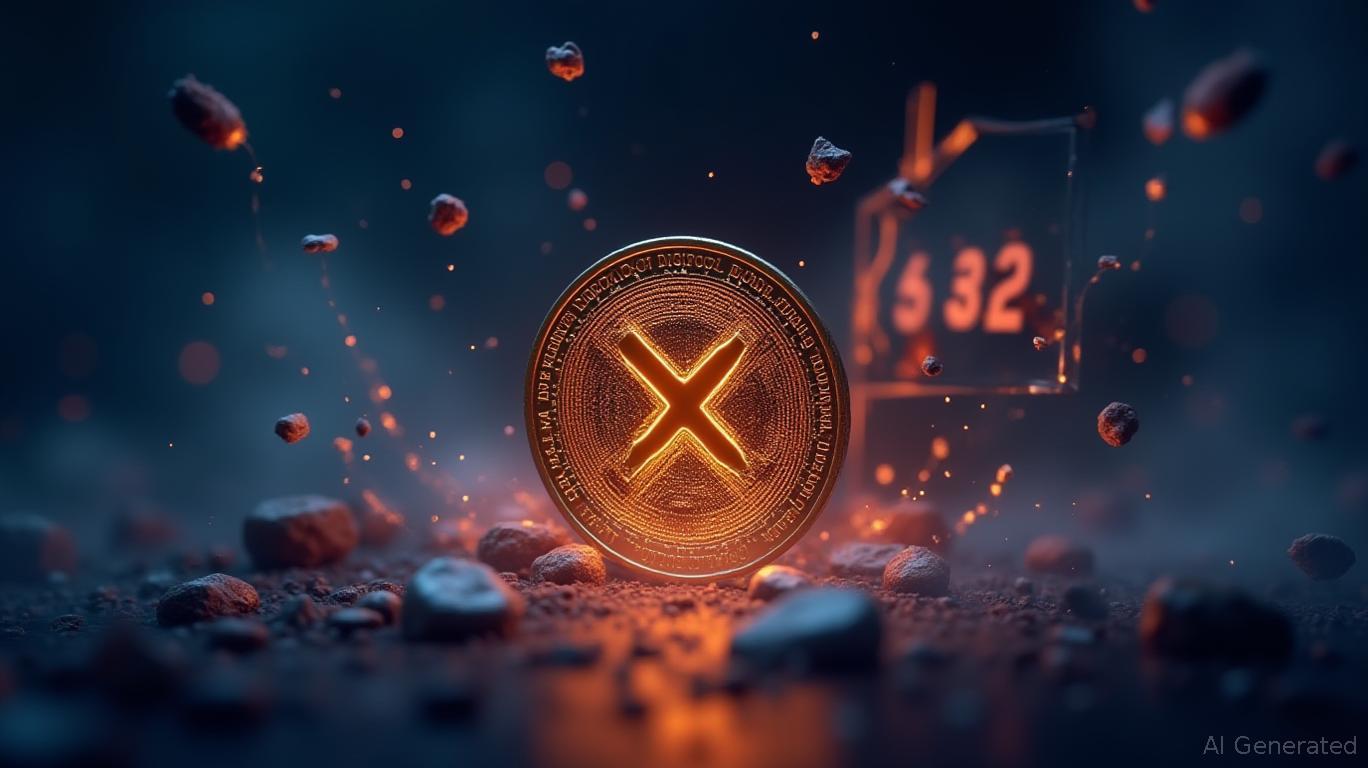
According to the trader known as KriptoMessi, XRP’s share of the crypto market could climb to a six-year high of 6.19%, fueling discussions about what this could mean for its price. The analyst pointed out a repeating four-phase fractal pattern in XRP’s dominance chart, which has historically signaled major increases in market share. This formation, which appeared twice in 2025, indicates a possible breakout above the downward trendline, with the most recent consolidation around 4.54% setting up
This fractal pattern is defined by four major points on the dominance chart. The first cycle started on March 19, 2025, when XRP’s dominance hit 5.35%. After falling through April and May, it bounced back to 4.63% in mid-May, marking the second point, but was rejected and continued downward. The third point was a consolidation at 4.13%, followed by a base near 4.04% as the fourth point. A breakout above the trendline in July lifted dominance to 5.53%, which coincided with XRP’s price reaching $3.60. A similar sequence unfolded in July–August 2025, with the current base at point four hinting at another possible rally TheCryptoBasic [ 1 ].
The anticipated increase in dominance would directly affect XRP’s price. At a 6.19% share, XRP’s market cap would reach $234 billion, provided the total crypto market size stays the same. This would put XRP’s price at $3.91, just above its July 2025 high. However, if the overall market grows to $4.17 trillion, that same dominance would push XRP to $4.32. Experts point out that this outcome would depend on a broad recovery in crypto market value, which has recently been challenged by global economic uncertainty TheCryptoBasic [ 1 ].
Wider market trends also play a role in XRP’s performance. In 2025, XRP’s dominance has ranged between 4.2% and 6%, with institutional investors favoring established cryptocurrencies, helping XRP remain relatively strong. Recent regulatory developments, including the resolution of its SEC case, have eased concerns about its valuation. Ripple’s collaborations with banks and the launch of its stablecoin RLUSD are also seen as drivers for cross-border payment adoption, potentially boosting demand for XRP TheCoinRepublic [ 4 ]. Nevertheless, the token has faced pressure from a broader crypto downturn, with its price dropping below $3 in late September 2025 after reaching $3.187 earlier that month TheCryptoBasic [ 1 ].
Analysts emphasize the importance of technical patterns in forecasting XRP’s price action. KriptoMessi’s research highlights that this fractal pattern has often marked periods of capitulation followed by accumulation. Similar formations in 2021–2022 and during Bitcoin’s 2018 decline were followed by sharp volatility and the start of new bull runs. While XRP’s current consolidation could lead to a breakout, the result depends on continued buying interest and a broader market recovery. Experts warn that short-term volatility remains high, with XRP’s RSI at 93.89 and on-chain data showing mixed market sentiment TheCoinRepublic [ 4 ].
Disclaimer: The content of this article solely reflects the author's opinion and does not represent the platform in any capacity. This article is not intended to serve as a reference for making investment decisions.
You may also like
The PENGU USDT Sell Alert: Is This a Turning Point for Stablecoin Approaches?
- PENGU/USDT's 2025 collapse triggered a $128M liquidity shortfall, exposing algorithmic stablecoin fragility and accelerating market shift to regulated alternatives. - USDC's market cap surged to $77.6B by 2025, while MiCA-compliant euro-stablecoins gained $680M in cross-border adoption amid regulatory clarity. - DeFi protocols adopted oracle validation and reserve-backed models post-PENGU, reducing exploit losses by 90% since 2020 through institutional-grade security upgrades. - Regulators now prioritize
Emerging Prospects in EdTech and AI-Powered Learning Systems: Ways Educational Institutions Are Transforming Programs and Enhancing Student Achievement
- AI is transforming education by reshaping curricula, enhancing student engagement, and optimizing institutional efficiency. - Universities like Florida and ASU integrate AI literacy across disciplines, offering microcredentials and fostering innovation. - AI tools like Georgia Tech’s Jill Watson and Sydney’s Smart Sparrow boost performance and engagement through personalized learning. - AI streamlines administrative tasks but faces challenges like ethical misuse and skill gaps, requiring structured train

Anthropological Perspectives on Technology and Their Impact on Education and Workforce Preparedness for the Future
- Interdisciplinary STEM/STEAM education integrates technology tools like AI and VR to bridge theory and real-world skills, driven by $163B global edtech growth. - U.S. faces 411,500 STEM teacher shortages and 28% female workforce representation gaps, prompting equity-focused programs like Girls Who Code. - STEM occupations earn $103K median wages (vs. $48K non-STEM), with 10.4% job growth projected through 2033, driving investor opportunities in edtech and workforce alignment. - Strategic investments in t

The Revival of Educational Technology in Higher Education After the Pandemic
- Global EdTech market grows to $7.3T by 2025, driven by hybrid learning and AI/AR/VR adoption in higher education. - Institutions like MIT and Harvard integrate AI across disciplines, boosting enrollment and workforce alignment through $350M-$500M investments. - EdTech platforms enabling personalized learning and immersive experiences see rising demand, with 45% annual growth in AI-related programs since 2020. - Undervalued EdTech stocks offer investment opportunities as $16B+ VC funding accelerates innov

Trending news
MoreCrypto prices
More





