
Bitcoin exchange supply drops to 6-year low after ATH

The Bitcoin supply on crypto exchanges has plummeted to around 2.8 million BTC, levels previously only seen in July 2019. This drop in supply follows the token’s recent ATH at $125,506.
- Bitcoin exchange balances hit a six-year low at just 2.8 million BTC, reflecting growing self-custody trends and rising institutional accumulation.
- BTC price momentum remains strong after reaching a new all-time high of $125,506, with technical signs suggesting consolidation above $122,000.
The amount of Bitcoin stored on trading platforms like Binance, Bitget, Coinbase and others has dropped significantly after the token reached a new all-time high just a day prior. According to data from on-chain analysis platform Glassnode, the total amount of BTC held on exchange addresses currently stands at just over 2.8 million BTC.
The last time the Bitcoin ( BTC ) supply on exchanges shrunk to about 2.8 million was in June 2019, back when BTC was just valued at around $8,745. Six years after, the price of BTC has multiplied a few times over, reaching a new high at $125,506. The new milestone may attract more demand from investors looking to acquire the asset.
Not only that, it also suggests a shift in BTC ownership. It could mean that more holders are withdrawing their tokens from centralized exchanges and storing them in self-custody wallets. These could include cold-storage wallets or private storage addresses.
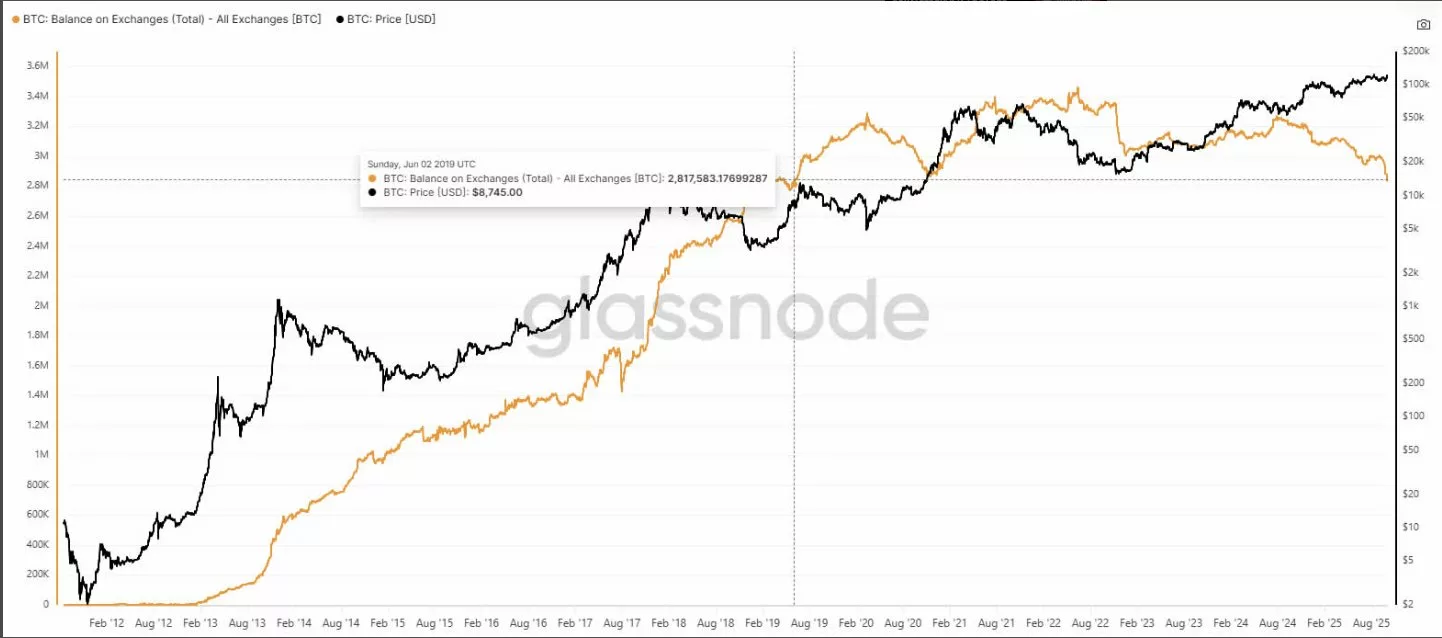 Bitcoin balance on exchanges drops to a six-year low | Source: Glassnode
On the other hand, Bitcoin has become a highly attractive asset to external parties; especially to institutional investors looking to stockpile more of the asset into corporate-held treasuries. As of late, more and more companies are following the blueprint set by Michael Saylor’s Strategy .
According to Bitcoin Treasuries , in the past 30 days there have been 25 new entities that decided to jump on the BTC bandwagon. The total number of institutions holding BTC stands at 344 entities, with the largest portion coming from the United States at 122 entities. In fact, the number far outweighs those in Canada, the U.K, Japan, and Hong Kong combined.
At the moment, there are 3.88 million BTC kept in corporate treasuries, surpassing the current supply kept in exchanges by more than 1 million BTC.
Bitcoin price analysis
The drop in BTC supply on exchanges reflects the increasing appetite from investors, as it coincides with the asset reaching a new all-time high. With just 2.8 million BTC held on trading platforms, there is now less sellable supply on the market.
That means when demand rises, there is less BTC for the market to absorb. This could potentially push the price higher, as scarcity often does.
According to data from TradingView, Bitcoin is currently trading around $123,610, slightly below its recent surge that pushed it to a new all-time high of $125,506. Since late September, BTC has been on a rally that’s been carried over by strong momentum; with Bitcoin consistently holding above its 30-day moving average.
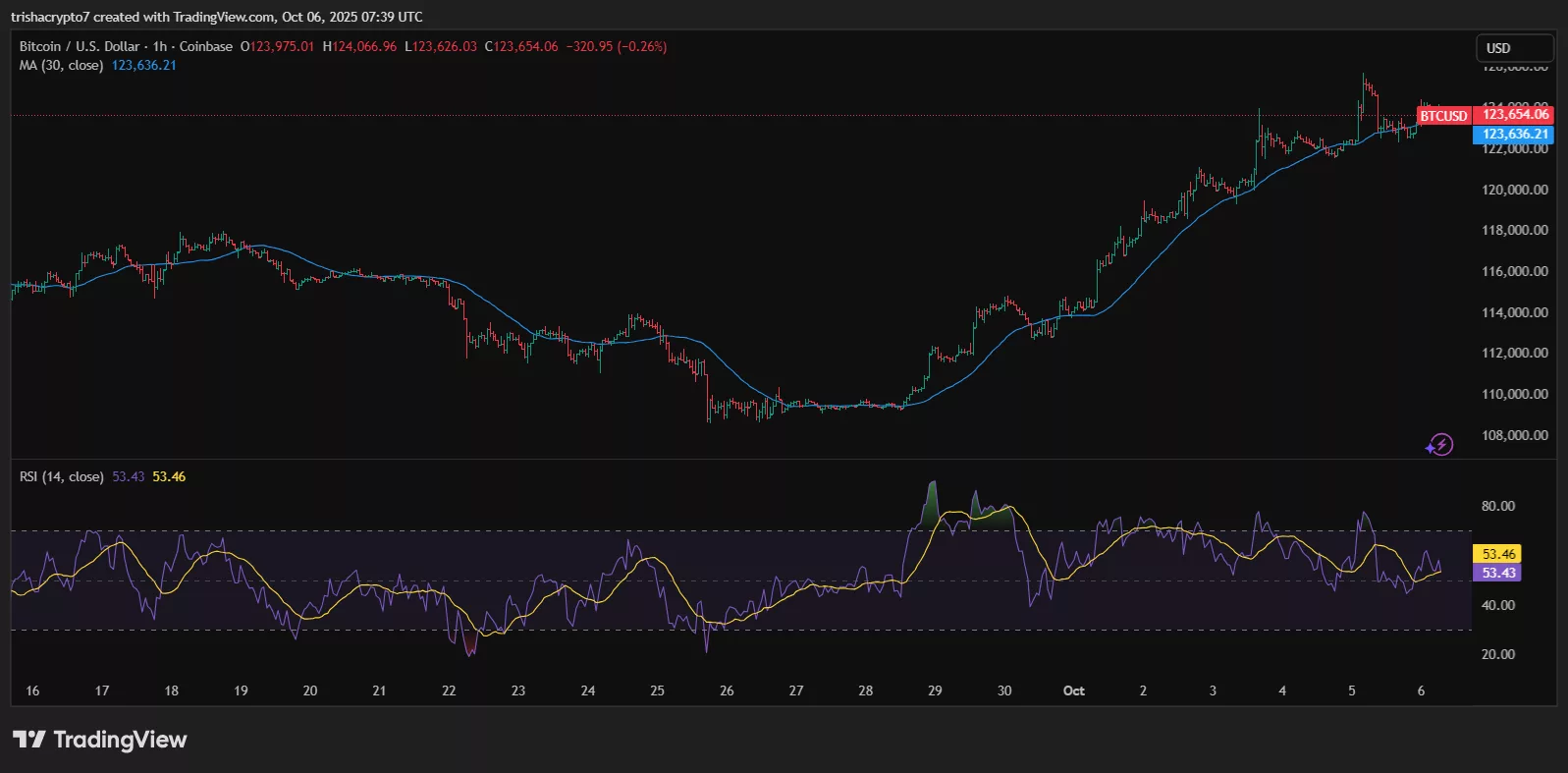 Bitcoin begins to stabilize after reaching a recent all-time high | Source: TradingView
This bullish momentum confirms the strength of the breakout that has catapulted BTC to fresh highs. The price remains close to its moving average at $123,636, showing that buyers are still defending support levels despite some profit-taking.
On the other hand, the Relative Strength Index is currently hovering at around 53, indicating a consolidation period after the token’s recent surge. This mid-range RSI suggests neither overbought nor oversold conditions, which could imply that Bitcoin is stabilizing after its strong run-up. The market may be preparing to lift it higher if bullish momentum resumes, though there is still room for short-term corrections.
If Bitcoin can sustain above the $122,000 to $123,000 range, the path toward retesting $125,000 and potentially pushing higher remains intact. On the downside, a clean break below the moving average could trigger a pullback toward $120,000, an area of prior consolidation.
Disclaimer: The content of this article solely reflects the author's opinion and does not represent the platform in any capacity. This article is not intended to serve as a reference for making investment decisions.
You may also like
The Emergence of Clean Energy Derivatives: How CleanTrade is Transforming Institutional Investment in Renewable Resources
- CleanTrade's CFTC-approved SEF designation in 2025 revolutionizes clean energy derivatives by introducing institutional-grade liquidity and standardized trading for VPPAs, PPAs, and RECs. - The platform's $16B notional trading volume within two months demonstrates rapid institutional adoption, with major players like Cargill leveraging its transparent infrastructure to manage energy risks. - Integrated ESG analytics and automated compliance tools enable investors to align portfolios with sustainability g

The Emergence of CFTC-Regulated Clean Energy Platforms and Their Influence on Institutional Investment Approaches
- CFTC-approved CleanTrade, the first SEF for VPPAs/RECs, transforms clean energy markets by addressing liquidity, transparency, and regulatory challenges. - Its $16B trading volume and Cargill-Mercuria's first transaction demonstrate institutional adoption of standardized, verifiable renewable energy assets. - CleanTrade enables ESG alignment through project-specific carbon tracking, reducing emissions by 15% for investors while complying with IRA-driven $2.2T global investments. - By bridging financial a

Clean Energy Market Fluidity and the Rise of CleanTrade: Strategic Considerations for Investors in a Regulatory Environment
- CleanTrade, a CFTC-approved SEF, addresses fragmented pricing and low liquidity in clean energy markets by standardizing VPPA, PPA, and REC trading. - The platform’s $16B in two-month transactions demonstrates institutional demand for transparent, ESG-aligned tools to hedge energy risks and track carbon impact. - By centralizing renewable derivatives and aligning with regulations like SFDR, CleanTrade lowers barriers for investors and developers, accelerating decarbonization while boosting market efficie

The Rise of a Dynamic Clean Energy Marketplace
- Global clean energy investment hit $2.1 trillion in 2024, driven by decarbonization trends and institutional demand. - REsurety's CFTC-approved CleanTrade platform addresses liquidity gaps by standardizing VPPA/REC trading with oil-like transparency. - The platform processed $16 billion in two months, enabling risk mitigation and rapid capital reallocation amid policy shifts. - Advanced analytics and structured workflows transform clean energy assets into tradable instruments, attracting diversified inst

Trending news
MoreCrypto prices
More





