
NFT Market Tries to Recover After $1.2 Billion in Losses

After a lightning plunge of $1.2 billion, the NFT market is attempting a comeback. Signs of recovery are multiplying, though uncertainties remain. Should this be seen as a mere bounce or a true renewed interest in digital assets? Full analysis here.
In brief
- The NFT market lost $1.2 billion in 24 hours, revealing its strong sensitivity to crypto volatility.
- Despite a partial recovery, only a few collections are holding up.
NFTs Dragged Down by the Crypto Market Crash
Last Friday, the crypto market faced a significant drop. The bitcoin price plunged to $102,000, in a climate weighed down by the announcement of trade sanctions between the United States and China. This shock triggered a wave of liquidations reaching $20 billion.
Like many other digital assets, NFTs took the full brunt of the impact. In 24 hours, sector capitalization fell from $6.2 to $5 billion, according to CoinGecko data . This 20% drop reveals the market’s structural dependence on crypto volatility and sudden liquidity drying up.
Timid Recovery of the NFT Market and Partial Confidence
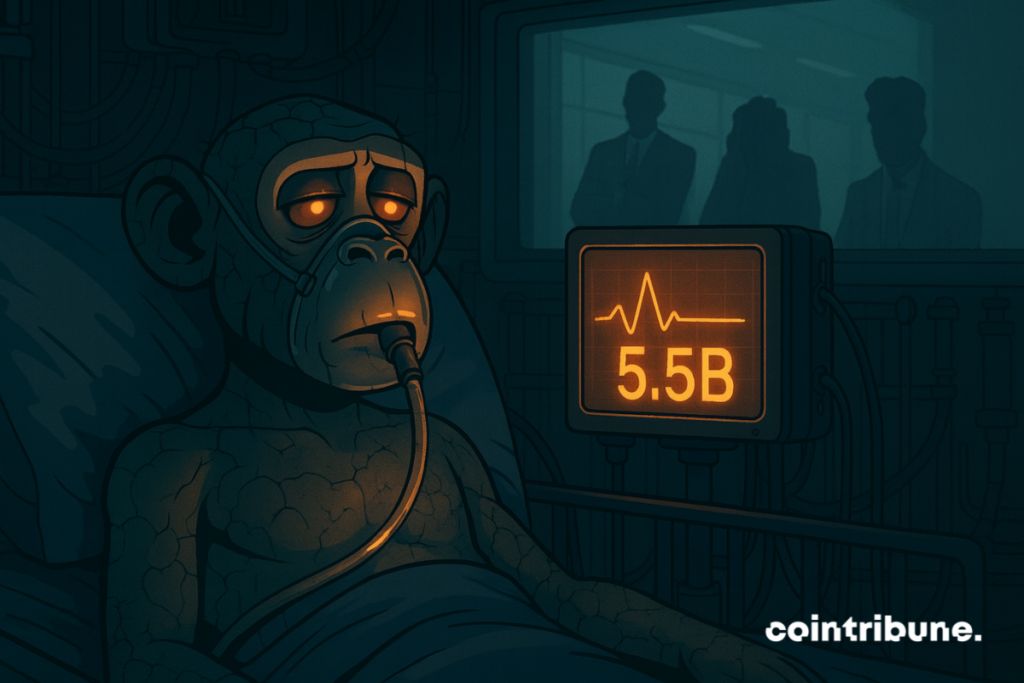
By Sunday, a slight rebound started. NFT capitalization briefly reached $5.5 billion before falling back to $5.4 billion. Some see this as a return of risk appetite. That said, the numbers remain mixed:
- historical collections like Bored Ape Yacht Club fall by 10.2% over seven days;
- Pudgy Penguins drop 21.4%;
- CryptoPunks give up 8%.
Only a few projects like Hypurr NFTs (+2.8%) or Mutant Ape Yacht Club (+1.5%) show a timid green. This reflects a more selective trend. It means buyers are scrutinizing fundamentals more and shunning overvalued collections.
Institutional Capital, a Shield Against Panic?
Despite the correction, institutional crypto products held firm. According to CoinShares, crypto ETPs recorded $3.17 billion in weekly inflows. This positive NFT flow stands in contrast with the markets’ bloodletting. More importantly, it signals long-term conviction among some players.
The question remains whether these investments truly support NFTs or focus on the BTC/ETH duo. The contrast with retail volatility highlights a strategic gap. NFTs, often seen as highly volatile assets, could come out stronger from this period if they demonstrate more than just a fleeting trend.
Despite some recovery signals, the NFT market still has to prove its resilience. The coming months could mark a turning point!
Disclaimer: The content of this article solely reflects the author's opinion and does not represent the platform in any capacity. This article is not intended to serve as a reference for making investment decisions.
You may also like
The Federal Reserve's Change in Policy and Its Effects on High-Yield Cryptocurrencies Such as Solana: Rethinking Risk Management Amidst Shifting Regulations in the Digital Asset Sector
- Fed's 2025 policy shift injected $72.35B into markets, briefly boosting Solana (+3.01%) before macro risks triggered a 6.1% price drop. - EU MiCA and US GENIUS Act regulations drove institutional adoption of compliant platforms, with Solana's institutional ownership reaching 8% of supply. - Fed's $340B balance sheet reduction and SIMD-0411 proposal exposed crypto liquidity fragility, causing 15% market cap decline and 4.7% TVL drop for Solana. - Institutions now prioritize MiCA-compliant stablecoins and

Algo slips 0.52% as Allego unveils app designed to simplify EV charging
- Algo (ALGO) fell 0.52% in 24 hours to $0.1335, with a 60.3% YTD decline, coinciding with Allego's new EV charging app launch. - Allego's app offers real-time pricing, smart routing, and Plug&Charge features to simplify European EV charging across 35,000+ stations. - The app eliminates partner network markups and provides transparent billing, targeting user frustrations with fragmented charging experiences. - As Europe's EV market grows, Allego positions itself as a key infrastructure provider through thi

Exploring How Artificial Intelligence Shapes Higher Education and Tomorrow’s Job Market: Supporting STEM and Technical Training to Counteract the Effects of Automation
- AI is reshaping global economies, forcing higher education and vocational programs to rapidly adapt to automation-driven workforce demands. - Institutions prioritize "AI fluency" across disciplines, while STEM/vocational training addresses growing demand in AI-augmented roles like data analysis and software development. - OECD projects AI education investments could boost GDP, with the AI education market expected to grow from $7.05B in 2025 to $112.30B by 2034. - Federal funding initiatives and private

The Growing Need for AI Professionals and How It Influences Technology Company Valuations
- Global AI talent demand surged in 2025, driving universities to expand AI curricula and industry partnerships. - Top institutions like MIT and Stanford prioritize ethical AI education, while international schools like Nanyang Tech boost AI research. - Universities with AI-focused endowments achieved 14-15.5% returns in 2025, outperforming traditional education assets. - Education ETFs like Leverage Shares +3x Long AI ETP rose 120% in 2025, tracking AI infrastructure growth and semiconductor demand. - AI

Trending news
MoreCrypto prices
More





