Liberate, an artificial intelligence company focused on automating insurance processes, has secured $50 million in funding led by Battery Ventures, aiming to expand its agent-based solutions to insurance providers and agencies worldwide.
This all-equity investment brings the three-year-old company’s post-money valuation to $300 million, with new investor Canapi Ventures joining, alongside existing supporters Redpoint Ventures, Eclipse, and Commerce Ventures.
The insurance sector has faced a challenging period, dealing with higher operational expenses, outdated infrastructure, and rising customer demands. In particular, the non-life insurance market is expected to see slower global premium growth through 2026, according to a recent Deloitte report, due to increased competition, weaker pricing power, and new cost challenges such as tariffs. While some insurers have tried using AI, many initial projects stalled because of scattered data and rigid processes. This is now shifting, as companies move to deeply integrate AI into their core operations instead of treating it as an add-on. Liberate is positioning itself to address this transformation directly.
Established in 2022 and based in San Francisco, Liberate develops AI platforms for property and casualty insurers, concentrating on sales, customer service, and claims management. Its voice AI assistant, Nicole, manages both incoming and outgoing calls to facilitate policy sales and handle service inquiries. In the background, a network of reasoning-driven AI agents interfaces with insurers’ legacy systems, collecting information and crafting responses that Nicole delivers—all without human involvement.
Liberate’s AI agents are designed to handle complete processes from start to finish, not just answer questions or escalate issues. Their tasks include generating quotes, processing claims, and updating policy endorsements, among other routine operations.
These agents are also capable of working via SMS and email, enabling insurers to engage with clients through multiple channels while further automating daily operations.
“Insurance firms want to expand, but they’re unable to,” said Liberate co-founder and CEO Amrish Singh (pictured above, center) in an interview. “The opportunity lies in the current state of the industry.”
Singh started Liberate after spending nearly four years at Metromile, a car insurance company owned by Lemonade, where he worked in both operations and technology. He partnered with Ryan Eldridge, Liberate’s VP of engineering and another Metromile alumnus, and Jason St. Pierre, the company’s CPO, who previously held positions at Twitter, Google, and Verily, Alphabet’s life sciences division.
According to Singh, Liberate’s AI solutions have boosted sales by an average of 15% and reduced costs by 23%. The company now serves over 60 clients, focusing on the top 100 carriers and agencies, which together account for 70% to 80% of the U.S. property and casualty insurance market.
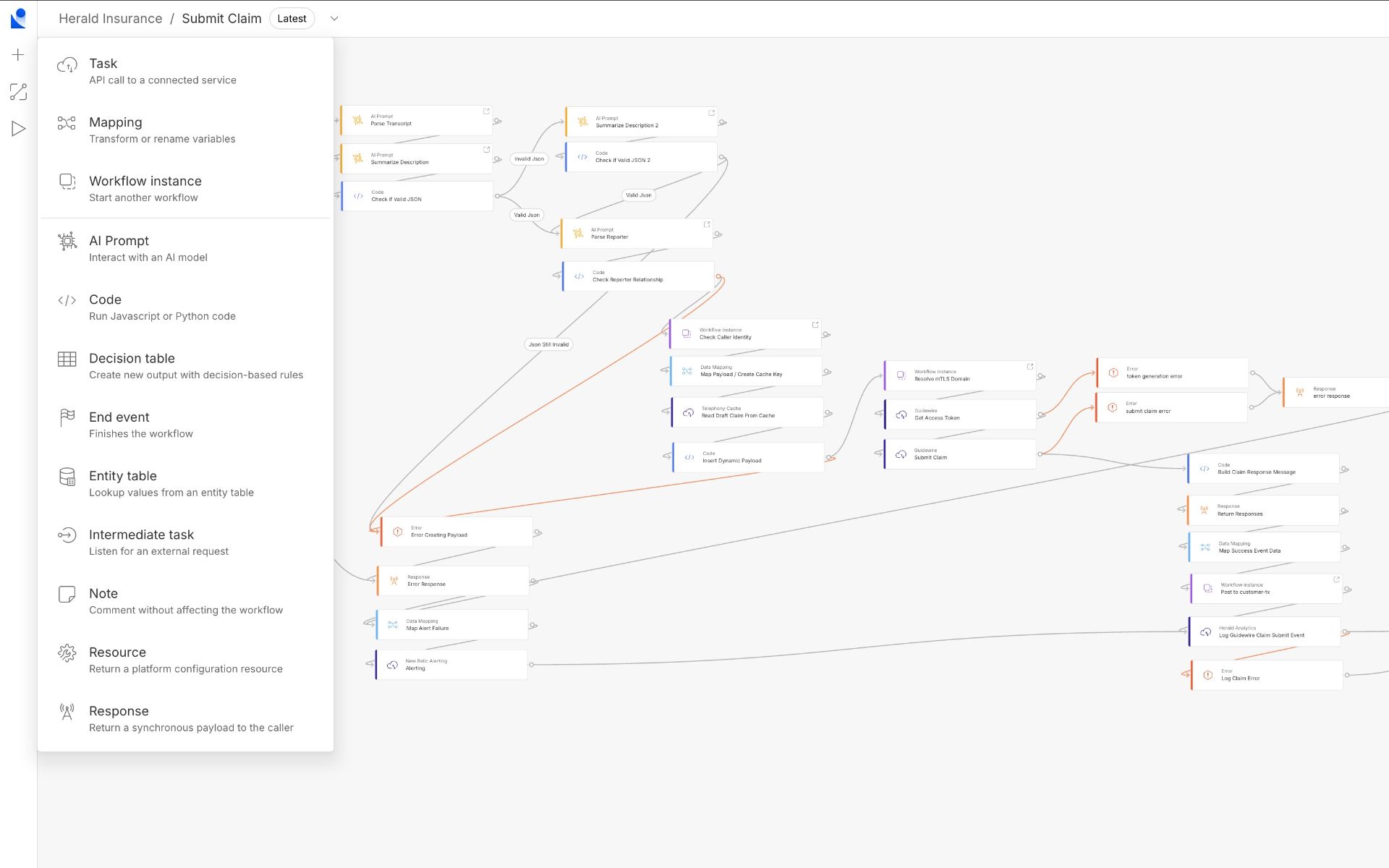 Liberate’s agent orchestration
Image Credits:Liberate
Liberate’s agent orchestration
Image Credits:Liberate
The platform applies reinforcement learning specifically adapted for lengthy, regulated insurance conversations. Each exchange is recorded and includes human oversight features to ensure compliance, according to the company.
Singh reported that over the last year, Liberate increased from 10,000 automated tasks per month to 1.3 million automated resolutions. These include direct customer engagements through its voice AI and back-office processes managed by AI agents integrated with insurers’ core platforms.
Since AI is not yet perfect and can still make errors, Liberate employs an internal tool called Supervisor to oversee all agent-customer interactions. This software detects issues or irregularities and escalates them to a human if the AI’s response appears off, Singh explained.
“By focusing on a single industry and just three main use cases, we’re able to implement far more safeguards,” the executive commented.
While Liberate did not reveal client names, the company shared that its agents reduced hurricane claim response times from 30 hours to just 30 seconds.
The AI agents make it possible to offer insurance sales around the clock, so customers can purchase policies late at night or early in the morning—hours when human agents are typically unavailable, Singh noted.
Prior to this funding, Liberate raised $15 million in a Series A round last year. Its voice AI-driven omnichannel capabilities and seamless integration with existing systems to fully automate tasks were major reasons investors decided to support the company on a larger scale.
“Liberate’s approach is to map out the process, model it, and ensure all system connections are robust, thoroughly tested, and properly designed so tasks can be completed—not just communicated,” Marcus Ryu, general partner at Battery Ventures, told TechCrunch.
Ryu, who previously worked with property and casualty insurers at Guidewire Software, now focuses on enterprise software, fintech, and insurtech investments at Battery Ventures. He will be joining Liberate’s board of directors.
The Series B investment will help Liberate enhance its reasoning technology and support wider adoption among insurance companies. To date, the startup has raised $72 million and currently employs about 50 people.