
Former IMF Chief Warns Of Looming Global Downturn

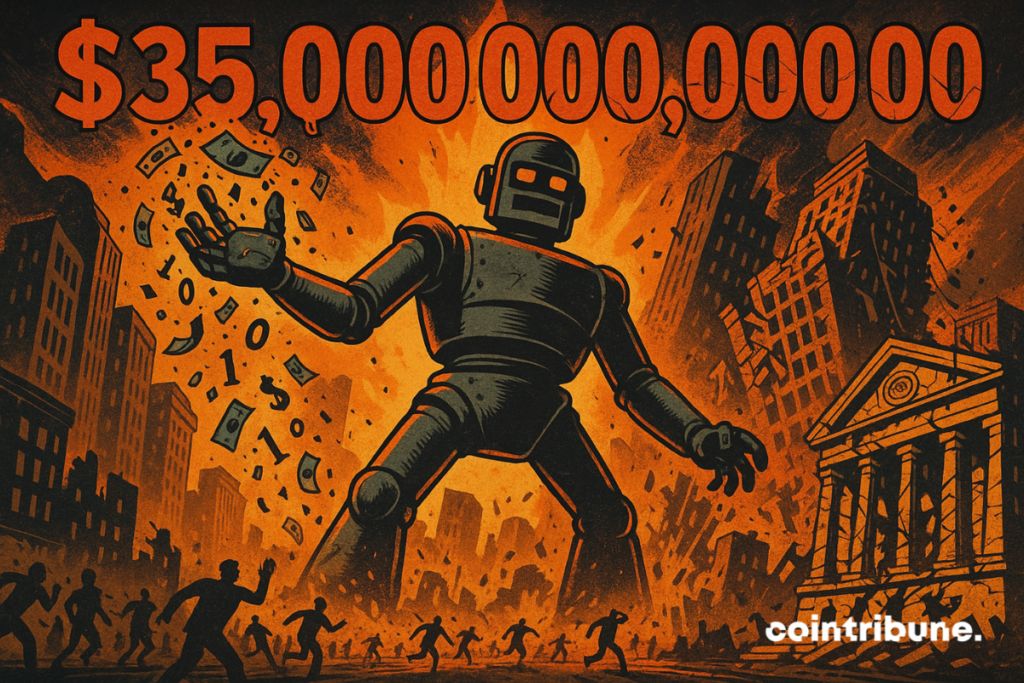
Gita Gopinath, former IMF Deputy Director, warns of a potential financial explosion. Driven by the euphoria around artificial intelligence, the current rally in US markets could, according to her, trigger an unprecedentedly violent global correction. At stake, up to 35 000 billion dollars in losses on global assets.
In brief
- Gita Gopinath, former IMF Deputy Director, warns of a risk of an unprecedented global financial crash.
- According to her, the current stock market rally, heavily fueled by AI, is disconnected from economic fundamentals.
- A market collapse could cause up to $35 trillion in losses globally.
- Households and institutional investors would all be exposed, with direct impacts on the real economy.
A $35 trillion crash ? The quantified warning from an IMF figure
While Trump’s tariffs caused chaos in the crypto market , Gita Gopinath, former chief economist and former Deputy Managing Director of the IMF, sounds the alarm.
According to her, the rapid rise of US markets is out of sync with real economic fundamentals. This rebound is largely driven by enthusiasm surrounding emerging technologies, particularly artificial intelligence.
However, this dynamic could quickly reverse. “There are good reasons to fear that the current rally is setting the stage for a painful new market correction“, she warns . In her view, the growing interconnection of economies and the overexposure of major global players make a worldwide contagion inevitable.
The economist provides a quantified estimate of potential damage in the event of a crash, and it is far from trivial :
- $20 trillion in losses for the US economy, roughly 3.5 % of its national GDP ;
- $15 trillion in losses for international investors, equivalent to nearly 20 % of the global GDP excluding the US ;
- An overall impact estimated at $35 trillion, with cascading effects throughout the financial system.
Gopinath draws a direct analogy with the dot-com bubble of the 2000s while highlighting major structural differences : “a crash today would probably not cause as brief and relatively mild a slowdown as that which followed the dot-com bubble burst“, she warns.
Systemic vulnerabilities, she says, are more severe today due to macroeconomic fragility and the increased complexity of global financial markets.
When the AI bubble threatens the real economy
Beyond the immediate threat to financial markets, Gita Gopinath stresses how the enthusiasm for AI profoundly distorts the structure of valuations. Indeed, JPMorgan notes that companies heavily exposed to artificial intelligence now represent 44 % of the total capitalization of the S&P 500, compared to only 22 % in 2022.
This rapid evolution has allowed American households to gain nearly $5 trillion in net wealth in recent years, an increase largely based on the artificial growth of these technology stocks. “The AI boom could be masking a slowdown in the traditional US economy“, warns the former IMF Deputy Director.
This imbalance creates a risk of direct transmission to the real economy. A sudden reversal would hit institutional investors but also households, increasingly exposed through their stock portfolios, pensions, and insurance.
Moreover, the effects of such a crash would spill over into strategic sectors such as energy, semiconductors, or cloud infrastructure, which feed the AI ecosystem. The damage would therefore not be limited to technology stocks themselves but could trigger a broader recession, also affecting supply chains and labor markets.
In this context of growing uncertainty, some investors might turn again to bitcoin, seen by part of the market as an alternative store of value. Although extremely volatile, the asset has historically stood out for its resilience to inflationary monetary policies and failures of the traditional banking system.
Even if a collapse scenario is not certain, several experts call for portfolio diversification and close attention to excessive valuations. Some mention the return of safe-haven assets like gold, whose recent performance reflects rising concerns in the markets. In any case, excessive dependence on a single theme, even if technological, exposes the global economy to systemic turbulence.
Disclaimer: The content of this article solely reflects the author's opinion and does not represent the platform in any capacity. This article is not intended to serve as a reference for making investment decisions.
You may also like
Pudgy Penguins NFT surpasses Bored Ape in one month: A quick overview of what the PENGU token is
PENGU is the official token of the Pudgy Penguins NFT series and will be launched on the Solana blockchain by the end of 2024. Pudgy Penguins is an NFT project featuring 8,888 unique penguin images, initially released on Ethereum, and has now become the second-largest NFT project by market capitalization. The launch of PENGU aims to expand the community, attract new users, and is planned for deployment on multiple blockchains. The total token supply is 88,888,888,888, allocated to the community, liquidity pools, project team, and others. Solana was chosen to reach a new audience and leverage its fast transactions and low-cost advantages. Summary generated by Mars AI This summary is generated by the Mars AI model, and the accuracy and completeness of its content are still in the process of iterative improvement.

Glassnode: Bitcoin Weakly Fluctuates, Is Major Volatility Coming?
If signs of seller exhaustion begin to appear, a short-term move towards $95,000 and the short-term holder cost basis is still possible.
Should You Still Believe in Crypto
No industry has always been right from the beginning, until it truly changes the world.

Zeus unveils institutional-grade MPC infrastructure blueprint at Solana Breakpoint 2025, enabling Bitcoin to enter Solana’s on-chain capital markets
The focus will now shift to building MPC tools and providing support for developers, driving the creation of more native UTXO applications on Solana.

Trending news
MoreCrypto prices
More





