
Ethereum Leads as Solana’s Developer Growth Challenges the Blockchain Hierarchy

A recent analysis of blockchain developer activity has revealed a strong influx of new talent across major ecosystems, with Ethereum maintaining its dominance. The report, based on data from Electric Capital, highlights shifting developer trends and growing debates over how blockchain contributions are tracked.

In brief
- Ethereum tops all blockchains with 31,869 active developers, maintaining dominance despite slower growth.
- Solana attracts over 17,000 developers, showing rapid expansion and challenging Ethereum’s long-held lead.
- Bitcoin ranks third with 11,036 developers, reflecting steady but slower ecosystem engagement.
- Debate rises over developer counts as experts question data accuracy and inclusion of automated projects.
Ethereum Retains Largest Developer Base, Followed by Solana and Bitcoin
Between January and September, more than 16,000 new developers began contributing to the Ethereum ecosystem , according to data from the Ethereum Foundation. Solana followed with over 11,500 new developers, though a representative from the Solana Foundation suggested the data may be outdated. Bitcoin ranked third, attracting nearly 7,500 new developers in the same period.
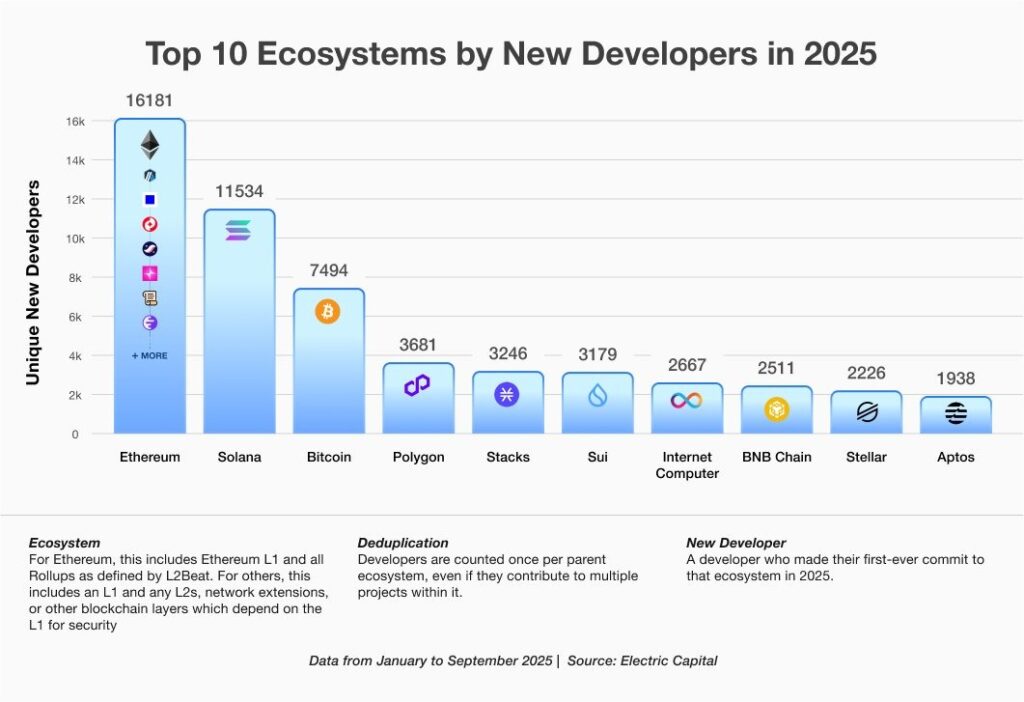
A closer look at the data shows that:
- Ethereum leads with 31,869 active developers , making it the largest developer base across all blockchain ecosystems.
- Solana ranks second with 17,708 developers, showing continued strong developer interest.
- Bitcoin holds third place with 11,036 active developers contributing to its ecosystem.
- The Ethereum figure includes contributors to both layer-1 and layer-2 networks, such as Arbitrum, Optimism, and Unichain, without double-counting developers active across multiple projects.
It is worth noting that developers active across multiple Ethereum-based projects were not double-counted.
Ethereum Growth Slows as Solana Gains Momentum
Although Ethereum leads in total developer numbers, its growth has been modest—rising 5.8% over the past year and 6.3% over the past two years. By contrast, Solana has shown stronger momentum. Electric Capital’s tracker reports a 29.1% increase in full-time developers over the past year and a 61.7% rise over the past two years.
Despite these figures, Jacob Creech, Solana Foundation’s head of developer relations, claims that the data undercounts Solana developers by around 7,800. He urged developers to register their GitHub repositories to help improve Solana’s internal tracking.
Several community members have questioned how Electric Capital grouped developer data. Some chains operating on the Ethereum Virtual Machine (EVM) were merged, while others were excluded.
Tomasz K. Stańczak, founder of Nethermind, argued that EVM-based networks such as Polygon and BNB Chain should be considered together since they share compatible tooling and developer skill sets.
Skepticism Grows Over Reported Developer Numbers
Some industry observers remain skeptical of the reported developer numbers. Jarrod Watts, head of Australia for the layer-2 project Abstract, said the figures may be inflated by repositories generated by automated coding tools and temporary hackathon projects.
Watts suggested that short-term or low-quality code—such as hackathon projects and inactive repositories—may inflate the developer figures. He added that genuine new developer participation appears limited this year.
A social media user known as memevsculture noted a gap between the reported number of developers and the visible number of active decentralized applications , suggesting that developer counts may not fully reflect meaningful activity.
Disclaimer: The content of this article solely reflects the author's opinion and does not represent the platform in any capacity. This article is not intended to serve as a reference for making investment decisions.
You may also like
SOL Price Forecast and Solana's Market Strength in Late 2025: A Two-Factor Assessment
- Solana (SOL) faces pivotal 2025 juncture with Fed easing and blockchain upgrades driving price resilience. - Fed rate cuts and $421M institutional inflows via ETFs (e.g., REX-Osprey) boost crypto adoption amid low yields. - Firedancer/Alpenglow upgrades cut validator costs by 80%, enabling 100-150ms finality and $10.2B DeFi TVL growth. - $133 support level and bullish TD Sequential signals suggest $150-$165 target by year-end despite inflation risks.

The Federal Reserve's Change in Policy and Its Effects on Rapidly Growing Cryptocurrencies Such as Solana
- Fed's 2025 rate cut and QT halt injected $72.35B liquidity, briefly boosting crypto markets and Solana (+3.01%) amid easing monetary policy. - Prolonged US government shutdown and $19B October liquidation event exposed crypto's liquidity risks, despite Fed support for speculative assets. - Solana saw $3.65B trading volume but 6.1% price drop in November, with TVL falling 4.7% as regulatory pressures and macro volatility offset institutional inflows. - SIMD-0411 proposal aims to reduce Solana issuance by
LUNA Rises 42.62% Over the Past Week Amid Ongoing Legal Developments in the Terra Ecosystem
- Terra's LUNA token surged 42.62% in 7 days amid ongoing legal proceedings against co-founder Do Kwon. - Prosecutors seek 12-year prison sentence for Kwon over 2022 Terra collapse, which triggered $40B market losses. - LUNA Classic and LUNC rose 70-130% as investors view legal drama as catalyst for renewed Terra ecosystem interest. - Kwon's guilty plea and sentencing hearing on Dec 11 could shape market sentiment, though pardon odds remain at 2%. - "Bankruptcy concept coins" like USTC and FTT also surged,
Bitcoin’s Latest Price Swings and Institutional Outlook: Managing Uncertainty in an Evolving Cryptocurrency Environment
- Bitcoin's 40% November 2025 price drop highlights volatility challenges despite growing institutional adoption and regulatory clarity. - 55% of hedge funds now hold Bitcoin as strategic inflation hedge, driven by ETF approvals and $3 trillion institutional asset unlocking. - Macroeconomic correlations (S&P 500 at 0.48) and Fed policy shifts demonstrate Bitcoin's evolving role as macroeconomic barometer. - 72% of institutions adopted advanced risk frameworks in 2025, emphasizing AI monitoring and regulato

Trending news
MoreCrypto prices
More





