
YFI rises 0.29% over 24 hours during turbulent short-term market adjustments
- YFI rose 0.29% in 24 hours but fell 40.23% year-to-date, reflecting ongoing DeFi token revaluation. - Market analysis shows bearish trends with 7-day/30-day declines, though RSI suggests potential short-term stabilization. - Price movements lack clear catalysts, driven by algorithmic trading and liquidity flows rather than fundamental changes. - Analysts predict continued downward pressure until institutional adoption or product innovation emerges in DeFi. - Backtesting challenges persist due to data for
As of October 24, 2025,
This token, which is central to Yearn Finance’s automated yield optimization, remains in a consolidation phase following a steep decline in the previous month. Although there was a modest gain in the last 24 hours, the overall market direction is still negative. The weekly and monthly losses indicate continued profit-taking and a correction in sentiment, with volatility still being a key feature of the market.
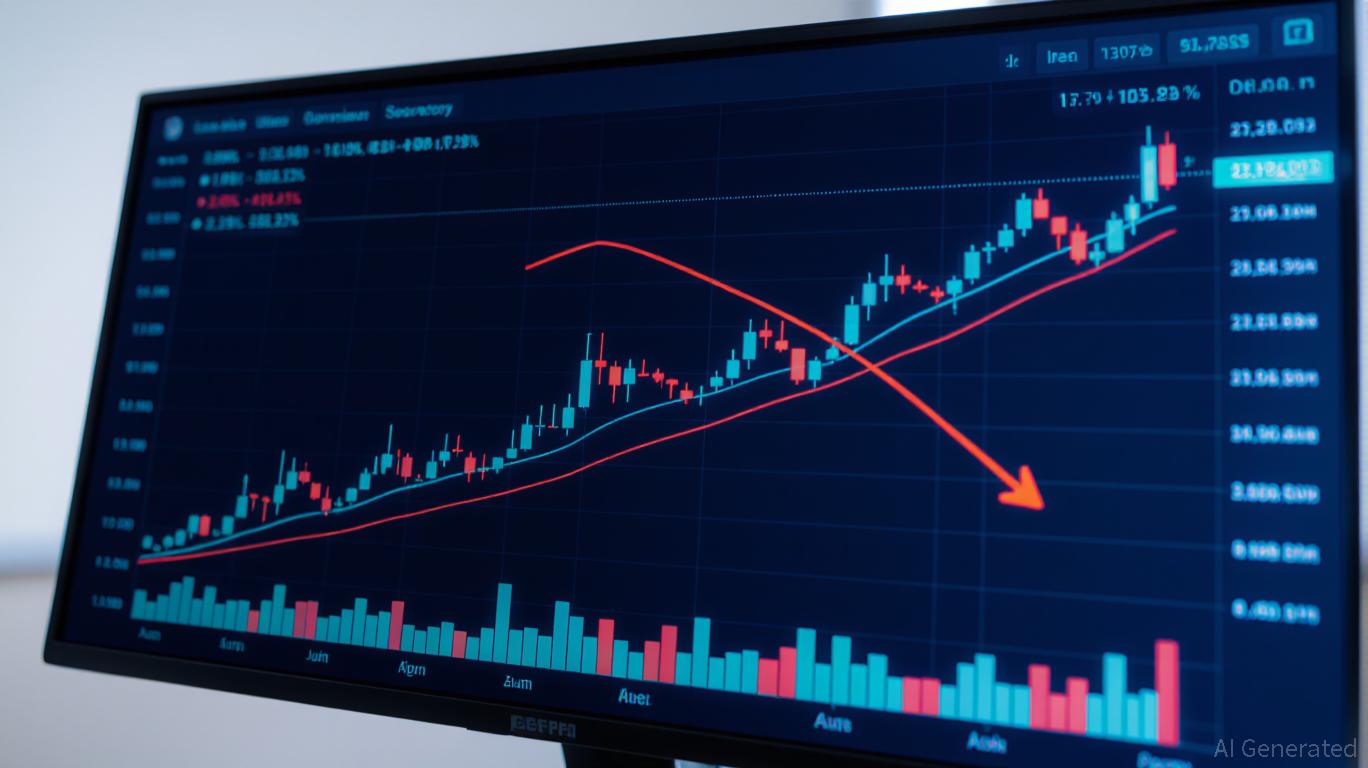
(text2img)
The recent 24-hour rise in YFI’s price did not coincide with any notable on-chain developments or significant shifts in the broader market. Rather, it seems to reflect a typical short-term rebound after a week of losses. Observers pointed out that the move lacked a clear trigger, suggesting that liquidity dynamics and algorithmic trading may have had a greater influence than changes in macro sentiment. The lack of new governance initiatives or major protocol changes further supports this view.
The nearly 40% decline over the past year highlights a broader reassessment of DeFi tokens, especially those associated with automated strategies and complex yield products. While Yearn Finance continues to be a significant player, YFI’s price trend reflects a sector-wide adjustment, with many high-utility tokens trading well below their highs from 2021 and 2022. Analysts expect this pattern to persist until there is renewed institutional interest or notable product breakthroughs.
(text2visual)
Technical analysis tools are currently being adjusted to better match the changing price landscape. The 7-day moving average remains above the 20-day average, indicating a possible short-term downward trend. However, the RSI has entered oversold levels, which could point to stabilization or a minor rebound in the near future. Market participants are watching trading volumes closely to assess whether the recent decline is approaching a bottom.
Backtest Hypothesis
To gain deeper insight into how a strategy based on YFI’s price might perform, a backtesting method has been suggested, though it has not yet been implemented due to limitations in data availability. The main challenge is determining the correct ticker and data provider. Verifying whether to use “YFI-USD”, “YFI-USDT”, or another format is crucial for retrieving accurate historical data.
It is also vital to clarify the event criteria. For example, a “10% drop” could mean either a daily close-to-close decrease or an intraday high-to-low move. This distinction affects how often signals are generated, which in turn influences trading frequency and risk. The proposed backtest period runs from January 1, 2022, to October 24, 2025, covering several market cycles for the token.
(backtest_stock_component)
Disclaimer: The content of this article solely reflects the author's opinion and does not represent the platform in any capacity. This article is not intended to serve as a reference for making investment decisions.
You may also like
SOL Price Forecast and Solana's Market Strength in Late 2025: A Two-Factor Assessment
- Solana (SOL) faces pivotal 2025 juncture with Fed easing and blockchain upgrades driving price resilience. - Fed rate cuts and $421M institutional inflows via ETFs (e.g., REX-Osprey) boost crypto adoption amid low yields. - Firedancer/Alpenglow upgrades cut validator costs by 80%, enabling 100-150ms finality and $10.2B DeFi TVL growth. - $133 support level and bullish TD Sequential signals suggest $150-$165 target by year-end despite inflation risks.

The Federal Reserve's Change in Policy and Its Effects on Rapidly Growing Cryptocurrencies Such as Solana
- Fed's 2025 rate cut and QT halt injected $72.35B liquidity, briefly boosting crypto markets and Solana (+3.01%) amid easing monetary policy. - Prolonged US government shutdown and $19B October liquidation event exposed crypto's liquidity risks, despite Fed support for speculative assets. - Solana saw $3.65B trading volume but 6.1% price drop in November, with TVL falling 4.7% as regulatory pressures and macro volatility offset institutional inflows. - SIMD-0411 proposal aims to reduce Solana issuance by
LUNA Rises 42.62% Over the Past Week Amid Ongoing Legal Developments in the Terra Ecosystem
- Terra's LUNA token surged 42.62% in 7 days amid ongoing legal proceedings against co-founder Do Kwon. - Prosecutors seek 12-year prison sentence for Kwon over 2022 Terra collapse, which triggered $40B market losses. - LUNA Classic and LUNC rose 70-130% as investors view legal drama as catalyst for renewed Terra ecosystem interest. - Kwon's guilty plea and sentencing hearing on Dec 11 could shape market sentiment, though pardon odds remain at 2%. - "Bankruptcy concept coins" like USTC and FTT also surged,
Bitcoin’s Latest Price Swings and Institutional Outlook: Managing Uncertainty in an Evolving Cryptocurrency Environment
- Bitcoin's 40% November 2025 price drop highlights volatility challenges despite growing institutional adoption and regulatory clarity. - 55% of hedge funds now hold Bitcoin as strategic inflation hedge, driven by ETF approvals and $3 trillion institutional asset unlocking. - Macroeconomic correlations (S&P 500 at 0.48) and Fed policy shifts demonstrate Bitcoin's evolving role as macroeconomic barometer. - 72% of institutions adopted advanced risk frameworks in 2025, emphasizing AI monitoring and regulato
Trending news
MoreCrypto prices
More





