
Bitcoin Updates: The Fate of Bitcoin Uncertain Amid $7.4 Trillion Fed Liquidity and Global Political Instability
- Fed rate cuts could unlock $7.4T in liquidity, pushing funds into Bitcoin and equities by 2026 as short-term yields decline. - U.S.-China trade tensions triggered 19.56% Bitcoin drop in October, though diplomatic talks briefly stabilized prices above $111,000. - BlackRock's IBIT attracted $3.5B inflows this month, reflecting institutional crypto adoption despite $40M+ ETF outflows during volatility. - AI trading platforms like CoinTech2u earned $1.3M during October's crash, highlighting automation's role
Anticipated interest rate reductions by the U.S. Federal Reserve may release as much as $7.4 trillion from money market funds, potentially driving significant inflows into riskier assets such as
Yet, current market conditions paint a different picture. Both Bitcoin (BTC) and
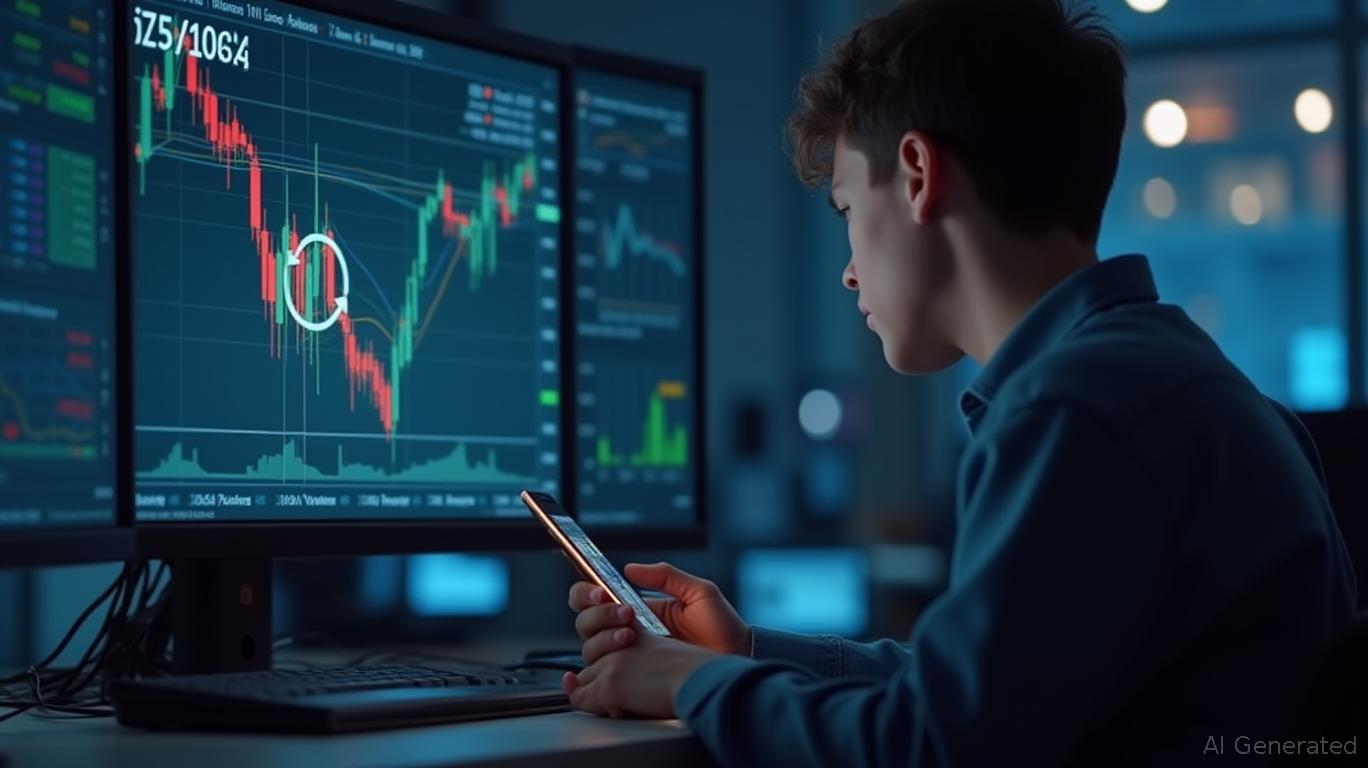
Market volatility has intensified due to rising trade tensions between the U.S. and China. The announcement of a potential 100% tariff increase on Chinese goods led to a 19.56% plunge in Bitcoin on October 11, erasing $19 billion in leveraged trades in a single day. Although a temporary agreement was reached, ongoing threats of further trade barriers and rare earth export controls have kept investors wary. Optimism briefly returned after U.S. President Donald Trump revealed plans for a meeting with Chinese President Xi Jinping, which helped Bitcoin recover to $111,000 by October 21. Still, analysts warn in a
During this period of turbulence, AI-powered trading platforms such as CoinTech2u have taken advantage of the volatility, earning $1.3 million in profits during the October downturn. The company’s adaptive algorithms responded to the “black swan” event by swiftly modifying trading strategies, highlighting the increasing importance of automation in volatile markets, according to a
The Federal Reserve’s expected rate cut on October 29, likely lowering the benchmark by 25 basis points, could further split the market. While long-term investors see this as a positive for Bitcoin, possibly driving prices toward $200,000, short-term instability remains a concern. “The market has already factored in the cut, but the actual announcement could prompt a ‘sell the news’ reaction,” said Geoff Kendrick of Standard Chartered, as cited in a
With trade talks and Federal Reserve decisions still in the spotlight, the future direction of Bitcoin and equities will depend on how macroeconomic uncertainties are resolved. As $7.39 trillion in money market funds stand ready for redeployment, the next few months could reshape the risk asset landscape, though significant geopolitical and regulatory challenges persist.
Disclaimer: The content of this article solely reflects the author's opinion and does not represent the platform in any capacity. This article is not intended to serve as a reference for making investment decisions.
You may also like
Crypto Market Faces New Frontier of Abuse, Solidus Labs Warns
Solana's Latest Steep Drop: An In-Depth Analysis of Security Flaws and Governance Challenges Facing Fast Smart Contract Networks
- Solana's SOL token plummeted below $165 in late 2025 amid heightened bearish sentiment and systemic risks. - Network vulnerabilities including a $36M Upbit hack, 68% validator node decline, and cryptographic flaws eroded investor confidence. - Governance dysfunction marked by stalled DAOs, delayed security patches, and inactive protocols (75% of 264) hindered crisis response. - Market fundamentals weakened with 20% TVL drop, 16% fee decline, and ETF outflows despite temporary DEX volume spikes. - Institu

Short the dip and buy the rip? What FOMC outcomes reveal about Bitcoin price action

Bitcoin Leverage Liquidation: Does It Pose a Systemic Threat to Retail Crypto Investors?
- October 2025's Bitcoin crash triggered $19B in leveraged liquidations, exposing crypto derivatives' fragility amid extreme retail leverage and thin liquidity. - High leverage (up to 1,001:1) and perpetual futures dominated by platforms like Hyperliquid amplified volatility, creating self-reinforcing downward spirals. - Behavioral biases (FOMO, overconfidence) and social media echo chambers drove irrational leveraged bets, while regulators paused risky ETFs and warned of systemic risks. - The crisis highl

Trending news
MoreCrypto prices
More





