
Ethereum Struggles Below $3,000 as Long-Term Holders Cash Out

Ethereum is struggling to reclaim momentum after a sharp 6% drop in the last 24 hours pushed the altcoin king back from the critical $3,000 barrier. The level has acted as both psychological and technical resistance, and the latest rejection comes at a time when some of Ethereum’s most influential holders are pulling back. Ethereum
Ethereum is struggling to reclaim momentum after a sharp 6% drop in the last 24 hours pushed the altcoin king back from the critical $3,000 barrier.
The level has acted as both psychological and technical resistance, and the latest rejection comes at a time when some of Ethereum’s most influential holders are pulling back.
Ethereum Holders’ Supply Drops
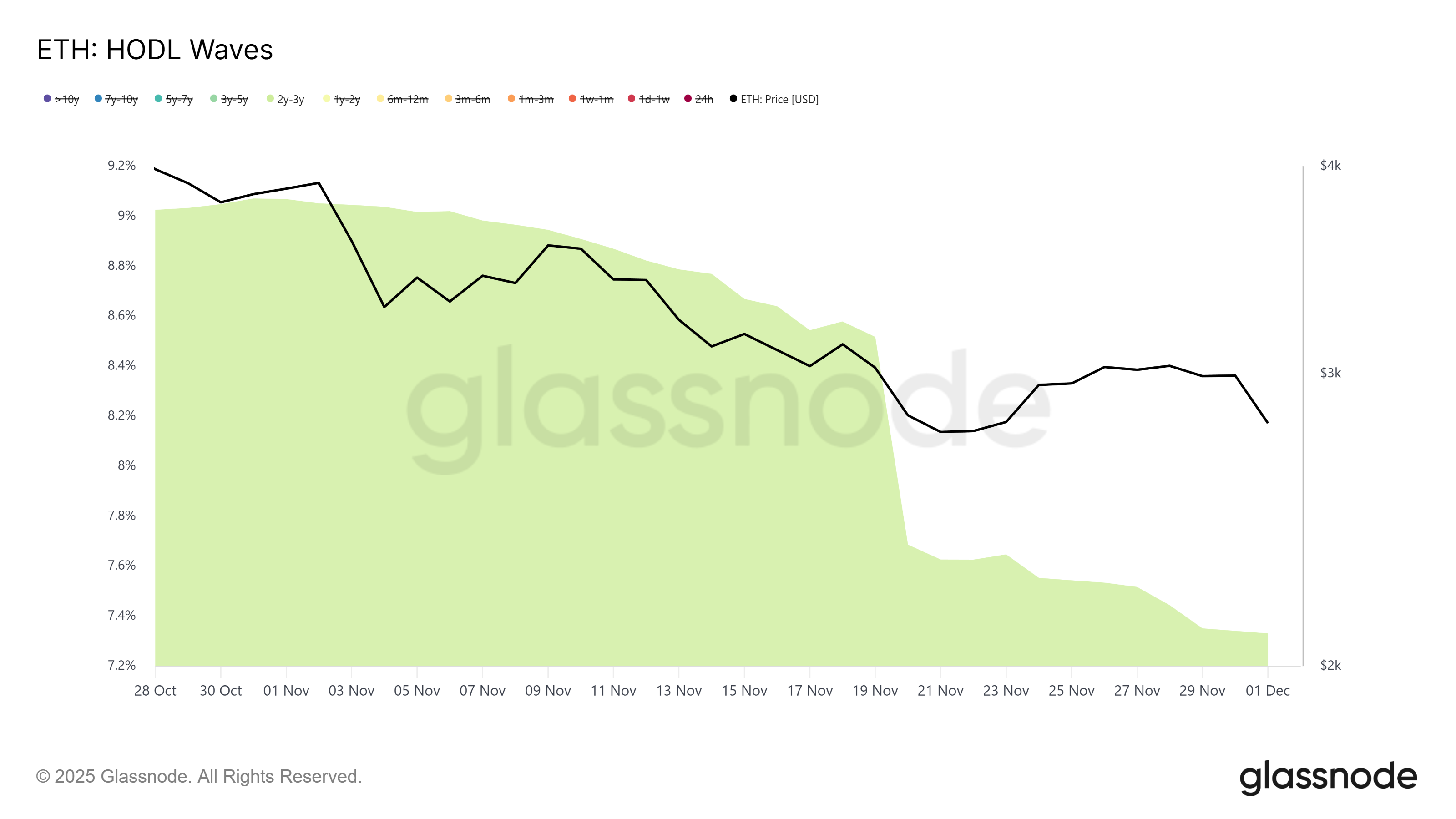
HODL Waves data shows that Ethereum’s long-term holders (LTHs) have been offloading their assets since early November. This selling pressure intensified around November 19, leading to a meaningful reduction in the supply controlled by the 2-to-3-year cohort. Their share of the circulating supply dropped from 8.51% to 7.33%, a clear sign that this group moved to offset losses and reduce risk exposure.
Given that LTHs tend to be the most stable participants in the Ethereum ecosystem, their selling has had a direct impact on price performance. More importantly, their positions have not recovered since the sell-off, creating a supply gap that new investors will need to fill if ETH is to regain upward momentum.
Want more token insights like this? Sign up for Editor Harsh Notariya’s Daily Crypto Newsletter
 Ethereum HODL Waves. Source:
Glassnode
Ethereum HODL Waves. Source:
Glassnode
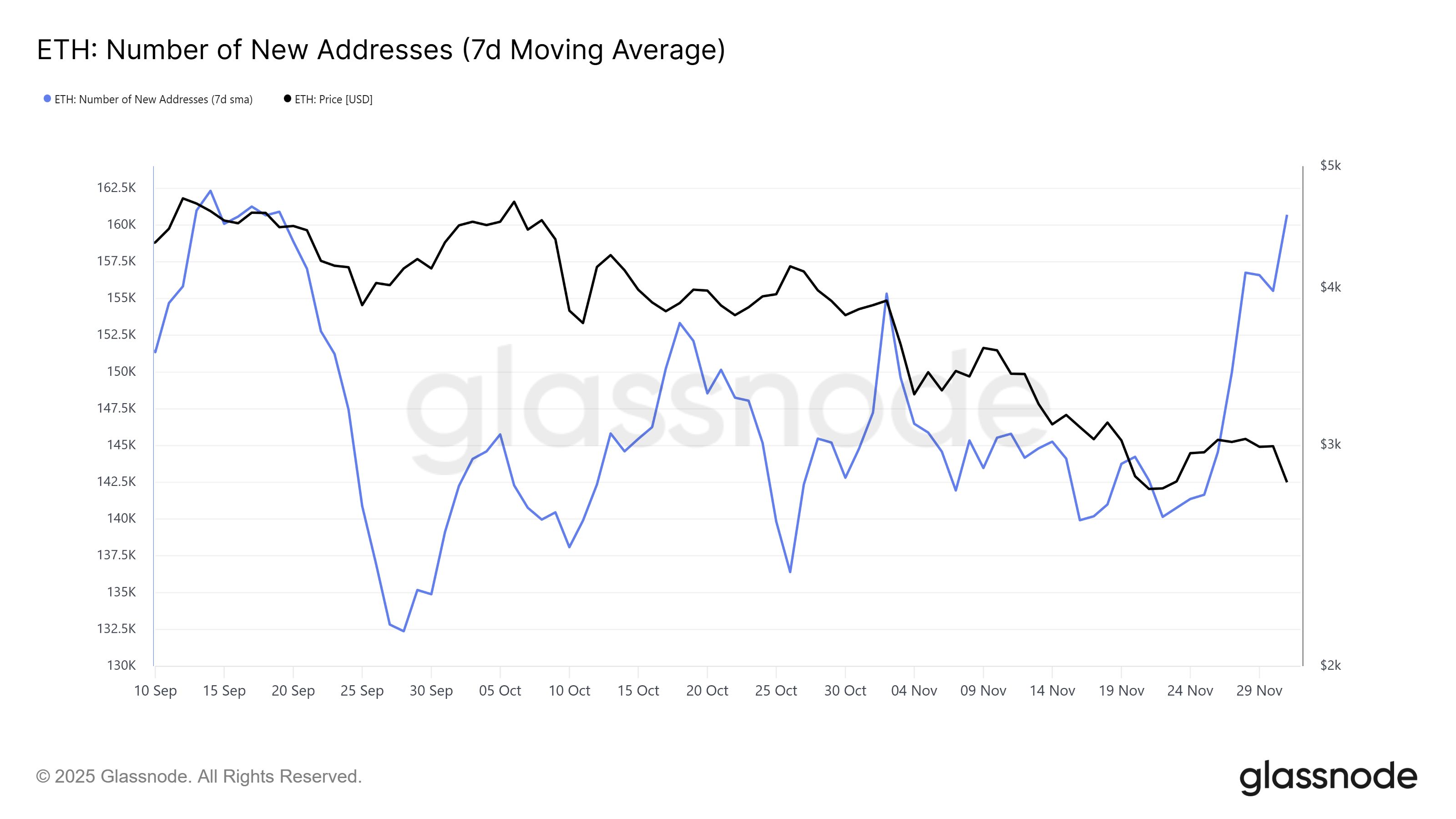
Fortunately, Ethereum is seeing encouraging signs of new demand. Over the past seven days, new addresses on the network have surged 13.4%, rising from 141,650 to 160,690. This marks the strongest weekly jump in more than two and a half months and signals fresh investor interest despite the recent correction.
New addresses often translate into new capital flowing into the market, which is critical for Ethereum as it attempts to stabilize above key support levels. However, sustaining this growth is essential. If the influx of new holders slows, the market may not be able to compensate for the missing LTH participation.
 Ethereum New Addresses. Source:
Glassnode
Ethereum New Addresses. Source:
Glassnode
ETH Price Is Yet To Find A Direction
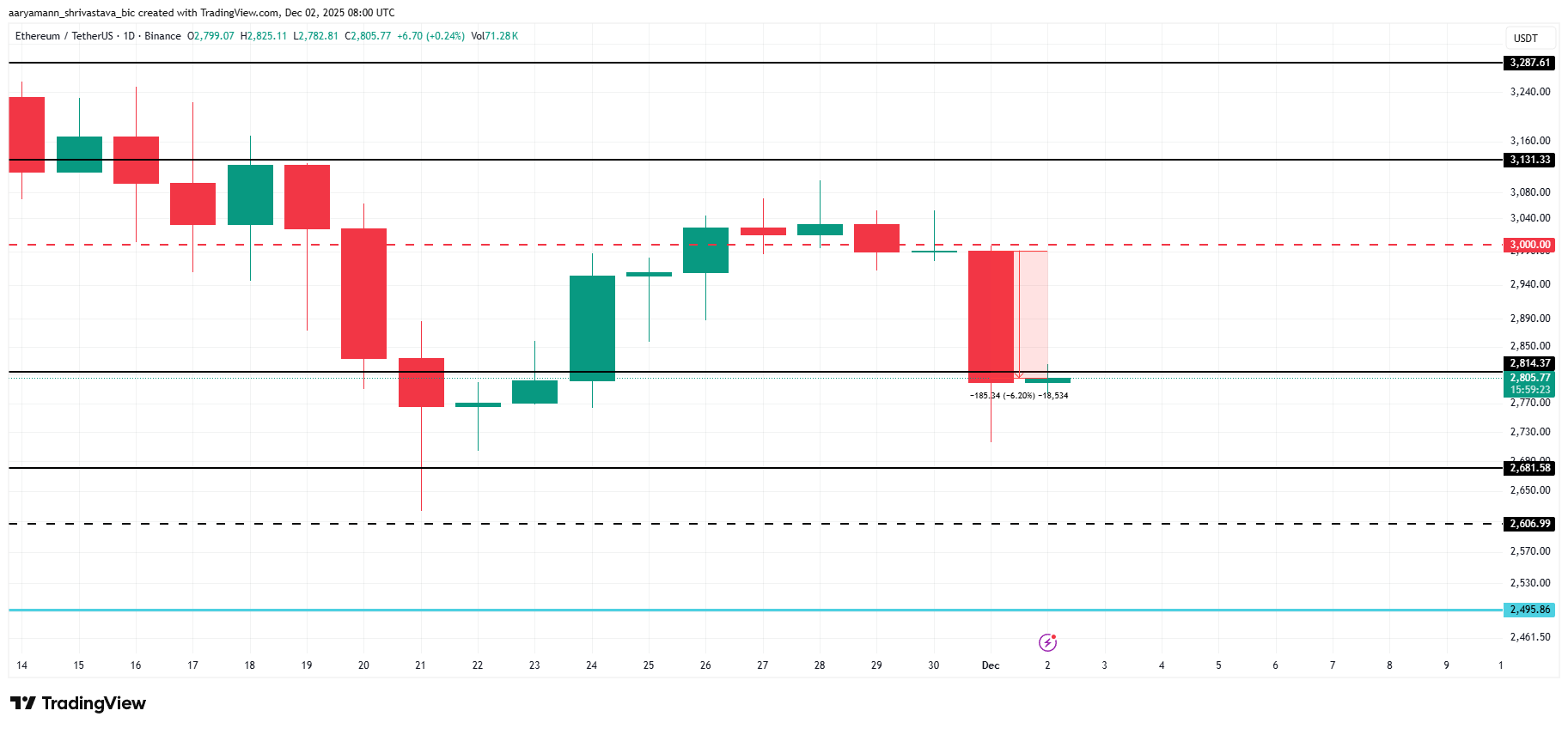
Ethereum is trading at $2,805 at the time of writing, reflecting a 6% daily decline. The asset is sitting just below the $2,814 resistance level after its latest failed attempt to break through $3,000.
Based on current sentiment and market structure, ETH could stabilize and attempt a rebound, but a strong recovery will require consistent investor support. In the near term, Ethereum will likely fluctuate between $2,814 and $3,000 as it searches for direction.
 ETH Price Analysis. Source:
TradingView
ETH Price Analysis. Source:
TradingView
If bullish momentum strengthens and fresh demand remains steady, Ethereum could finally break above the $3,000 barrier. A successful breach would pave the way for a move toward $3,131 and potentially $3,287. This would invalidating the short-term bearish thesis.
Disclaimer: The content of this article solely reflects the author's opinion and does not represent the platform in any capacity. This article is not intended to serve as a reference for making investment decisions.
You may also like
How CFTC-Recognized Platforms Such as CleanTrade Are Transforming the Landscape of Clean Energy Investments
- CFTC-approved CleanTrade introduces a regulated SEF for clean energy derivatives, addressing market fragmentation and liquidity gaps. - The platform enables institutional-scale trading of vPPAs/RECs, achieving $16B notional volume in two months by aggregating demand/supply. - Integrated risk analytics (e.g., CleanSight) enhance transparency, allowing investors to hedge project-specific risks like grid congestion and curtailment. - Dual investment pathways attract hedge funds/pension funds through direct

The Rise of CFTC-Regulated Clean Energy Markets: Opening a New Chapter for Institutional Investors
- CFTC's 2025 approval of REsurety's CleanTrade as a SEF marks a landmark shift in clean energy markets by introducing standardized, transparent trading for VPPAs and RECs. - The platform attracted $16B in notional value within two months, enabling rapid institutional-grade transactions that previously took months to negotiate. - By addressing liquidity gaps and enabling precise risk modeling, CleanTrade is accelerating capital flows into decarbonization while bridging ESG investment gaps for institutional

The Increasing Overlap Between Health and Financial Wellbeing in Managing Personal Finances
- Global wellness economy to hit $9 trillion by 2028, driven by holistic well-being trends. - Millennials/Gen Z prioritize wellness as lifestyle, with 55% spending over $100/month on health. - Employers integrate financial wellness into health programs to reduce burnout and boost productivity. - Investors target wellness-driven SaaS, healthcare tech , and financial literacy platforms for holistic solutions.

Revealing the Value of Green Gold: The Transformative Impact of Institutional-Grade Platforms on Clean Energy Markets
- Clean energy markets hit $35.42B in 2025 but face VPPA/PPA liquidity gaps as U.S. policy rollbacks raise costs by 11.8% YoY. - REsurety's CleanTrade platform digitizes PPA trading, unlocking $16B in liquidity via CFTC-approved SEF infrastructure within two months. - Strategic S&P Global partnership standardizes PPA/REC valuations, addressing institutional investors' risk management gaps in green energy markets. - While global PPA markets grow at 14.6% CAGR to $9.5B by 2035, U.S. policy uncertainty remain

Trending news
MoreCrypto prices
More





