
Ethena’s synthetic USDe contracts sharply as dollar-backed stablecoins expand

Ethena’s synthetic-dollar stablecoin USDe saw one of its sharpest monthly contractions yet, while fiat-backed stablecoins including USDT, USDC and PYUSD attracted billions in inflows.
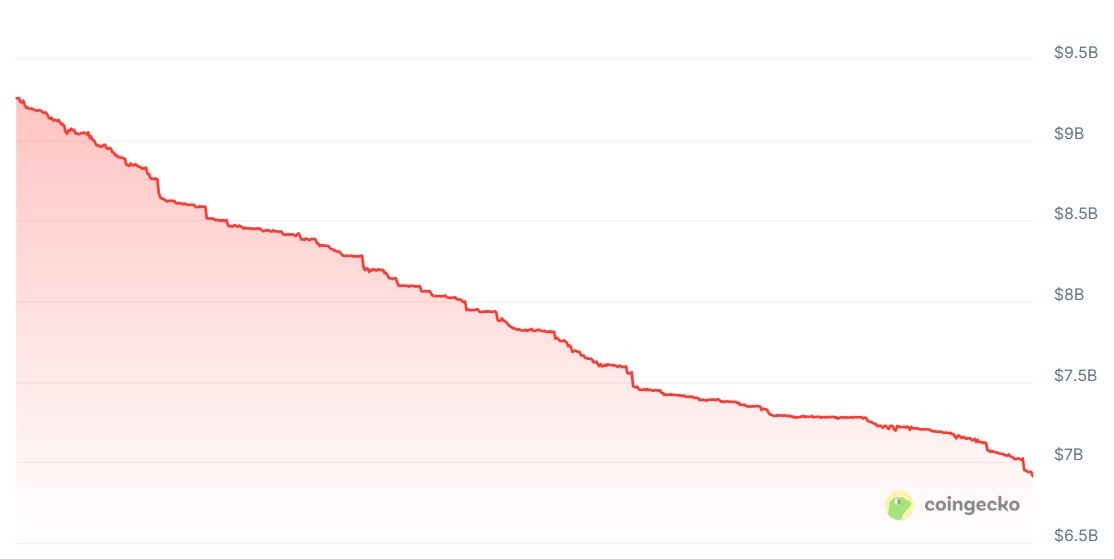
CoinGecko data showed that Ethena’s USDe stablecoin fell from a market capitalization of $9.3 billion on Nov. 1 to $7.1 billion on Nov. 30. The token saw about $2.2 billion in redemptions, marking a 24% decline in supply in November.
Ethena’s USDe is a synthetic stablecoin that maintains its dollar peg through trading strategies with crypto and futures contracts rather than holding actual dollars. USDe outflows mean that users are either selling USDe on the open market, withdrawing from pools or unwinding their positions on decentralized applications (DApps).
At the time of writing, CoinGecko data shows that the overall stablecoin market cap is at $311 billion. The market remains dominated by US dollar stablecoins, capturing $303 billion of the sector’s total valuation.
USDe outflows follow October depeg
USDe’s November contraction comes weeks after the synthetic stablecoin suffered a depegging event on the crypto exchange Binance. At the time, USDe briefly plunged to $0.65 on the exchange.
Ethena founder Guy Young said that the drop was caused by a Binance-specific oracle issue and not a problem with USDe’s underlying collateral mechanism that backs the asset.
Young said that the USDe token’s minting and redemption functions operated “perfectly” during the incident, with about 2 billion tokens redeemed across decentralized finance (DeFi) platforms.
On Oct. 9, USDe market cap hovered at $14.8 billion, making it the third-largest stablecoin at the time. Since then, it has lost over 53% of its market capitalization.
At the time of writing, CoinGecko data shows that USDe has a total valuation of $6.9 billion, dropping it to the fourth spot in the stablecoin market cap rankings.
Related: Lawmakers stumble on stablecoin terms as US Congress grills Fed’s Bowman
Fiat-backed stablecoins increased by $3.2 billion in November
While the synthetic-dollar stablecoin struggled during the month, fiat-backed stablecoins recorded modest but steady gains over the same time period.
Tether’s USDt (USDT) saw a $1.3 billion increase to $184.6 billion, while Circle’s USDC (USDC) climbed to $76.5 billion, adding roughly $600 million to its supply.
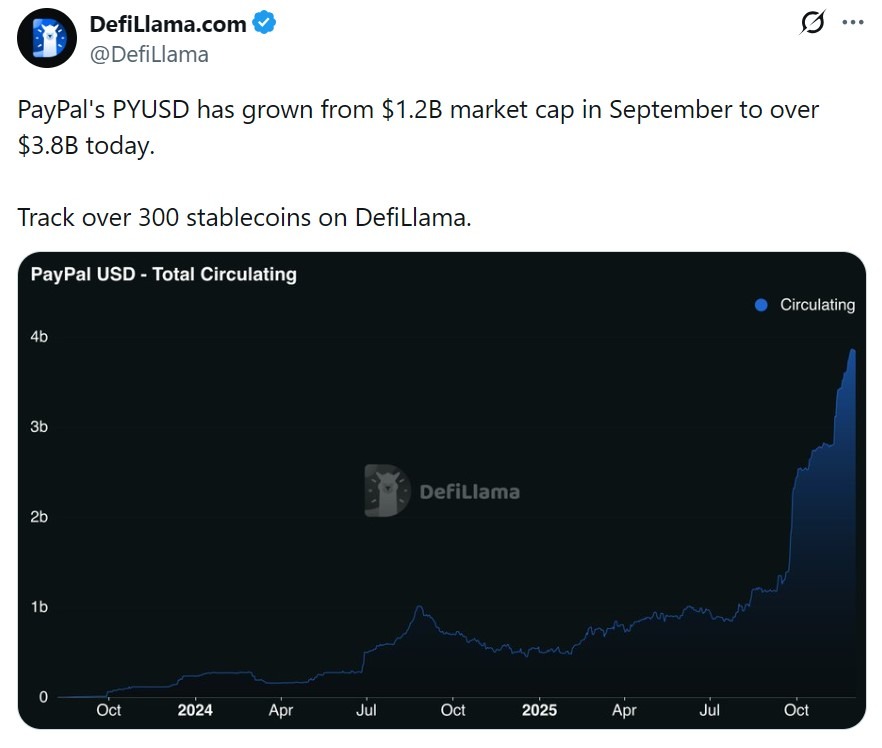
PayPal USD (PYUSD) posted the strongest growth among the major dollar-pegged stablecoins, jumping from $2.8 billion to $3.8 billion in November. This marks 1 billion inflow for the month, a 35% month-on-month growth.
DefiLlama data showed that the PayPal PYUSD stablecoin expanded by over 216% since September, when it had a market cap of $1.2 billion. This represents a $2.6 billion increase in just three months.
Ripple’s (RLUSD) stablecoin, which breached a market capitalization of $1 billion for the first time in November, continued its growth throughout the month.
According to CoinGecko, RLUSD went from a $960 million market cap on Nov. 1 to a market cap of $1.26 billion on Nov. 30, marking a $300 million increase.
Magazine: China officially hates stablecoins, DBS trades Bitcoin options: Asia Express
Disclaimer: The content of this article solely reflects the author's opinion and does not represent the platform in any capacity. This article is not intended to serve as a reference for making investment decisions.
You may also like
Zcash Halving and Its Potential Impact on Cryptocurrency Market Fluctuations
- Zcash's 2025 halving cut block rewards by 50%, tightening annual inflation to 2%, sparking debates on supply reduction's impact on investor sentiment and institutional adoption. - ZEC surged 1,172% post-halving but faced extreme volatility ($736 to $25.96 in 16 days), driven by speculative trading and liquidity constraints in its $10.3B market cap. - Institutional adoption accelerated with Grayscale's $151.6M investment and Zcash ETF filing, while EU's MiCA regulations challenge privacy coins but Zcash's

ICP Price Jumps 30%: Exploring the Driving Forces and Long-Term Investment Outlook
- ICP token surged 30% in Nov 2025 to $4.71, driven by ICP 2.0 upgrades and institutional partnerships with Microsoft , Google, and SWIFT. - Price retreated to $3.50 by Dec 2025 amid waning AI hype, macroeconomic pressures, and speculative trading volatility. - NVT ratio and DCF analyses highlight valuation challenges, with optimistic 2026 price projections ($11.15–$31.89) contingent on real-world adoption and institutional traction. - Market dynamics reveal a duality: innovative infrastructure potential v

AI and Financial Stability in 2025: The Role of ICP Caffeine AI in Transforming Risk Management Amid Market Uncertainty
- ICP Caffeine AI, DFINITY's blockchain-AI platform, reduces AI inference costs by 20-40% while enabling real-time financial risk analysis through hybrid cloud-decentralized infrastructure. - AI-driven risk tools outperform traditional VaR models by 10% in predictive accuracy, achieving 60% efficiency gains for institutions through real-time data processing and regulatory integration. - Despite $237B TVL and 56% ICP price growth, the platform faces challenges including 22.4% dApp activity decline, token vo

Why is Internet Computer (ICP) Experiencing Rapid Growth in Late 2025: An In-Depth Examination of Blockchain Expansion and the Evolution of Decentralized Web Systems
- Internet Computer Protocol (ICP) surges in late 2025 due to protocol upgrades, institutional adoption, and alignment with AI-driven finance trends. - Chain Fusion enables cross-chain interoperability with Bitcoin/Ethereum, while Caffeine AI democratizes dApp development via natural language prompts. - Institutional adoption grows with 2,000+ new developers, $1.14B TVL, and zero-fee transactions attracting financial institutions seeking cost-efficient solutions. - ICP's hybrid cloud/Web3 model addresses e

Trending news
MoreCrypto prices
More





