
What Actually Changed with the Ethereum Fusaka Upgrade

Ethereum has activated Fusaka, an upgrade that expands network capacity, reduces rollup costs, and improves long-term scalability. Here’s what changed, why it matters, and what ETH holders should expect next.
Ethereum just completed the Fusaka upgrade, a hard fork designed to prepare the network for larger scale and cheaper use. While technical on paper, the change touches the core functions of Ethereum — how data is stored, how transactions fit into blocks, and how Rollups like Arbitrum, Base, and Optimism interact with the main chain.
For anyone holding ETH, this upgrade forms the groundwork for lower fees, better network efficiency, and a more resilient long-term ecosystem.
A Larger Network With More Room to Breathe
The biggest change arrived in how Ethereum handles data.
Every transaction, NFT mint, DeFi swap, or Layer-2 batch needs block space, and until now, that space was limited. Fusaka increases Ethereum’s capacity so blocks can carry more information at once.
Missed the Fusaka network upgrade?13 Ethereum Improvement Proposals (EIPs) are now live on Mainnet.Here’s Fusaka in 35 seconds. pic.twitter.com/DlUh1ATA55
— Ethereum (@ethereum) December 4, 2025
This does not make the chain instantly faster, but it removes pressure when demand spikes, such as during market volatility or popular token launches.
In simple terms, Ethereum can absorb more activity without struggling.
Cheaper Rollups Through Expanded Blob Capacity
A large portion of today’s Ethereum traffic comes from Rollups. These networks batch thousands of user transactions and settle them on Ethereum as compressed data called “blobs.”
Before Fusaka, blob space was constrained. When demand surged, fees climbed. Fusaka expands the room available for blob submissions and introduces a flexible system for raising or lowering capacity without a full upgrade.
As rollups scale into this new space, users should experience lower transaction costs and smoother application activity.
The end goal is simple: more transactions, less friction.
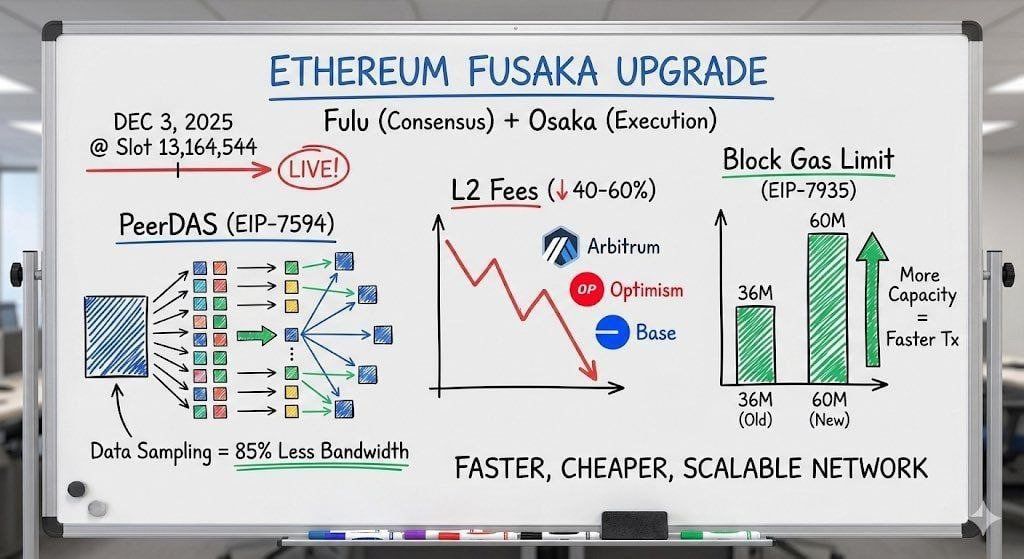 Ethereum Fusaka Upgrade Explained. Source:
X/Bull Theory
Ethereum Fusaka Upgrade Explained. Source:
X/Bull Theory
PeerDAS: A Simpler Way to Verify Data
Another major improvement is how Ethereum nodes verify data. Previously, nodes had to download large sections of block data to confirm that nothing was missing or hidden.
Fusaka introduces PeerDAS, a system that checks small, random pieces of data rather than the entire load.
It works like inspecting a warehouse by opening a few random boxes instead of checking every single one.
PeerDAS in Fusaka is significant because it literally is sharding.Ethereum is coming to consensus on blocks without requiring any single node to see more than a tiny fraction of the data. And this is robust to 51% attacks – it's client-side probabilistic verification, not… pic.twitter.com/OK81xBteER
— vitalik.eth (@VitalikButerin) December 3, 2025
This reduces bandwidth and storage requirements for validators and node operators, making it easier — and cheaper — for more people to run infrastructure.
A wider validator base strengthens decentralization, which ultimately strengthens Ethereum’s security and resilience.
Higher Block Capacity Means More Throughput
Alongside scaling capacity, Fusaka also raises the block gas limit. A higher limit means more work can fit inside each block, allowing more transactions and smart-contract calls to settle without delay.
It doesn’t increase block speed, but it increases throughput. DeFi activity, NFT auctions, and high-frequency trading will have more room to breathe in peak hours.
Better Wallet Support and Future UX Improvements
Fusaka also includes improvements to Ethereum’s cryptography and virtual machine. The upgrade adds support for P-256 signatures, which are used in modern authentication systems, including those behind password-less login on smartphones and biometric devices.
This opens a path for future wallets that act more like Apple Pay or Google Passkeys rather than seed-phrase-based apps. Over time, this could make Ethereum access simpler for mainstream users.
Ethereum is about to 10x the wallet UX.The Fusaka upgrade includes EIP-7951 – support for the signature scheme that the iPhones use to power things like Face ID.Meaning you'll soon be able to sign transactions with your face.Huge win for bringing normal people on-chain. pic.twitter.com/7Ad38m4Oxz
— Jarrod Watts (@jarrodwatts) November 27, 2025
What Fusaka Means for ETH Holders
The impact for ETH holders is gradual but meaningful. Fees on Layer-2 networks should ease as data capacity expands. Network congestion should become less common. More validators can participate due to lower hardware demands.
Most importantly, Ethereum now has room to grow without sacrificing security or decentralization. If adoption increases, settlement volume grows with it — and so does ETH’s role as the asset that powers, secures, and settles everything on top.
$ETH is still consolidating around the $3,000 level.Not much price action due to weekends, but next week could be interesting.QT is ending on December 1st, Powell's speech is on December 1st, and the Fusaka upgrade is coming on December 3rd.If Ethereum holds above the… pic.twitter.com/pxgmrOHyah
— Ted (@TedPillows) November 30, 2025
A Foundational Upgrade, Not a Flashy One
Fusaka does not rewrite Ethereum’s economics or make ETH suddenly deflationary, but it strengthens the foundation that future demand depends on. Cheaper rollup fees invite usage.
A more scalable base layer invites developers. A more accessible node environment invites participation. These are structural upgrades, the kind that do little in a day but transform the network over time.
Ethereum widened the highway, improved the toll system, and made it easier for new drivers to join. That is the real meaning of Fusaka — a quiet shift with long-term weight.
As Layer-2 networks expand and applications multiply, the effects should move from technical discussion into user experience, transaction cost, and ultimately, ETH value itself.
Disclaimer: The content of this article solely reflects the author's opinion and does not represent the platform in any capacity. This article is not intended to serve as a reference for making investment decisions.
You may also like
The Growing Impact of Artificial Intelligence on Learning and Professional Development
- Global AI in education market to grow from $7.57B in 2025 to $32.27B by 2030 (31.2% CAGR), driven by classroom AI adoption and workforce training. - Asia-Pacific leads growth (35.3% CAGR), with 60% U.S. teachers and 86% global students using AI for personalized learning and content summarization. - Institutions like Farmingdale State College pioneer AI integration through interdisciplinary programs and NSF-funded ethical AI research initiatives. - Strategic partnerships (e.g., IBM-Pearson) and platforms

The Influence of TWT’s Updated Tokenomics on the Dynamics of the Cryptocurrency Market
- TWT/TON's 2025 tokenomics shift from speculative governance to utility-driven ecosystem integration, embedding tokens in platform functions like Trust Premium. - Deflationary mechanisms (88.9B tokens burned) and cross-chain FlexGas systems create scarcity, mitigating oversupply risks while expanding transactional use cases. - Governance reforms prioritize community voting on fees and partnerships, but face challenges from regulatory uncertainty and Solana network dependencies. - Institutional adoption gr

Astar (ASTR) Price Spike: Unraveling the Reasons for Recent Market Fluctuations
- Astar (ASTR) price surged amid Tokenomics 3.0 reforms, institutional capital inflows, and strategic partnerships in November 2025. - Deflationary mechanisms like Burndrop and a $29.15M buyback program reduced circulating supply to 8.24B tokens. - Galaxy Digital's $3. 3M OTC purchase and Coinbase listing roadmap signaled institutional confidence in ASTR's long-term potential. - Partnerships with Sony , Toyota , and Japan Airlines expanded ASTR's real-world utility in logistics and digital identity sectors
The Increasing Importance of STEM Education as a Strategic Asset in a Technology-Focused World Economy
- U.S. STEM education is reshaping curricula and partnerships to meet AI, cybersecurity, and renewable energy demands, driven by $75M investments like Farmingdale State College's expanded Computer Sciences Center. - Public-private collaborations, including NSF AI Education Act and Google/IBM workforce pledges, are accelerating workforce readiness through AI research and micro-credential programs. - STEM-focused universities achieved 11.5% average endowment returns in 2025, but proposed excise taxes threate

Trending news
MoreCrypto prices
More





