
Civil war erupts within the Solana ecosystem: Jupiter and Kamino fall out, Foundation urges reconciliation

Stop arguing, or ethereum will take advantage!
Original Title: "The Two Lending Giants on Solana Fall Out, Foundation Steps In to Mediate"
Original Author: Azuma, Odaily
This past weekend, the two leading lending protocols on Solana, Jupiter Lend and Kamino, had a public falling out.
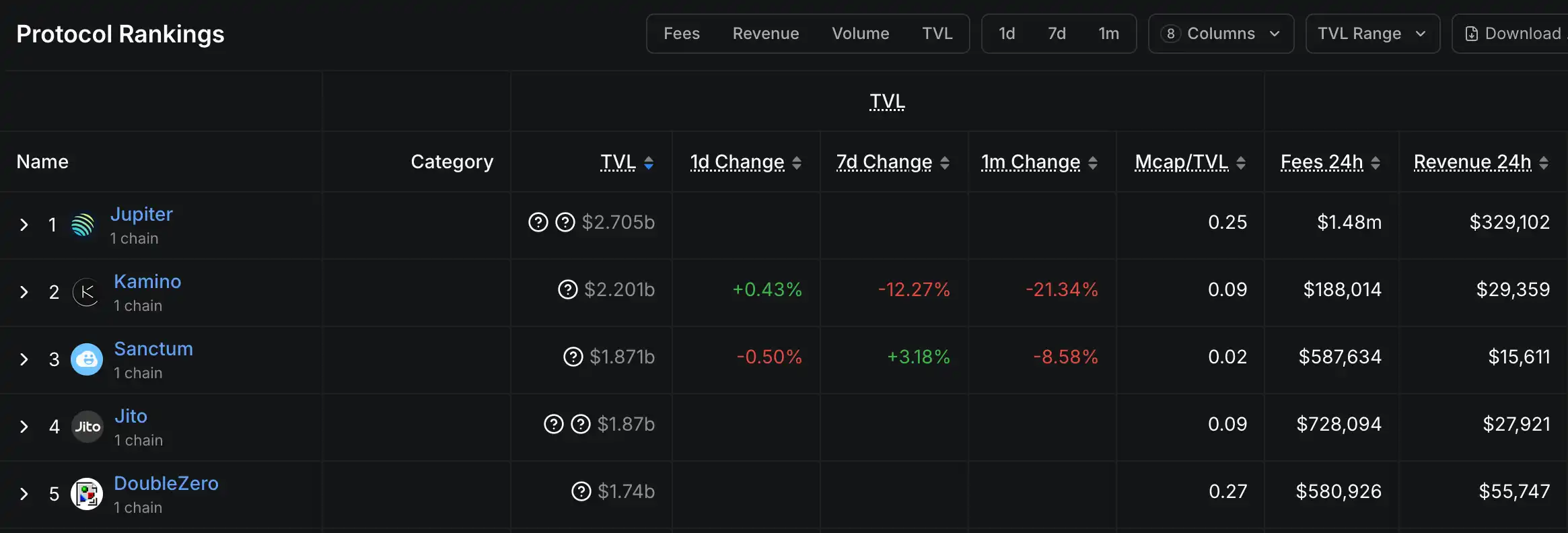
· Odaily note: According to Defillama data, Jupiter and Kamino are currently the top two protocols in the Solana ecosystem by TVL.
Origin of the Incident: The Tweet Jupiter Quietly Deleted
The incident traces back to August this year, when Jupiter was promoting its lending product Jupiter Lend before launch. At the time, Jupiter repeatedly emphasized that the lending product featured "risk isolation" (related posts have been deleted), meaning that risks would not cross-contaminate between different lending pools.
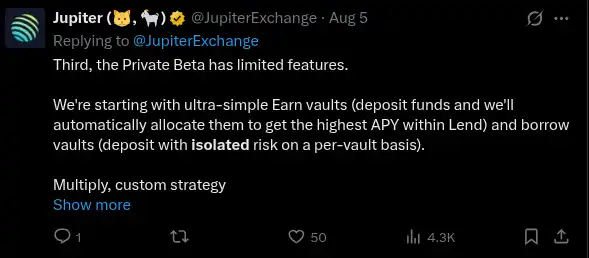
However, the actual design of Jupiter Lend does not conform to the commonly accepted model of risk isolation in the market. In general market perception, a DeFi lending pool that can be called risk-isolated is one that, through its design, segments the risks of different assets or markets, preventing a single asset default or market collapse from affecting the entire protocol. The main features of this structure include:
· Pool isolation: Different asset types (such as stablecoins, volatile assets, NFT collateral, etc.) are allocated to independent lending pools, each with its own liquidity, debt, and risk parameters.
· Collateral isolation: Users can only use assets within the same pool as collateral to borrow other assets, cutting off cross-pool risk transmission.
But in reality, Jupiter Lend's design supports rehypothecation (reusing deposited collateral elsewhere in the protocol to improve capital efficiency), which means that collateral deposited in the vaults is not completely isolated from each other. Jupiter co-founder Samyak Jain explained that Jupiter Lend's lending pools are "in a sense" isolated, as each pool has its own configuration, caps, liquidation thresholds, liquidation penalties, etc. The rehypothecation mechanism is simply to better optimize capital efficiency.
Although Jupiter's product documentation for Jupiter Lend provides a more detailed explanation than its promotional content, objectively speaking, the "risk isolation" mentioned in its early promotions does deviate from general market understanding and could be considered misleading.
The Battle Erupts: Kamino Launches an Attack
On December 6, Kamino co-founder Marius Ciubotariu seized the opportunity to criticize Jupiter Lend and blocked Kamino's migration tool to Jupiter Lend.
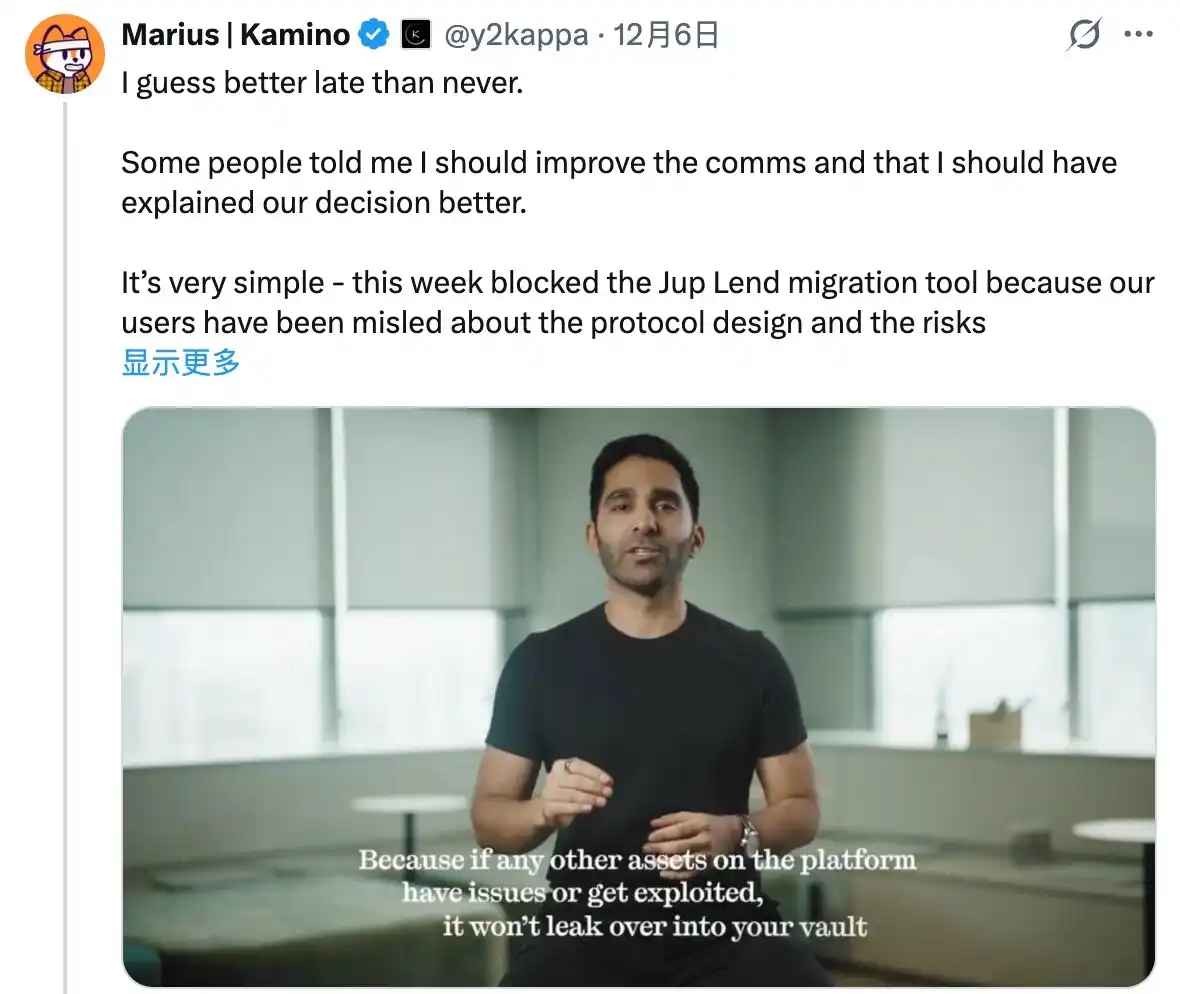
Marius stated: "Jupiter Lend repeatedly claims there is no cross-contamination between assets, which is utter nonsense. In reality, in Jupiter Lend, if you deposit SOL and borrow USDC, your SOL will be lent out to other users who are using JupSOL or INF for recursive lending, and you will bear all the risks of those recursive loans collapsing or assets blowing up. There are no isolation measures here; there is complete cross-contamination, which is contrary to the advertising and what people have been told... In both TradFi and DeFi, whether collateral is rehypothecated and whether there is contagion risk are important pieces of information that must be clearly disclosed, and no one should be allowed to give vague explanations about this."
After Kamino's attack, discussions about Jupiter Lend's product design quickly exploded in the community. Some agreed that Jupiter was guilty of false advertising—for example, Penis Ventures CEO 8bitpenis.sol angrily accused Jupiter of openly lying and deceiving users from the start; others believed Jupiter Lend's design model balanced safety and efficiency, and Kamino's attack was merely for market competition and not pure in motive—for example, overseas KOL letsgetonchain commented: "Jupiter Lend's design achieves the capital efficiency of a pooled model while also having some risk management capabilities of modular lending protocols... Kamino can't stop people from migrating to better technology."
Under heavy pressure, Jupiter quietly deleted its early posts, but this only triggered even greater FUD. Subsequently, Jupiter COO Kash Dhanda also admitted that the team's previous claims on social media about Jupiter Lend's "zero contagion risk" were inaccurate and apologized, saying they should have issued a correction statement when deleting the posts.
Core Dispute: The Definition of "Risk Isolation"
Summing up the current opposing views in the community, the fundamental disagreement seems to be about the different definitions of "risk isolation" among different groups.
From the perspective of Jupiter and its supporters, "risk isolation" is not a completely static concept and allows for some design flexibility. Although Jupiter Lend does not follow the conventional risk isolation model, it is not a completely open pooled model either. While sharing a general liquidity layer that allows rehypothecation, each lending pool can be configured independently, with its own asset caps, liquidation thresholds, and liquidation penalties.
From the perspective of Kamino and its supporters, any allowance for rehypothecation is a complete denial of "risk isolation", and project teams should not use vague disclosures or false advertising to deceive users.
Higher-Level Perspectives: Some Fuel the Fire, Some Mediate
Aside from the dispute between the two sides and the community, another point worth noting in this incident is the attitude of various higher-level stakeholders in the Solana ecosystem.
First is Multicoin, the most influential venture capital fund in the Solana ecosystem (seemingly without question). As an investor in Kamino, Multicoin partner Tushar Jain directly questioned Jupiter, saying "either stupid or malicious, but either way, it's unforgivable"—objectively, his comments greatly intensified the incident.
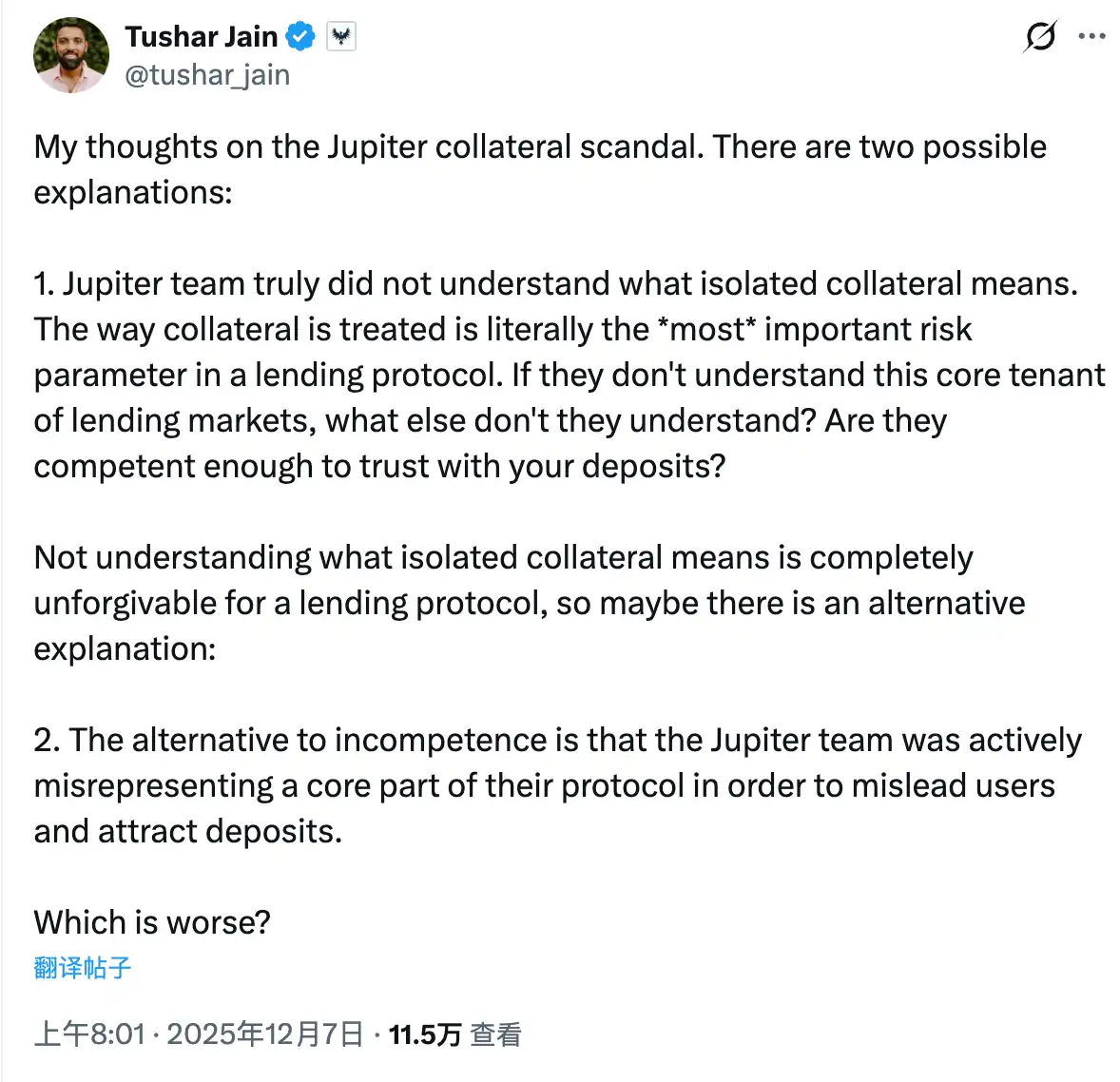
Tushar stated: "There are two possible explanations for the controversy around Jupiter Lend. One is that the Jupiter team truly does not understand the meaning of isolated collateral. The way collateral is handled is the most important risk parameter in a lending protocol. If they don't understand this core principle of lending markets, what else do they not understand? Can their professional competence be trusted with users' funds? For a lending protocol, not understanding the meaning of isolated collateral is completely unforgivable. The other possibility is that the Jupiter team is not incompetent, but is deliberately misrepresenting the core part of their protocol to mislead users and attract deposits."
Clearly, Tushar's motive is very clear: to seize this opportunity to help Kamino strike at its competitor as much as possible.
Another important higher-level comment came from the Solana Foundation. As the parent ecosystem, Solana obviously does not want to see its two leading projects become overly antagonistic, leading to internal strife in the ecosystem as a whole.
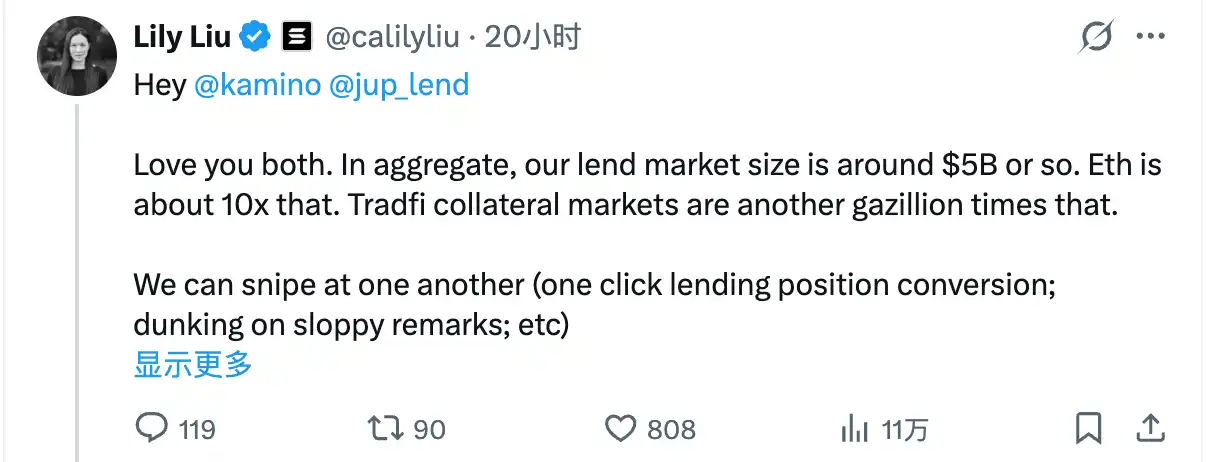
Yesterday afternoon, Solana Foundation President Lily Liu posted on X, calling on both projects to reconcile: "Love you all. Overall, our lending market size is currently about $5 billion, while Ethereum's ecosystem is about 10 times that. As for the collateral market in traditional finance, that's many times this number. We can choose to attack each other, or we can choose to look further ahead—first work together to capture a bigger share of the crypto market, then jointly advance into the vast world of traditional finance."
To summarize simply—Stop fighting, or Ethereum will benefit!
The Underlying Logic: The Battle for Lending Dominance on Solana
Looking at the data and market environment for Jupiter Lend and Kamino, although this incident erupted suddenly, it seems to have been an inevitable clash that was only a matter of time.
On one hand, Kamino (red line in the chart below) had long dominated as the leading lending protocol in the Solana ecosystem, but since Jupiter Lend (blue line below) launched, it has seized a large share of the market, becoming the only real challenger to Kamino within the Solana ecosystem.
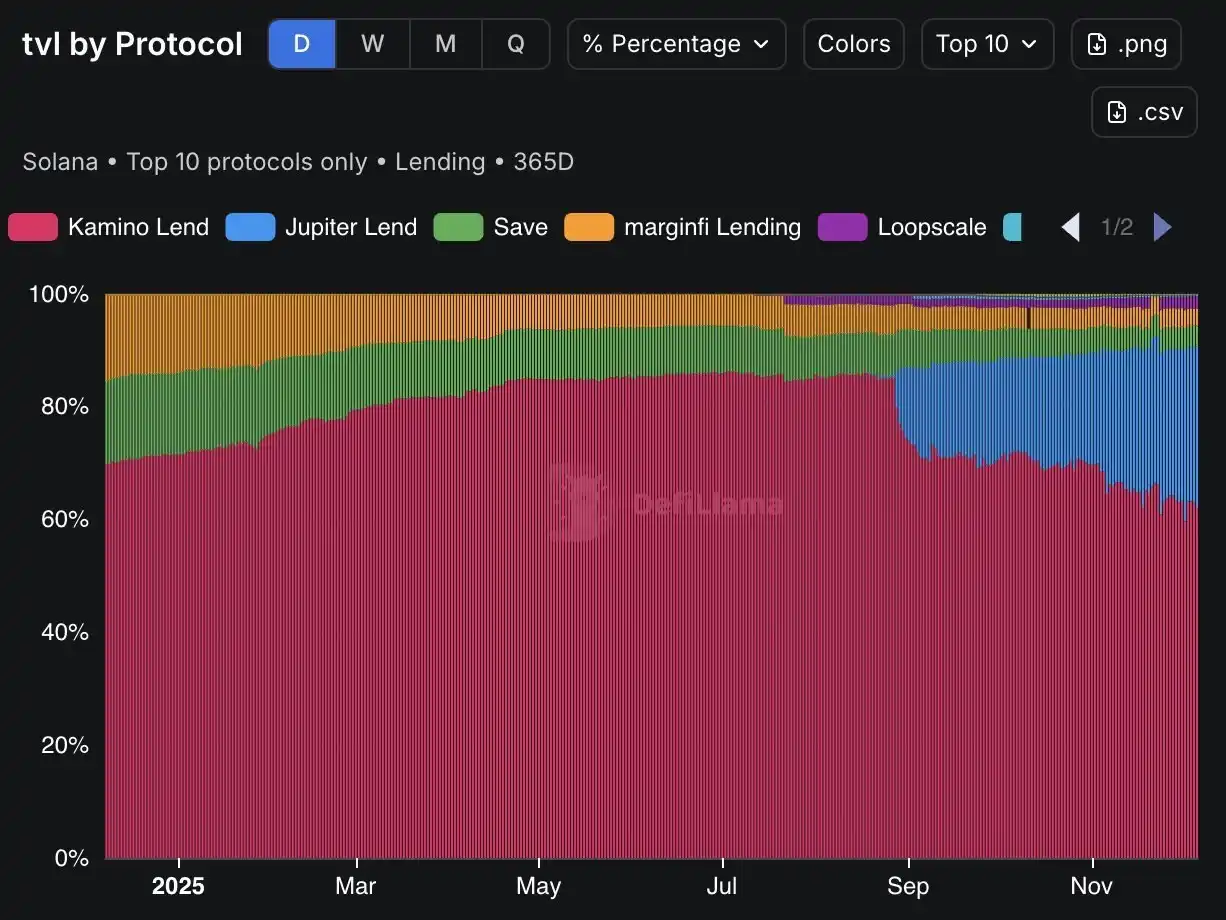
On the other hand, since the major crash on October 11, market liquidity has tightened significantly, and Solana's overall TVL has continued to decline; coupled with a series of project blowups, the DeFi market has become extremely sensitive to "security".
When the market environment was good and there was plenty of new capital, Jupiter Lend and Kamino coexisted relatively peacefully—after all, there was still money to be made, and it seemed like there would only be more... But as the market shifted to a zero-sum game, competition between the two became much more intense, and security issues became the most effective angle of attack— even though Jupiter Lend has never had a security incident in its history, mere suspicion in its design is enough to make users wary.
Perhaps in Kamino's view, now is the perfect time to deal a heavy blow to its rival.
Disclaimer: The content of this article solely reflects the author's opinion and does not represent the platform in any capacity. This article is not intended to serve as a reference for making investment decisions.
You may also like
Market "Discount Season": What Are Whales Quietly Buying According to On-Chain Data?
A pullback is a buying opportunity; the more it drops, the more I buy, and I hardly pay attention to short-term prices.

Funding Wheel Halts, Crypto Treasury Firm Losing Buy-the-Dip Capability
The Treasury Company appears to be well-capitalized, but after the stock price premium has disappeared, the funding chain has broken, causing it to lose the ability to buy the dip.

Why is the bitcoin bear market about to end?
The bitcoin bear market may be 90% complete.

Solana Ecosystem Civil War Erupts: Jupiter and Kamino Fall Out, Foundation Urges Peace
Stop making noise, any more noise and Ethereum will be able to buy the dip!

Trending news
MoreCrypto prices
More





