
Trump Takes Control of the Federal Reserve: The Impact on Bitcoin in the Coming Months

A once-in-a-century major transformation is taking place in the U.S. financial system.
Tonight, the most anticipated Fed rate cut decision of the year will take place.
The market generally bets that a rate cut is almost a certainty. But what will truly determine the trajectory of risk assets in the coming months is not another 25 basis point cut, but a more crucial variable: whether the Fed will inject liquidity back into the market.
This time, therefore, Wall Street is not watching the interest rate, but the balance sheet.
According to expectations from institutions such as Bank of America, Vanguard, and PineBridge, the Fed may announce this week that it will launch a $4.5 billion monthly short-term bond purchase program starting in January next year, as a new round of "reserve management operations." In other words, this means the Fed may be quietly restarting an era of "covert balance sheet expansion," allowing the market to enter a phase of liquidity easing even before rate cuts.
But what truly makes the market nervous is the backdrop against which this is happening—the United States is entering an unprecedented period of monetary power restructuring.
Trump is taking over the Fed in a way that is much faster, deeper, and more thorough than anyone expected. It's not just about replacing the chair, but redrawing the boundaries of the monetary system's power, reclaiming the dominance over long-term interest rates, liquidity, and the balance sheet from the Fed back to the Treasury. The central bank independence that has been regarded as an "institutional iron law" for decades is quietly being loosened.
This is also why, from Fed rate cut expectations to ETF fund flows, from MicroStrategy and Tom Lee's contrarian accumulation, all seemingly scattered events are actually converging on the same underlying logic: the US is ushering in a "fiscal-dominated monetary era."
And what impact will these have on the crypto market?
MicroStrategy Makes Its Move
In the past two weeks, the entire market has been discussing the same question: Will MicroStrategy be able to withstand this round of decline? Bears have simulated various scenarios of the company's "collapse."
But Saylor clearly doesn't think so.
Last week, MicroStrategy increased its bitcoin holdings by about $963 million, specifically 10,624 BTC. This is his largest purchase in recent months, even exceeding the total of the previous three months combined.
It should be noted that the market had been speculating whether MicroStrategy would be forced to sell its coins to avoid systemic risk when its mNAV approached 1. As the price nearly hit 1, not only did he not sell, but he doubled down, and by a significant margin.

Meanwhile, the ETH camp also staged an equally impressive contrarian move. Tom Lee's BitMine, despite ETH's price plummeting and the company's market cap correcting by 60%, was still able to keep tapping the ATM, raising a large amount of cash, and last week bought $429 million worth of ETH in one go, pushing its holdings to $12 billion.
Even though BMNR's stock price has corrected by more than 60% from its peak, the team can still keep raising money through the ATM (additional issuance mechanism) and keep buying.
CoinDesk analyst James Van Straten put it more bluntly on X: "MSTR can raise $1 billion in a week, while in 2020, it took them four months to achieve the same scale. The exponential trend continues."
From a market cap impact perspective, Tom Lee's move is even "heavier" than Saylor's. BTC is five times the market cap of ETH, so Tom Lee's $429 million buy order is equivalent to Saylor buying $1 billion in BTC in terms of "double the impact" by weight.
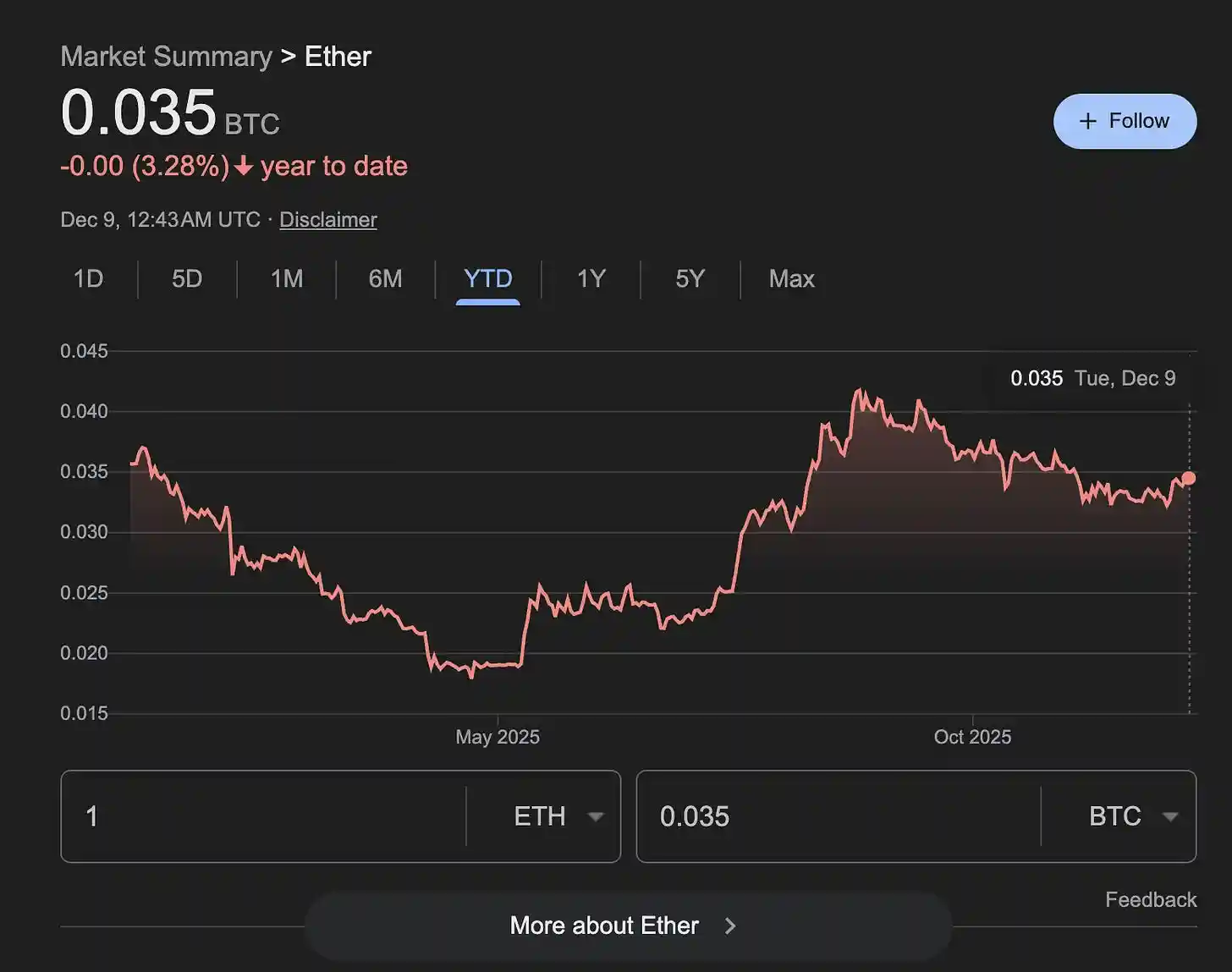
No wonder the ETH/BTC ratio has started to rebound, breaking out of a three-month downtrend. History has repeated itself countless times: whenever ETH leads the recovery, the market enters a short but fierce "altcoin rebound window."
BitMine now holds $1 billion in cash, and the ETH pullback range is just the best position for them to significantly lower their cost basis. In a market where liquidity is generally tight, having an institution that can keep firing is itself part of the price structure.
ETF Outflows Are Not an Exodus, But a Temporary Retreat of Arbitrage Funds
On the surface, bitcoin ETFs have seen nearly $4 billion in outflows over the past two months, with the price dropping from $125,000 to $80,000, leading the market to a crude conclusion: institutions have retreated, ETF investors are panicking, and the bull market structure has collapsed.
But data from Amberdata offers a completely different explanation.
These outflows are not "value investors running away," but "leveraged arbitrage funds being forced to unwind." The main source is a structured arbitrage strategy called "basis trade" that broke down. Funds originally earned a stable spread by "buying spot/selling futures," but since October, the annualized basis has dropped from 6.6% to 4.4%, with 93% of the time below the breakeven point, turning arbitrage into a loss and forcing the strategy to be unwound.
This triggered the "dual action" of ETF selling + futures covering.
By traditional definition, capitulation selling usually occurs in an extreme sentiment environment after a continuous decline, when market panic peaks and investors no longer try to stop losses but completely abandon all positions. Typical features include: almost all issuers seeing large-scale redemptions, trading volume surging, sell orders flooding in regardless of cost, and accompanied by extreme sentiment indicators. But this ETF outflow clearly does not fit this pattern. Although there was a net outflow overall, the direction of funds was not consistent: for example, Fidelity's FBTC continued to see inflows throughout the period, and BlackRock's IBIT even absorbed some incremental funds during the worst net outflow phase. This shows that only a few issuers truly exited, not the entire institutional group.
More crucial evidence comes from the distribution of outflows. As of the 53 days from October 1 to November 26, Grayscale's funds contributed more than $900 million in redemptions, accounting for 53% of the total outflow; 21Shares and Grayscale Mini followed closely, together accounting for nearly 90% of the redemption scale. In contrast, BlackRock and Fidelity—the most typical institutional allocation channels—were net inflows overall. This is completely inconsistent with a true "panic institutional retreat" and looks more like a "localized event."
So, which type of institution is selling? The answer: large funds engaged in basis arbitrage.
Basis trading is essentially a direction-neutral arbitrage structure: funds buy spot bitcoin (or ETF shares) while shorting futures, earning the spot-futures spread (contango yield). This is a low-risk, low-volatility strategy that attracts large institutional participation when futures premiums are reasonable and funding costs are manageable. However, this model relies on one premise: futures prices must remain above spot prices, and the spread must be stable. Since October, this premise has suddenly disappeared.
According to Amberdata statistics, the 30-day annualized basis compressed from 6.63% to 4.46%, with 93% of trading days below the 5% breakeven point required for arbitrage. This means such trades are no longer profitable and even start losing money, forcing funds to exit. The rapid collapse of the basis led to a "systematic unwinding" of arbitrage positions: they had to sell ETF holdings while buying back previously shorted futures to close out the arbitrage trade.
This process can be clearly seen in market data. Bitcoin perpetual contract open interest fell by 37.7% over the same period, dropping by more than $4.2 billion, with a correlation coefficient of 0.878 with the basis change—almost a synchronous move. This "ETF selling + short covering" combination is the typical path for basis trade exits; the sudden amplification of ETF outflows was not driven by price panic, but was the inevitable result of the collapse of the arbitrage mechanism.
In other words, the ETF outflows of the past two months are more like the "liquidation of leveraged arbitrage positions," not the "retreat of long-term institutions." This is a highly specialized, structured trade unwinding, not panic selling pressure caused by a market sentiment collapse.
More importantly, after these arbitrage positions are cleared, the remaining fund structure becomes healthier. ETF holdings are still maintained at a high level of about 1.43 million bitcoins, with most shares coming from allocation-type institutions rather than short-term funds chasing spreads. As the leverage hedging of arbitrage positions is removed, the overall market leverage ratio drops, sources of volatility decrease, and price action will be more driven by "real buying and selling power" rather than forced technical operations.
Amberdata's head of research, Marshall, described this as a "market reset": after the arbitrage positions retreat, new ETF funds are more directional and long-term, structural noise in the market is reduced, and subsequent trends will better reflect real demand. This means that although it appears to be a $4 billion outflow on the surface, it may not be a bad thing for the market itself. On the contrary, it could lay the foundation for the next healthier rally.
If Saylor, Tom Lee, and ETF funds represent the attitude of micro-level capital, the changes happening at the macro level are deeper and more intense. Will there be a Christmas rally? To find the answer, we may need to look further at the macro level.
Trump "Takes Control" of the Monetary System
For decades, the Fed's independence has been regarded as an "institutional iron law." Monetary power belongs to the central bank, not the White House.
But Trump clearly disagrees.
More and more signs show that the Trump team is taking over the Fed in a way that is much faster and more thorough than the market expected. It's not just a symbolic "change to a hawkish chair," but a complete rewrite of the power distribution between the Fed and the Treasury, changing the balance sheet mechanism, and redefining the way the yield curve is priced.
Trump is attempting to restructure the entire monetary system.
Former New York Fed trading desk chief Joseph Wang (who has long studied the Fed's operational system) has also clearly warned: "The market is significantly underestimating Trump's determination to control the Fed. This change could push the market into a higher-risk, higher-volatility phase."
From personnel arrangements and policy direction to technical details, we can see very clear traces.
The most direct evidence comes from personnel appointments. The Trump camp has already placed several key figures in core positions, including Kevin Hassett (former White House economic adviser), James Bessent (important Treasury decision-maker), Dino Miran (fiscal policy think tank), and Kevin Warsh (former Fed governor). These people have one thing in common: they are not traditional "central bank types," and certainly do not insist on central bank independence. Their goal is clear: to weaken the Fed's monopoly over interest rates, long-term funding costs, and system liquidity, and to return more monetary power to the Treasury.
The most symbolic point is: the widely regarded most suitable candidate to succeed as Fed chair, Bessent, ultimately chose to stay at the Treasury. The reason is simple: in the new power structure, the position at the Treasury is more decisive than that of the Fed chair.
Another important clue comes from changes in term premium.
For ordinary investors, this indicator may be a bit unfamiliar, but it is actually the most direct signal for the market to judge "who controls long-term interest rates." Recently, the spread between 12-month US Treasuries and 10-year Treasuries has once again approached a stage high, and this round of increase is not due to an improving economy or rising inflation, but because the market is reassessing: in the future, it may not be the Fed, but the Treasury, that determines long-term interest rates.

The yields on 10-year and 12-month Treasuries are continuing to decline, indicating that the market is strongly betting on the Fed to cut rates, and at a faster and larger pace than previously expected
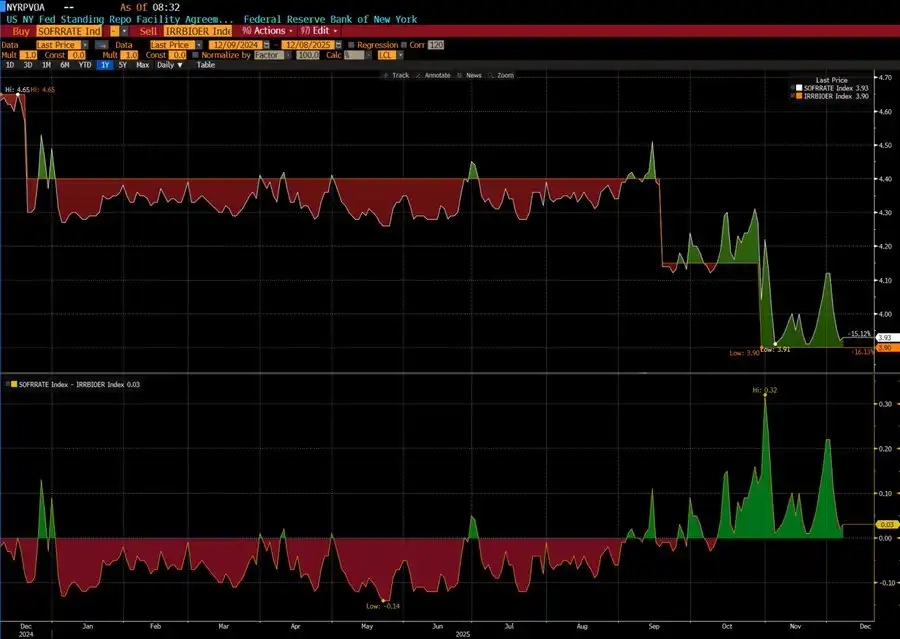
SOFR (Secured Overnight Financing Rate) experienced a cliff-like drop in September, indicating a sudden collapse in US money market rates and a significant loosening signal in the Fed's policy rate system
The initial rise in the spread was because the market thought Trump would overheat the economy after taking office; later, when tariffs and large-scale fiscal stimulus were absorbed by the market, the spread quickly fell back. Now the spread is rising again, reflecting not growth expectations, but uncertainty about the Hassett–Bessent system: if the Treasury controls the yield curve in the future by adjusting debt duration, issuing more short-term debt, and compressing long-term debt, then traditional methods of judging long-term rates will become completely ineffective.
More hidden but more crucial evidence lies in the balance sheet system. The Trump team frequently criticizes the current "ample reserves system" (the Fed expands its balance sheet and provides reserves to the banking system, making the financial system highly dependent on the central bank). But at the same time, they clearly know: current reserves are already tight, and the system actually needs balance sheet expansion to remain stable.
This contradiction of "opposing expansion, but having to expand" is actually a strategy. They use this as a reason to question the Fed's institutional framework and push for more monetary power to be transferred back to the Treasury. In other words, they are not seeking immediate balance sheet reduction, but are using the "balance sheet controversy" as a breakthrough point to weaken the Fed's institutional status.
If we piece these actions together, we see a very clear direction: term premium is compressed, Treasury durations are shortened, long-term rates gradually lose independence; banks may be required to hold more Treasuries; government-sponsored agencies may be encouraged to leverage up to buy mortgage bonds; the Treasury may influence the entire yield structure by increasing short-term debt issuance. Key prices once determined by the Fed will gradually be replaced by fiscal tools.
The result may be: gold enters a long-term uptrend, stocks maintain a slow upward structure after volatility, and liquidity gradually improves due to fiscal expansion and repo mechanisms. The market may appear chaotic in the short term, but this is only because the boundaries of monetary system power are being redrawn.
As for bitcoin, which is of most concern to the crypto market, it sits on the edge of this structural change—not the direct beneficiary, nor the main battleground. On the positive side, improved liquidity will provide a price floor for bitcoin; but in the longer term, looking 1–2 years ahead, it still needs to go through another accumulation period, waiting for the new monetary system framework to truly take shape.
The US is moving from a "central bank-dominated era" to a "fiscal-dominated era."
In this new framework, long-term rates may no longer be set by the Fed, liquidity will come more from the Treasury, central bank independence will be weakened, market volatility will increase, and risk assets will face a completely different pricing system.
When the underlying system is being rewritten, all prices will behave more "illogically" than usual. But this is an inevitable stage as the old order loosens and the new order arrives.
The market trends of the next few months are likely to be born out of this chaos.
Disclaimer: The content of this article solely reflects the author's opinion and does not represent the platform in any capacity. This article is not intended to serve as a reference for making investment decisions.
You may also like
Federal Reserve's Major Shift: From QT to RMP, How Will the Market Transform by 2026?
The essence of RMP, the mystery surrounding its scale, and its impact on risk assets.

Questioning the Necessity of Gas Futures: Does the Ethereum Ecosystem Really Need Them?
How did the Do Kwon trial trigger an 1.8 billion USD speculative frenzy?

Trending news
MoreCrypto prices
More





