
Crypto among sectors ‘debanked’ by 9 major banks: US regulator

The nine largest US banks restricted financial services to politically contentious industries, including cryptocurrency, between 2020 and 2023, according to the preliminary findings of the Office of the Comptroller of the Currency (OCC).
The banking regulator said on Wednesday that its early findings show that major banks “made inappropriate distinctions among customers in the provision of financial services on the basis of their lawful business activities” across the three-year period.
The banks either implemented policies restricting access to banking or required escalated reviews and approvals before giving financial services to certain customers, the OCC said, without giving specific details.
The OCC initiated its review after President Donald Trump signed an executive order in August, directing a review of whether banks had debanked or discriminated against individuals based on their political or religious beliefs.
Crypto issuers and exchanges caught in restrictions
The OCC’s report found that in addition to crypto, the sectors that faced banking restrictions included oil and gas exploration, coal mining, firearms, private prisons, tobacco and e-cigarette manufacturers and adult entertainment.
Banks’ actions toward crypto included restrictions on “issuers, exchanges, or administrators, often attributed to financial crime considerations,” the OCC said.
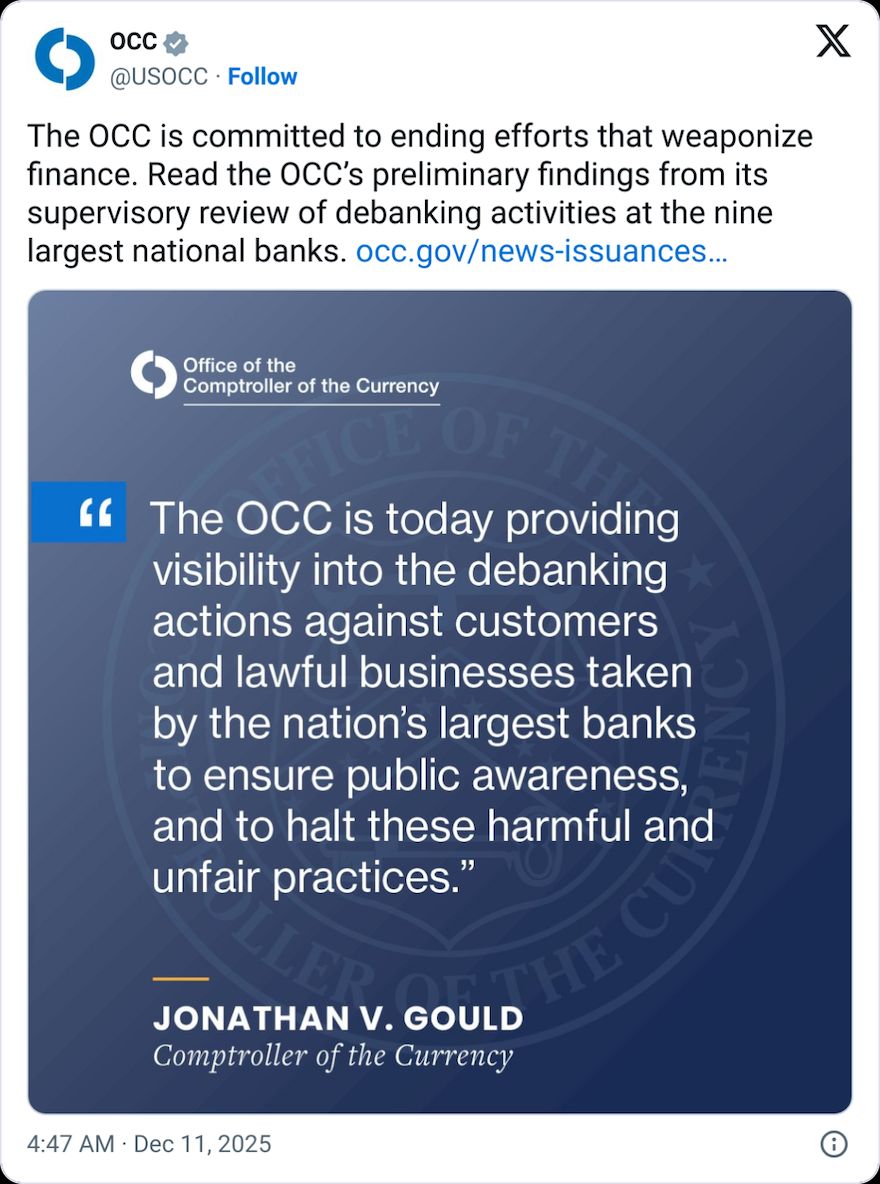
“It is unfortunate that the nation’s largest banks thought these harmful debanking policies were an appropriate use of their government-granted charter and market power,” said Comptroller of the Currency Jonathan Gould.
“While many of these policies were undertaken in plain sight and even announced publicly, certain banks have continued to insist that they did not engage in debanking,” he added.
The OCC examined JPMorgan Chase, Bank of America, Citibank, Wells Fargo, US Bank, Capital One, PNC Bank, TD Bank and BMO Bank, the largest national banks it regulates.
The OCC reported that it is continuing its investigation and could refer its findings to the Justice Department.
OCC debanking report leaves “much to be desired”
Nick Anthony, a policy analyst at libertarian think tank the Cato Institute, said in an emailed statement to Cointelegraph that the OCC’s report “leaves much to be desired” and didn’t mention “the most well-known causes of debanking.”
“The report criticizes banks for severing ties with controversial clients, but it fails to mention that regulators explicitly assess banks on their reputation,” he said.
“Making matters worse, the report appears to blame banks for cutting ties with cryptocurrency companies, yet makes no mention of the fact that the [Federal Deposit Insurance Corporation] explicitly told banks to stay away from these companies,” Anthony added.
Republicans on the House Finance Committee reported earlier this month that the FDIC’s so-called “pause letters” it sent to banks under the Biden administration helped to spur “the debanking of the digital asset ecosystem.”
Caitlin Long, the founder and CEO of the crypto-focused Custodia Bank, said the “worst culprits” of crypto-related debanking under the Biden administration were the FDIC and Federal Reserve, “not OCC.”
“In OCC’s defense, this report covers large banks only. Crushing crypto wasn’t a supervisory priority for large banks like it was for small [and] mid-sized banks,” she added.
Disclaimer: The content of this article solely reflects the author's opinion and does not represent the platform in any capacity. This article is not intended to serve as a reference for making investment decisions.
You may also like
How Prompt Engineering is Transforming AI-Based Decision Processes in the Financial Sector
- Prompt engineering is transforming finance by enabling AI to generate unconventional insights and reduce biases through tailored queries. - Structured prompting techniques like GoT and CoT improve portfolio accuracy by 15-25%, according to 2025 studies, by forcing multi-path reasoning. - Bias-mitigation prompts force AI to avoid anchoring effects and align with institutional goals, as shown by ACM frameworks and 2025 research. - Tree-of-Thought prompts simulate expert-level scenario analysis, enabling st

SOL Drops by Half: Causes Behind the Fall and Key Takeaways for Crypto Investors
- Solana (SOL) plummeted 50% in Nov 2025 due to network congestion, inflationary pressures, and institutional liquidity shifts. - Technical failures (80% failed transactions) and 7.5% annual inflation exacerbated downward momentum amid Fed tightening. - Investors were urged to avoid panic selling, prioritize security, and rebalance toward fundamentally strong crypto projects. - The crash highlighted systemic altcoin risks, emphasizing disciplined risk management and macroeconomic awareness for long-term re

Satoshi Nakamoto statue arrives at NYSE in major crypto culture shift
Norway decides not to pursue digital currency for now
Trending news
MoreCrypto prices
More





