
Behind the 15 million financing, does Surf aim to become an AI analyst in the crypto field?

Cyber co-founder starts a new venture.
Cyber co-founder starts a new venture.
Written by: 1912212.eth, Foresight News
Despite a significant decrease in crypto sector financing, some projects are still favored by venture capital. On December 10, Surf successfully raised $15 million in funding, with Pantera Capital leading the round and Coinbase Ventures and DCG participating. Surf positions itself as an AI intelligence platform designed specifically for cryptocurrencies. What makes it stand out?
It is well known that current large language models still experience "hallucinations" that lead to biased results. In addition, as a vertical field, the complex content and analysis in cryptocurrency may not be perfectly presented by general-purpose large models. Surf provides accurate and reliable insights through a simple chat interface, helping traders, researchers, and investors avoid common mistakes made by general AI models.
In short, what Surf aims to do is to become the ChatGPT of the crypto field.
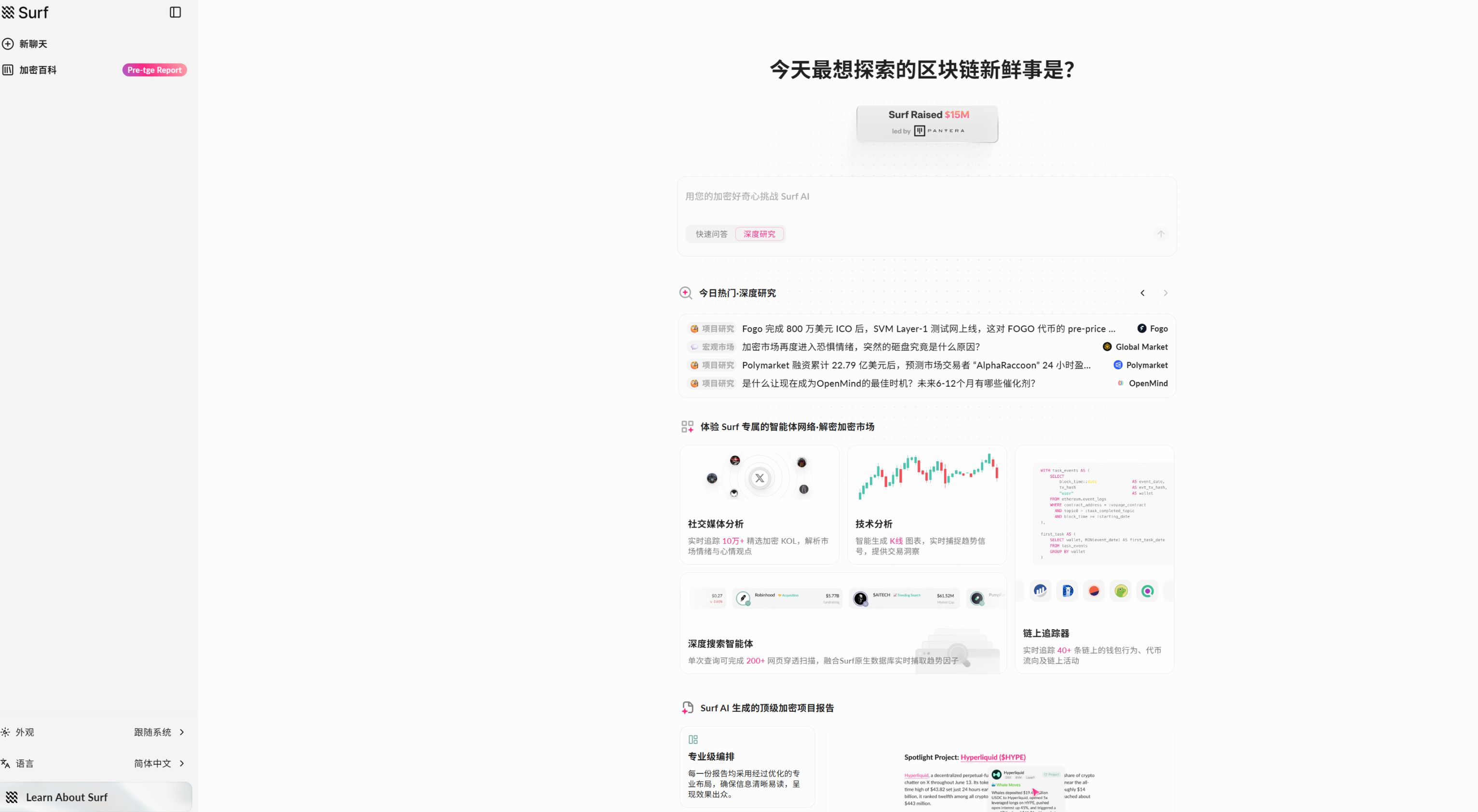
The core of Surf is a multi-agent architecture AI system that combines proprietary models and industry-leading data sources to deliver accuracy that surpasses general LLMs. Users can ask questions through the chat interface, ranging from basic knowledge (such as "What is Bitcoin halving?") to advanced analysis (such as "Analyze on-chain activity and social sentiment of a certain token"). The platform integrates social sentiment, on-chain activity, and token market behavior in real time, providing insights through a single entry point and avoiding the errors and hassle of manual research.
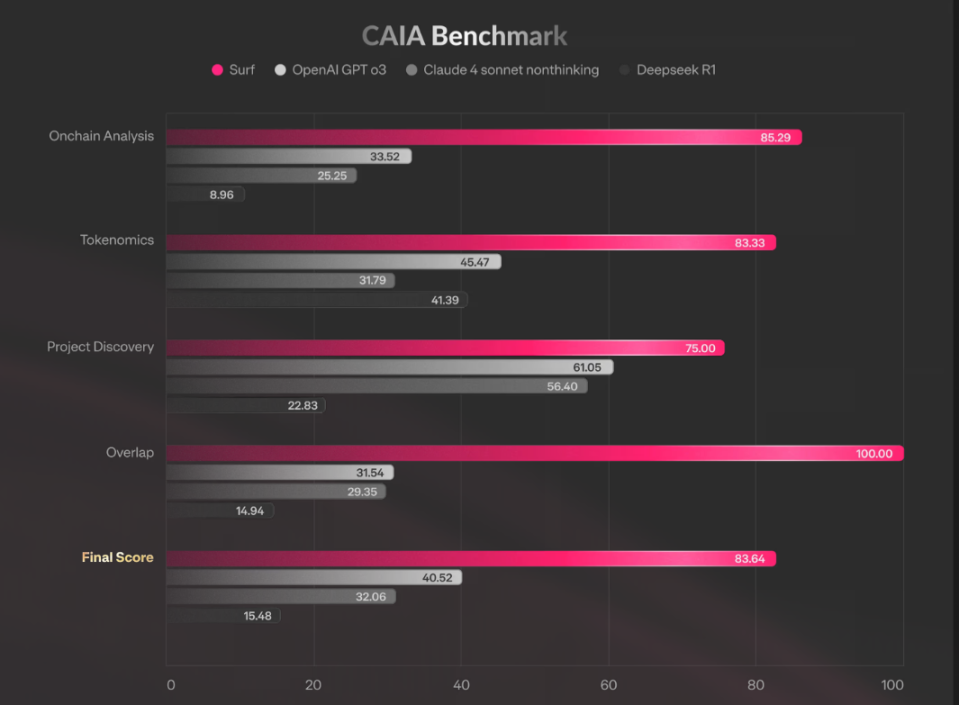
In terms of performance, Surf 1.0 stood out in the CAIA benchmark test. This benchmark, co-developed by Surf and Princeton University, evaluates the ability of AI models to perform tasks of junior human analysts. Results show that Surf outperforms models like ChatGPT and Grok by four times on crypto-specific tasks, providing more concrete references and fewer errors.
In addition, Surf supports on-chain data tracking for more than 40 blockchain networks, helping users understand capital flows, wallet behavior, and protocol activity. It is not only a research tool but also acts as a trading assistant, allowing users to obtain real-time market data and answers supported by a crypto knowledge base, just like chatting with ChatGPT. Recently, Surf also launched a mobile app, further lowering the threshold for information access.
Unlike other AI assistants, Surf emphasizes "trust." In an interview, Ryan Li stated: "When people make financial decisions, they need reliable information. General AI tools are not built for this. We created Surf to provide reliable support in the fast-changing crypto market." This philosophy stems from the unique challenges of crypto data: the market is highly volatile, information sources are diverse and easily manipulated. Surf's proprietary training ensures higher contextual understanding and detail accuracy, avoiding the common failures of general models in crypto scenarios.
Surf was co-founded by Ryan Li, who graduated from the University of California, Berkeley with a bachelor's degree in Electrical Engineering and Computer Science. He was the CTO of BitTorrent and also a co-founder of CyberConnect. In May 2024, the decentralized social platform CyberConnect transformed into a social restaking modular L2, rebranded and renamed as Cyber, and spun off Link3 as an independent brand.

According to official disclosures, Ryan Li personally experienced the pain points of AI in the crypto market. General AI platforms output inaccurate or fabricated information, which can lead to significant losses for traders. Based on this observation, Ryan decided to create Surf—an AI model designed specifically for crypto.
Surf was launched in July 2025 on an invite-only basis and opened to the public in September. Currently, its team has fewer than 30 people and has achieved millions of dollars in annual recurring revenue (ARR). In just a few months, the platform has generated over 1 million research reports, with more than 80,000 users and a monthly growth rate as high as 50%.
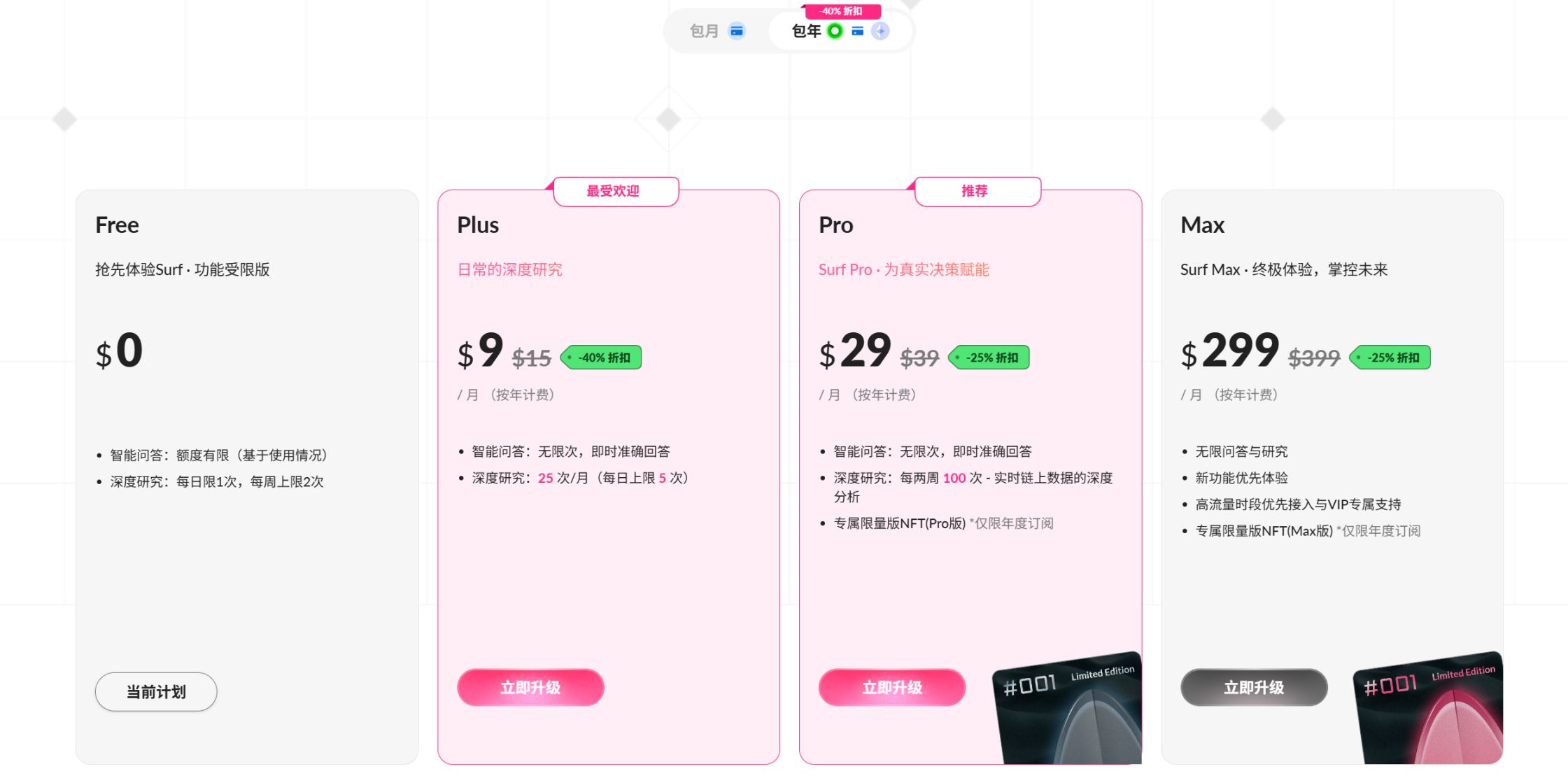
Like general large models, Surf adopts a paid subscription model. Free users can use Ask and Research features, but with limited quotas. Paid members have higher usage limits and enjoy exclusive support.
Currently, information on the official website shows that Surf has no plans to issue a token.
After the completion of this round of financing, Surf will soon launch Surf 2.0. The official statement says this version will feature the most advanced proprietary model, as well as expanded data pipelines designed for market and on-chain intelligence, and additional agents capable of handling complex, multi-step analytical workflows.
Disclaimer: The content of this article solely reflects the author's opinion and does not represent the platform in any capacity. This article is not intended to serve as a reference for making investment decisions.
You may also like
When Hackers Become State Actors and AI: A Security Self-Assessment Checklist for Crypto Projects in 2026
Wall Street interprets the Federal Reserve decision as more dovish than expected
The market originally expected a "hawkish rate cut" from the Federal Reserve, but in reality, there were no additional dissenters, no higher dot plot, and the anticipated tough stance from Powell did not materialize.

The Federal Reserve cuts rates again but divisions deepen, next year's path may become more conservative
Although this rate cut was as expected, there was an unusual split within the Federal Reserve, and it hinted at a possible prolonged pause in the future. At the same time, the Fed is stabilizing year-end liquidity by purchasing short-term bonds.

Betting on LUNA: $1.8 billion is being wagered on Do Kwon's prison sentence
The surge in LUNA’s price and huge trading volume are not a result of fundamental recovery, but rather the market betting with real money on how long Do Kwon will be sentenced on the eve of his sentencing.

Trending news
MoreCrypto prices
More





