
PENGU Price Forecast: Analyzing Market Drivers and Changing Sentiment in the Fourth Quarter of 2025
- PENGU token faces extreme volatility in Q4 2025 driven by technical indicators, regulatory uncertainty, and shifting investor sentiment. - Whale accumulation ($273K) and rising OBV suggest institutional interest, but SEC's delayed ETF decision and new crypto regulations (GENIUS Act, MiCA) create compliance challenges. - Social media-driven FOMO fueled a 480% July surge, but panic selling and regulatory confusion (e.g., PNW mix-up) caused 80%+ value drops, highlighting market fragility. - Current $0.01114
PENGU Token: Navigating Volatility Amid Regulatory and Market Shifts
The PENGU token, closely linked to the Pudgy Penguins ecosystem, has seen dramatic price swings in late 2025. This turbulence stems from a blend of technical market signals, evolving regulations, and rapidly changing investor attitudes. As the token approaches crucial resistance points and comes under increased regulatory examination, those considering investment must carefully evaluate these dynamics to anticipate its future direction.
Key Drivers: Technical Trends Versus Regulatory Pressures
Recent blockchain analytics point to a pivotal moment for PENGU. Notably, large investors have accumulated approximately $273,000 worth of the token, and On-Balance Volume (OBV) has been on the rise since November 4, 2025—signaling heightened interest from institutional players. The token’s price has neared a significant resistance at $0.0235, suggesting that a breakout could spark a short-lived rally. However, this positive momentum is counterbalanced by regulatory developments.
The U.S. Securities and Exchange Commission’s postponement of a decision regarding the Canary PENGU ETF until October 2025 has injected uncertainty, contributing to a 42.3% drop in PENGU’s value over the past month.
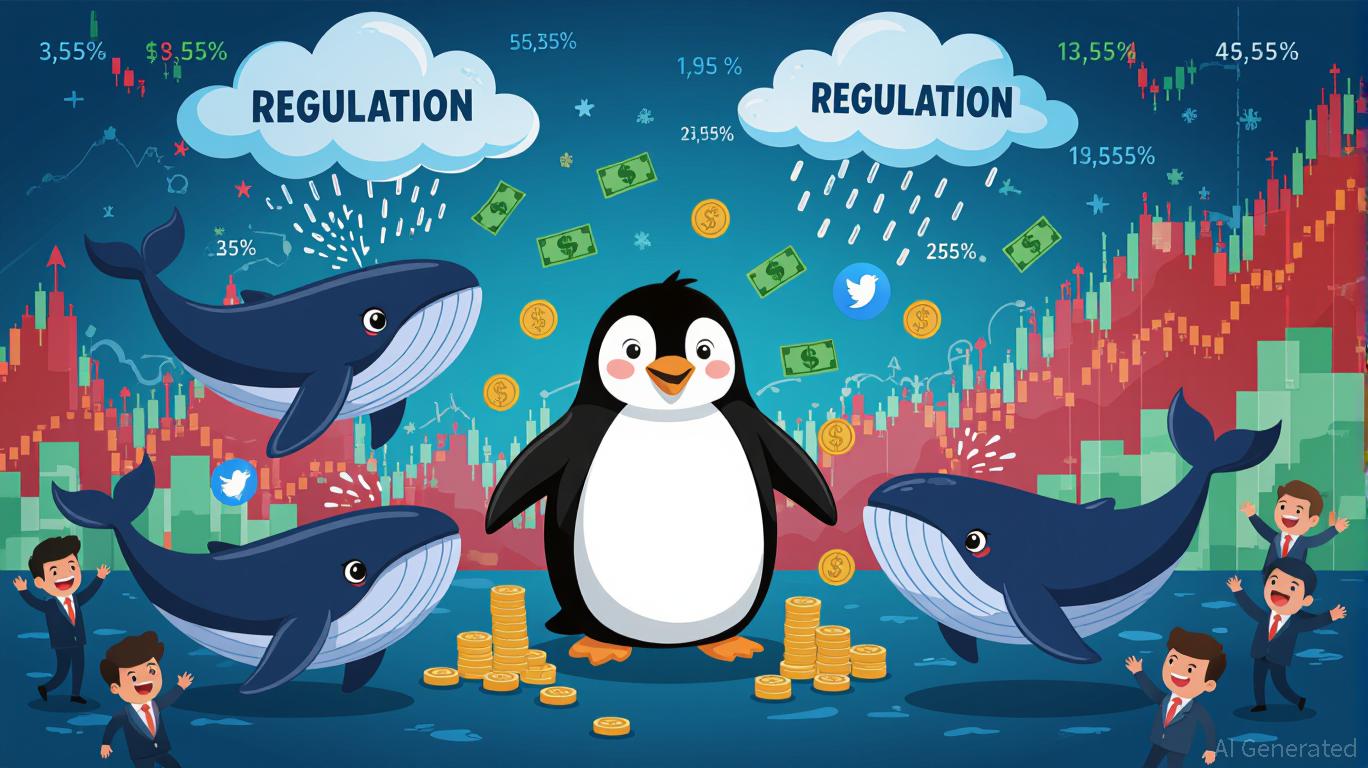
New legislative measures, such as the U.S. GENIUS Act and the European Union’s MiCA regulation, have further complicated the landscape. These rules have raised compliance expenses and limited liquidity for speculative tokens like PENGU. For example, Gate’s adoption of stricter KYC and AML protocols in 2025 coincided with an 80% plunge in PENGU’s market capitalization, illustrating how regulatory moves can disproportionately affect niche digital assets. Additionally, a regulatory investigation in late November 2025—mistakenly conflating PENGU with Pinnacle West Capital Corp (PNW)—triggered a single-day price drop of 30%, underscoring the fragility of market confidence amid confusion.
Investor Psychology: From Panic to FOMO and the Influence of Social Media
Sentiment among PENGU holders has fluctuated sharply throughout November 2025. After a 30% price fall, retail investor optimism slid from 90% to 72%, while the Fear & Greed Index plummeted to 28, a level often linked to oversold conditions and possible stabilization. Despite this, the outlook remains uncertain.
Earlier in July 2025, social media-driven FOMO propelled PENGU to a 480% surge, only for panic selling to erase 28.5% of its value by October, as highlighted in market reports. These dramatic shifts reveal the herd mentality that dominates speculative markets. More recently, coordinated buying by large holders and significant inflows from top traders—totaling $103,000—have temporarily boosted bullish sentiment.
Nevertheless, relying on social media sentiment analysis carries inherent risks. Algorithm-driven amplification and echo chambers can distort reality, fueling exaggerated narratives and intensifying volatility. For instance, the recent regulatory probe was widely circulated on online forums, accelerating sell-offs even after clarifications distinguished PENGU from PNW.
Outlook: Exercising Prudence in an Uncertain Environment
While technical patterns and whale activity hint at possible short-term gains, the broader context remains challenging. Ongoing regulatory ambiguity and macroeconomic pressures suggest that any upward movement may be fleeting. Currently, PENGU trades at $0.011140—down 69% from its peak—reflecting a stressed market where limited liquidity amplifies price movements.
Investors should focus on two critical factors: first, the SEC’s upcoming decision on the Canary PENGU ETF, which could either validate or further undermine the token; and second, whether on-chain activity can sustain recent momentum. For PENGU to break above $0.0235, not only technical confirmation but also a shift from fear to cautious optimism will be necessary—a scenario dependent on regulatory clarity and reduced panic in online communities.
Final Thoughts
PENGU’s performance in the last quarter of 2025 mirrors the broader challenges facing the cryptocurrency sector. While some technical and on-chain indicators offer hope, regulatory risks and behavioral biases remain significant obstacles. Investors are advised to proceed with caution, viewing any short-term rallies as opportunities to reassess risk rather than as signals for long-term commitment. In a market where sentiment can swing rapidly, the wisest approach may be to await clearer regulatory guidance and more stable on-chain trends before making substantial moves.
Disclaimer: The content of this article solely reflects the author's opinion and does not represent the platform in any capacity. This article is not intended to serve as a reference for making investment decisions.
You may also like
Emerging Prospects in EdTech and AI-Powered Learning Systems: Ways Educational Institutions Are Transforming Programs and Enhancing Student Achievement
- AI is transforming education by reshaping curricula, enhancing student engagement, and optimizing institutional efficiency. - Universities like Florida and ASU integrate AI literacy across disciplines, offering microcredentials and fostering innovation. - AI tools like Georgia Tech’s Jill Watson and Sydney’s Smart Sparrow boost performance and engagement through personalized learning. - AI streamlines administrative tasks but faces challenges like ethical misuse and skill gaps, requiring structured train

Anthropological Perspectives on Technology and Their Impact on Education and Workforce Preparedness for the Future
- Interdisciplinary STEM/STEAM education integrates technology tools like AI and VR to bridge theory and real-world skills, driven by $163B global edtech growth. - U.S. faces 411,500 STEM teacher shortages and 28% female workforce representation gaps, prompting equity-focused programs like Girls Who Code. - STEM occupations earn $103K median wages (vs. $48K non-STEM), with 10.4% job growth projected through 2033, driving investor opportunities in edtech and workforce alignment. - Strategic investments in t

The Revival of Educational Technology in Higher Education After the Pandemic
- Global EdTech market grows to $7.3T by 2025, driven by hybrid learning and AI/AR/VR adoption in higher education. - Institutions like MIT and Harvard integrate AI across disciplines, boosting enrollment and workforce alignment through $350M-$500M investments. - EdTech platforms enabling personalized learning and immersive experiences see rising demand, with 45% annual growth in AI-related programs since 2020. - Undervalued EdTech stocks offer investment opportunities as $16B+ VC funding accelerates innov

Navigating the Fluctuations of AI Tokens: Insights Gained from the ChainOpera AI Downturn
- ChainOpera AI's (COAI) 2025 token crash from $44.90 to $0.52 highlights systemic risks in AI-driven crypto projects due to centralized governance and regulatory ambiguity. - The CLARITY Act's regulatory framework created short-term volatility while exposing fragility in AI-linked tokens like algorithmic stablecoins xUSD and deUSD. - Investors must prioritize diversification, technical due diligence (e.g., EY six-pillar model), and compliance tools to mitigate risks in volatile AI crypto markets. - Succes
Trending news
MoreCrypto prices
More





