
From Cross-Chain Bridge Aggregation to Universal Liquidity Market, LI.FI Secures an Additional $29 Million in Funding

Why has a cross-chain infrastructure platform that has been "hacked twice" received another round of capital injection?
Why has a cross-chain infrastructure project that has been "hacked twice" received another round of capital injection?
Written by: ChandlerZ, Foresight News
Cross-chain infrastructure startup LI.FI has once again secured capital injection.
This Berlin-based cross-chain liquidity aggregation protocol announced the completion of a new $29 million funding round, led by crypto venture firms Multicoin Capital and CoinFund. This round is an extension of its 2023 Series A, bringing the company’s total funding to approximately $51.7 million.
According to official disclosures, LI.FI currently has over 100 employees, with a lifetime trading volume exceeding $60 billion. In October alone, its monthly trading volume reached $8 billion, representing a 595% increase from $1.15 billion a year ago. Its B2B partners number nearly 1,000, including mainstream financial and Web3 applications such as Robinhood, Binance, Kraken, MetaMask, Phantom, Ledger, Hyperliquid, Circle, and Alipay.
In a crypto market still wary of "cross-chain bridge security," why are investors willing to inject another $29 million into a cross-chain liquidity project?
Funding and Team
LI.FI co-founder and CEO Philipp Zentner compared the company’s positioning to a "combination of Google Flights + Google Maps" in an interview with Fortune: on one hand, helping enterprises compare exchange rates and bridging fees across different chains, and on the other, finding the most cost-effective and efficient cross-chain route for each transaction.
According to LinkedIn, LI.FI’s founder and CEO is Philipp Zentner. In September 2012, Zentner founded the information analytics company STOMT and served as CEO, helping brands collect and manage qualitative feedback at scale through standardized communication, machine learning, and natural language processing (NLP). Zentner began participating in Web3 projects in 2021, serving as co-founder of NFT project CryptoPixels and Tezos-based DeFi project Freibier.io, and officially founded LI.FI in May 2021.
LI.FI’s co-founder and CTO is Max Klenk, who was also co-founder and CTO of STOMT. He holds a Master of Science degree from the Hasso Plattner Institute in Germany, majoring in systems engineering.
In terms of funding pace, LI.FI completed a $5.5 million strategic round in July 2022, led by crypto-native fund 1kx, with participation from Dragonfly Capital, Coinbase Ventures, and others. In March 2023, it completed a $17.5 million Series A round, co-led by CoinFund and Singapore’s Superscrypt, with participation from Bloccelerate, L1 Digital, Circle, Factor, Perridon, Theta Capital, Three Point Capital, Abra, and nearly 20 angel investors. This $29 million Series A extension brings the total funding to about $51.7 million.
The new funds will primarily be used to drive further business expansion and new product development, including building infrastructure for AI agents and stablecoins, as well as launching an open intent and solver marketplace in Q1 2026 to expand third-party liquidity access channels.
Notably, according to Fortune, LI.FI has already achieved self-sufficiency in profitability, with revenue mainly coming from transaction fee sharing with B2B clients, though the company declined to disclose specific figures. As of October, the company’s monthly trading volume was about seven times that of the same period last year. This round of funding appears to be more about accelerating product line expansion and market share, rather than "survival."
From Cross-Chain Bridge Aggregation to "Universal Liquidity Market"
Traditional financial institutions, internet finance applications, and mainstream crypto enterprises that want to integrate multi-chain asset trading and cross-chain transfers into their products must connect to different bridging protocols, DEXs, and aggregators on various chains, while also maintaining and monitoring security risks. For most teams, this is both expensive and lacking in expertise.
LI.FI’s mission is to "abstract" away this complexity:
- Protocol layer: Aggregates cross-chain bridges, DEXs, and DEX aggregators across dozens of public chains, enabling "any asset to any asset" cross-chain trading.
- Developer tools: Provides APIs/SDKs/widgets to wallets, trading platforms, neo-banks, and other B2B clients, solving "multi-chain quoting + route planning + execution" with a single interface.
- Frontend product: Its proprietary Jumper.Exchange is a cross-chain aggregation interface for end users.
If early LI.FI was more like a "cross-chain bridge + DEX aggregator," solving "how to find the optimal swap route among dozens of chains," then starting in 2025, LI.FI has articulated a grander narrative: to build a "universal liquidity market" covering all chains.
In its early 2025 release of LI.FI 2.0, the company pointed out that as the number of public chains, rollups, and appchains grows from linear to exponential, the traditional aggregation model relying solely on connecting cross-chain bridges and DEXs can no longer support the interoperability needs of the entire multi-chain ecosystem.
LI.FI 2.0, through the acquisition of intents protocol Catalyst, in-house development of solver/fast bridge Pioneer, and cooperation with cross-chain token aggregation layer Glacis, has upgraded its original cross-chain aggregator into a universal liquidity infrastructure that spans "from user intent to cross-chain execution." The goal is to enable any chain to have interoperability from day one, while providing unified liquidity routing and settlement for thousands of chains and millions of assets.
How Does a Cross-Chain Infrastructure "Hacked Twice" Talk About Security?
When it comes to cross-chain, security is unavoidable. In recent years, cross-chain bridges have almost become "ATMs for hackers," with attacks on the scale of hundreds of millions of dollars, from Nomad to Wormhole. According to SlowMist’s hacker database, there have been 51 security incidents involving cross-chain bridges, resulting in over $1.79 billion in economic losses.
LI.FI itself is not "accident-free":
- March 2022: Its early smart contract was found to have a vulnerability, which attackers exploited through malicious contract calls to steal about $600,000 from 29 wallets. The company later released a detailed technical analysis and promised to compensate affected users with its own funds.
- July 2024: After a contract upgrade, a newly added contract module again exposed a vulnerability that allowed malicious calls to users with infinite approval, resulting in the theft of approximately $10 million to $11.6 million. LI.FI quickly disabled the affected contracts after the incident and published a post-mortem report explaining the cause and fix.
According to external security team reviews, both attacks were related to "arbitrary call permissions to any contract," essentially sacrificing some security boundaries for greater flexibility.
For a protocol positioned as "universal liquidity infrastructure," such security incidents are a serious warning. On one hand, LI.FI’s aggregation model means that any incident could affect the entire B2B client chain; on the other, cross-chain bridges and liquidity aggregation are among the most complex attack surfaces in infrastructure, making it difficult to achieve absolute security while maintaining high flexibility.
Competing for "Routing Rights" in a Fragmented Multi-Chain World
If LI.FI’s current positioning could be summed up in one sentence, it would be: striving to seize the "liquidity routing and price discovery" discourse power in a highly fragmented multi-chain world.
Will the new $29 million in funding bring LI.FI closer to its vision of a "universal liquidity market"? The answer depends on three variables: whether security governance can withstand the next black swan event, whether intents and chain abstraction can achieve large-scale adoption, and where regulation will ultimately land in the multi-chain DeFi space.
For readers following cross-chain infrastructure and the DeFi sector, this round of funding for LI.FI at least sends a signal. At the infrastructure level, capital is still willing to bet on a "multi-chain future," but the way of betting has shifted from "single cross-chain bridges" to higher-level aggregation and abstraction.
Disclaimer: The content of this article solely reflects the author's opinion and does not represent the platform in any capacity. This article is not intended to serve as a reference for making investment decisions.
You may also like
When "decentralization" is abused, Gavin Wood redefines the meaning of Web3 as Agency!

A decade-long tug-of-war ends: "Crypto Market Structure Bill" sprints to the Senate
At the Blockchain Association Policy Summit, U.S. Senators Gillibrand and Lummis stated that the "Crypto Market Structure Bill" is expected to have its draft released by the end of this week, with revisions and hearings scheduled for next week. The bill aims to establish clear boundaries for digital assets by adopting a classification-based regulatory framework, clearly distinguishing between digital commodities and digital securities, and providing a pathway for exemptions for mature blockchains to ensure that regulation does not stifle technological progress. The bill also requires digital commodity trading platforms to register with the CFTC and establishes a joint advisory committee to prevent regulatory gaps or overlapping oversight. Summary generated by Mars AI. The accuracy and completeness of this summary, generated by the Mars AI model, is still being iteratively updated.

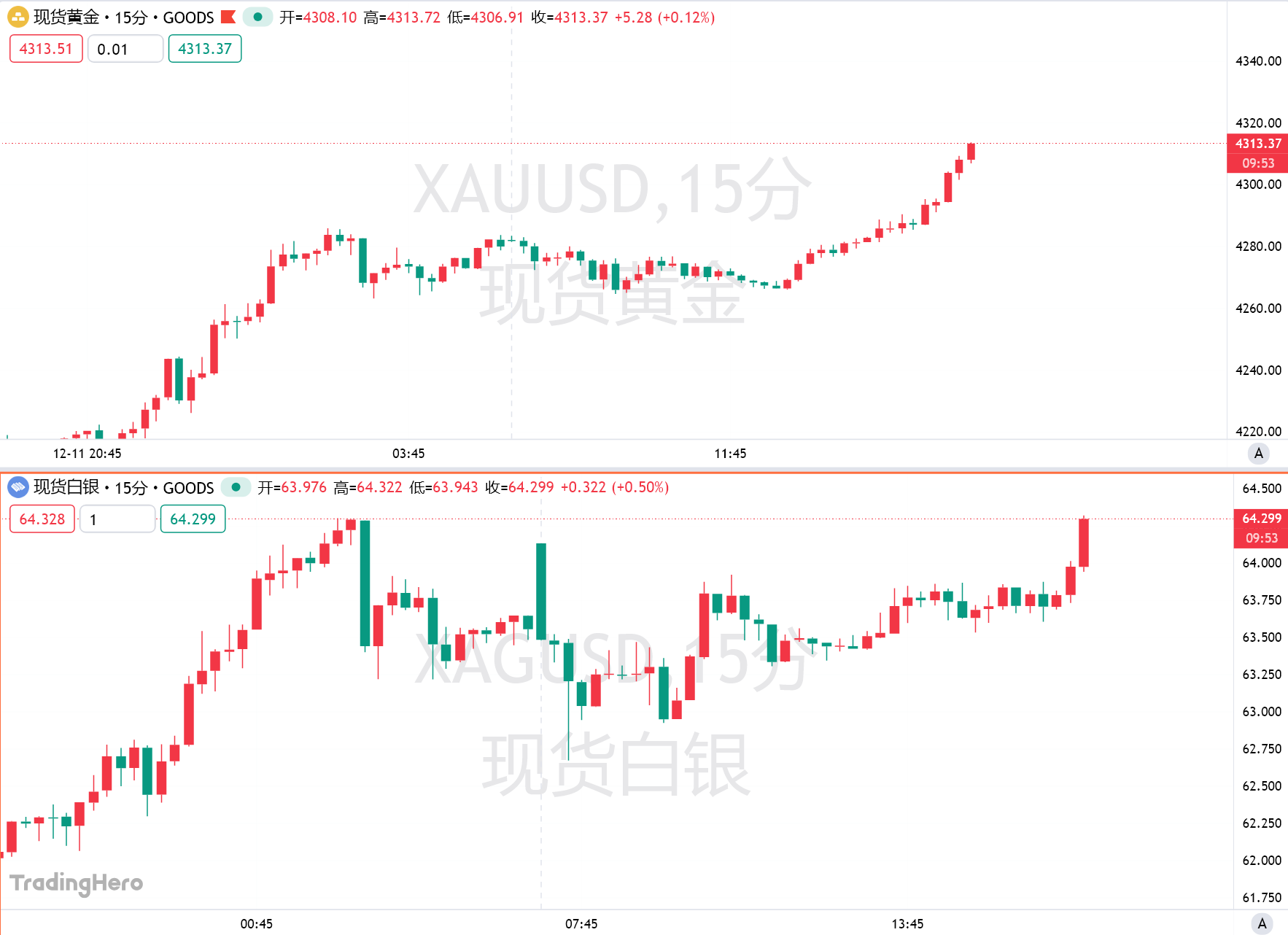
Gold surpasses the $4,310 mark—Is the "bull frenzy" returning?
Boosted by expectations of further easing from the Federal Reserve, gold has risen for four consecutive days. Technical indicators show strong bullish signals, but there remains one more hurdle before reaching a new all-time high.
Trending news
MoreCrypto prices
More





