
OG Strategies May Be Hurting Bitcoin’s Momentum

While Bitcoin ETFs attract massive institutional inflows and macroeconomic conditions argue for a rebound in risky assets, the price remains surprisingly stuck below 90,000 dollars. This stagnation, out of sync with the prevailing bullish signals, points to invisible forces restricting its progress. Between yield strategies and sophisticated arbitrage, a more discreet mechanism seems to weigh on the market just as investors expect a new momentum.
In Brief
- Bitcoin remains stuck around $90,000, despite growing investor interest via ETFs.
- An analyst points to a discreet strategy used by some historic holders: selling covered call options.
- This practice generates invisible selling pressure on the market, slowing BTC price progress.
- Meanwhile, BTC is decoupling from stock markets, despite strong institutional demand via ETFs like IBIT.
Invisible but Real Selling Pressure
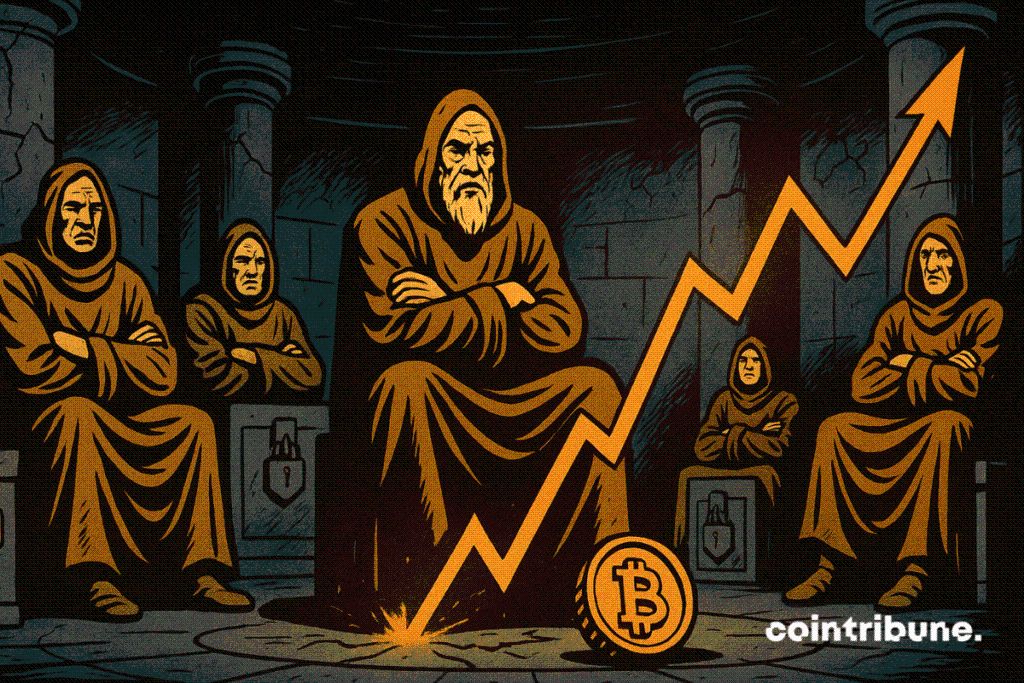
According to market analyst Jeff Park, some of the oldest Bitcoin holders, nicknamed the “OGs”, contribute to slowing the progression of the BTC price by adopting a well-known strategy in the derivatives world: selling covered call options.
This technique allows them to generate passive income by selling call options on their Bitcoin holdings, which they have held for more than ten years. “When you already have the Bitcoin inventory you’ve held for over ten years and you sell call options on it, only the sale of these adds delta to the market, and this direction is negative,” Jeff Park states .
Here are the main elements of this mechanism that acts as a brake on the crypto price:
- The “OGs” sell call options on BTC they already hold, which allows them to pocket an immediate premium without parting with their tokens, unless the price exceeds the strike ;
- Liquidity providers who buy these options must hedge by selling spot Bitcoin to limit their exposure ;
- These spot sales create artificial downward pressure on the price, even with strong buying demand ;
- The Bitcoin used for these strategies is not from recent purchases, meaning it does not represent any new capital injection into the market ;
- Covered call options become a source of negative delta, according to Park, meaning the entire market experiences a structural selling influence.
This phenomenon, subtle for non-initiates, partly explains why Bitcoin struggles to take off despite growing enthusiasm from institutional investors. In short, OGs optimize their short-term gains at the expense of medium-term bullish momentum.
Increasing Decoupling and Tensions with Traditional Flows
While tech stocks continue to break historical records, Bitcoin seems to have decoupled from this momentum.
Since the second half of the year, analysts have observed a clear decoupling between BTC and stock markets, an unusual phenomenon given that the two moved in tandem in previous cycles.
In this context, BTC’s inaction is surprising, especially given the strong investment flows via ETFs. Despite strong demand on BlackRock’s IBIT, prices remain contained. This anomaly is all the more striking as volatility curves observed on ETFs now differ significantly from those on crypto derivatives platforms like Deribit.
Several hypotheses emerge to explain this inertia. Some analysts remain optimistic. They believe that the Fed’s ongoing rate cut cycle could inject a new wave of liquidity favorable to risky assets, which Bitcoin would fully benefit from.
According to CME Group data (FedWatch tool), 24.4% of traders anticipate another rate cut as early as January 2026 . However, other voices are more cautious, even skeptical. For these experts, the bull run may already be behind us, and a drop back to 76,000 dollars is not excluded.
Bitcoin collapses after false hope of rebound , revealing the limits of a pressured market. Despite optimism sparked by incoming flows, some actors’ defensive strategies continue to neutralize bullish momentum. The expected recovery will now have to contend with more structural resistances.
Disclaimer: The content of this article solely reflects the author's opinion and does not represent the platform in any capacity. This article is not intended to serve as a reference for making investment decisions.
You may also like
Hyperliquid (HYPE) Price Rally: Unpacking the Institutional Liquidity Transformation in DeFi
- Hyperliquid (HYPE) drove 2025 DeFi institutional adoption via HIP-3 upgrades, slashing fees 90% and boosting TVL to $2.15B. - Strategic partnerships with Anchorage Digital and USDH stablecoin integrations enhanced institutional confidence in HYPE's compliance and liquidity. - Deflationary tokenomics (97% fee buybacks) and $340M buyback programs stabilized HYPE amid November 2025 price drops to $27.43. - Macroeconomic risks and token unlocks challenge HYPE's momentum, but USDH auctions and $1B public offe

PEPE Holds Tight Range Near $0.054 as Support and Resistance Limit Price Movement

Bittensor Structure Hinges on $228 as HTF Reset Signals New Trend

SUI Shows Bullish Moves: Strong Weekly Gains, and Consistent Trading Volume

Trending news
MoreCrypto prices
More





