
Bridgewater founder: Enormous risks from huge bubbles and vast wealth gaps

The balance sheet of American households shows that their total wealth is about $150 trillion, but the amount of cash or deposits is less than $5 trillion.
Written by: Ray Dalio
Translated by: Block unicorn
Although I am still an active investor and passionate about investing, at this stage of my life, I am also a teacher, striving to pass on what I have learned about how reality works and the principles that have helped me deal with it. Having been engaged in global macro investing for over 50 years and having learned many lessons from history, what I teach is naturally closely related to these experiences.
This article will cover:
- The most important distinction between wealth and money, and
- How this distinction drives bubbles and crashes, and
- How this dynamic, when accompanied by a huge wealth gap, can burst bubbles and lead to destructive crashes not only financially, but also socially and politically.
Understanding the difference between wealth and money and the relationship between them is extremely important. Most importantly: 1) how bubbles are created when financial wealth becomes very large relative to the amount of money; 2) how bubbles burst when the need for money leads to the sale of wealth to obtain money.
This is a very basic and easy-to-understand concept about how things work, but it is not widely understood, even though it has helped me a lot in my investment career.
The main principles to master are:
- Financial wealth can be created very easily, but this does not represent its real value;
- Financial wealth only has value when it is converted into money that can be spent;
- Converting financial wealth into spendable money requires selling it (or collecting its returns), which usually leads to the bursting of bubbles.
Regarding the statement "financial wealth can be created very easily, but this does not represent its real value," for example, nowadays, if a startup founder sells company shares—let's say worth $50 million—and values the company at $1 billion, then the seller becomes a billionaire. This is because the company is valued at $1 billion, while in reality, the company's actual wealth is far less than $1 billion. Similarly, if a buyer of a listed company purchases a small amount of shares from a seller at a certain price, the valuation of all shares will be based on this price, so by valuing all shares, the total wealth owned by the company can be determined. Of course, the actual value of these companies may not be as high as these valuations, because the value of assets depends on their sale price.
Regarding the point that "financial wealth is essentially worthless unless converted into money," this is because wealth cannot be spent, but money can.
When wealth is very large relative to the amount of money, and those who own wealth need to sell it to obtain money, the third principle applies: "Converting financial wealth into spendable money requires selling it (or collecting its returns), which usually leads to the bursting of bubbles."
If you understand these things, you will understand how bubbles are created and how they burst, which will help you predict and deal with bubbles and crashes.
It should also be noted that although both money and credit can be used to buy things: a) money is the means of final settlement of transactions, while credit creates debt that must be repaid in the future; b) credit is easy to create, while money can only be created by central banks. People may think that buying things requires money, but this is not entirely correct, because people can also buy things with credit, which creates debt that must be repaid. This is usually how bubbles are created.
Now, let's look at an example.
Although throughout history, the way all bubbles and crashes operate is essentially the same, I will use the bubble of 1927-1929 and the crash of 1929-1933 as examples. If you think about the late 1920s bubble, the 1929-1933 crash, and the Great Depression from a mechanistic perspective, and the measures President Roosevelt took in March 1933 to alleviate the crash, you will understand how the principles I just described work in practice.
What funds drove the stock market boom and ultimately formed the bubble? And where did the bubble come from? Common sense tells us that if the money supply is limited and everything must be bought with money, then buying anything means diverting funds from something else. Due to selling, the prices of the diverted goods may fall, while the prices of the purchased goods will rise. However, at that time (for example, in the late 1920s) as well as now, what drove the stock market boom was not money, but credit. Credit can be created without money and used to buy stocks and other assets that form bubbles. The operating mechanism at that time (and the most classic mechanism) was: people created and borrowed credit to buy stocks, thus creating debt, and these debts had to be repaid. When the funds needed to repay the debt exceeded the funds generated by the stocks, financial assets had to be sold, causing prices to fall. The process of bubble formation in turn led to the bursting of the bubble.
The general principle of these dynamics that drive bubbles and crashes is:
When the purchase of financial assets is funded by a large expansion of credit, and the total amount of wealth rises sharply relative to the total amount of money (i.e., there is much more wealth than money), a bubble is formed; and when wealth needs to be sold to obtain funds, a crash is triggered. For example, during 1929-1933, stocks and other assets had to be sold to repay the debts used to buy them, so the bubble dynamic reversed and became a crash. Naturally, the more people borrowed and bought stocks, the better the stocks performed, and the more people wanted to buy. These buyers could buy stocks without selling anything because they could buy with credit. As credit purchases increased, credit tightened and interest rates rose, both because borrowing demand was strong and because the Federal Reserve allowed interest rates to rise (i.e., tightened monetary policy). When loans needed to be repaid, stocks had to be sold to raise funds to repay the debt, so prices fell, defaults occurred, collateral values fell, credit supply decreased, and the bubble turned into a self-reinforcing crash, followed by a depression.
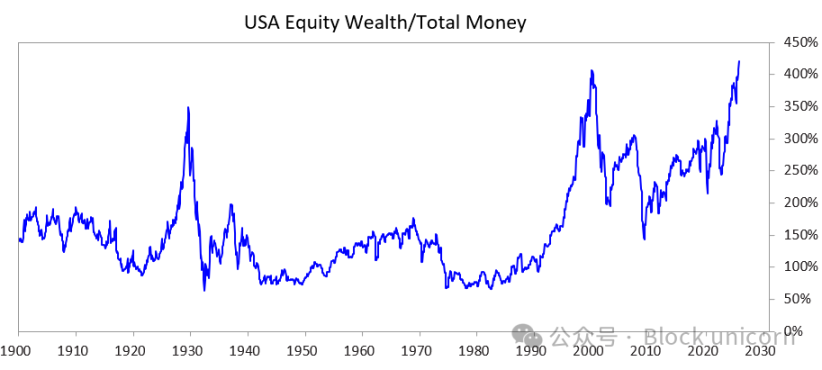
To explore how this dynamic, accompanied by a huge wealth gap, can burst bubbles and lead to a crash that may cause serious damage in the social, political, and financial spheres, I studied the chart below. This chart shows the past and present wealth/money gap, as well as the ratio of total stock market capitalization to total money supply.
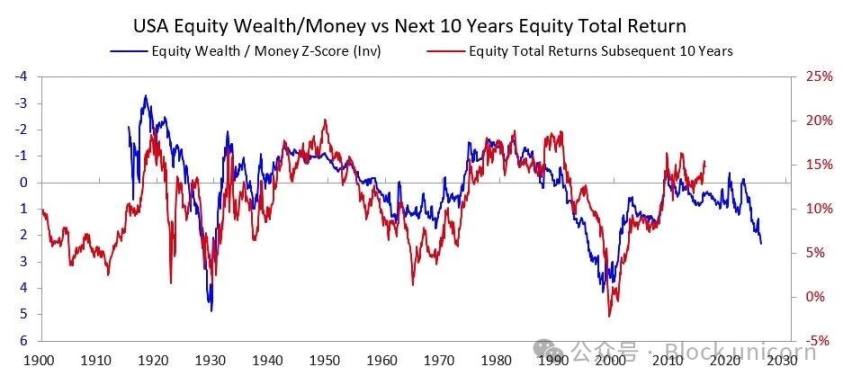
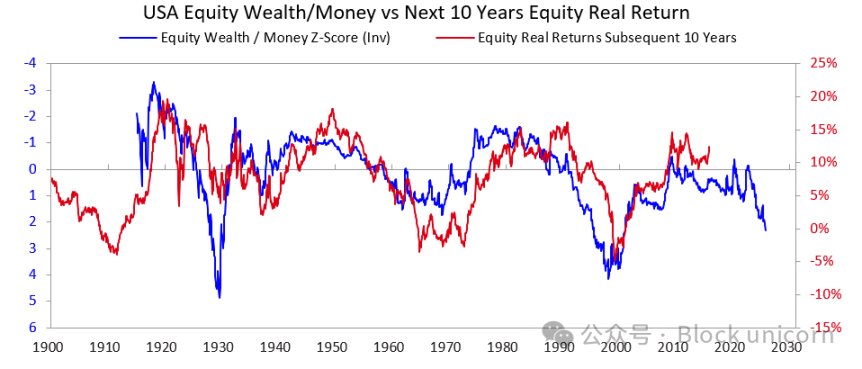
The next two charts show how this indicator predicts nominal and real returns over the next 10 years. These charts speak for themselves.
When I hear people trying to assess whether a stock or the stock market is in a bubble by judging whether the company will eventually be profitable enough to support the current stock price, I often feel that they do not understand how bubbles work at all. Long-term returns on investment are certainly important, but this is not the main reason for bubbles bursting. Bubbles do not burst because people suddenly wake up one morning and realize that the company's future income and profits are not enough to support the current stock price. After all, whether enough income and profits can be generated to support a good investment return usually takes many years, even decades, to become clear. The principle we need to remember is:
Bubbles burst because the funds flowing into assets begin to dry up, and holders of stocks or other wealth assets need to sell assets for money for some reason (most commonly to repay debt).
What usually happens next?
After a bubble bursts, when money and credit are insufficient to meet the needs of financial asset holders, the market and economy decline, and internal social and political turmoil usually intensifies. If the wealth gap is huge, this is especially true, as it exacerbates the division and anger between the rich/right and the poor/left. In the 1927-1933 case we examined, this dynamic triggered the Great Depression, which in turn led to serious internal conflict, especially between the rich/right and the poor/left. This dynamic ultimately led to the ousting of President Hoover and the election of President Roosevelt.
Naturally, when bubbles burst and markets and economies decline, it brings about huge political changes, massive fiscal deficits, and large-scale debt monetization. In the case of 1927-1933, the market and economic downturn occurred from 1929-1932, political change occurred in 1932, and these factors led to President Roosevelt's government running a huge budget deficit in 1933.
His central bank printed a large amount of money, causing the currency to depreciate (for example, relative to gold). This method of currency depreciation alleviated the shortage of money and: a) helped systemically important debtors who were overwhelmed by debt to repay their debts; b) pushed up asset prices; c) stimulated the economy. Leaders who come to power during such periods usually also carry out many shocking fiscal reforms, which I cannot explain in detail here, but I can say for sure that these periods often lead to huge conflicts and massive transfers of wealth. In the case of Roosevelt, these circumstances led to a series of major fiscal policy reforms aimed at transferring wealth from the top to the bottom (for example, raising the top marginal income tax rate from 25% in the 1920s to 79%, sharply increasing estate and gift taxes, and greatly expanding social welfare programs and subsidies). This also led to huge conflicts both within countries and between countries.
This is the typical dynamic. Throughout history, this situation has occurred repeatedly in countless countries over many years, forcing countless leaders and central banks to respond in the same way again and again, with so many cases that they cannot all be listed here. By the way, before 1913, the United States had no central bank and the government had no power to print money, so bank defaults and deflationary depressions were more common. In either case, bondholders suffered losses, while gold holders profited greatly.
Although the 1927-1933 example illustrates the classic bubble-bursting cycle well, that event was also relatively extreme. The same dynamic was reflected in the measures taken by President Nixon and the Federal Reserve in 1971, and these measures were behind almost all other bubbles and crashes (for example, the Japanese financial crisis of 1989-1990, the internet bubble of 2000, etc.). These bubbles and crashes also have many other typical characteristics (for example, markets are heavily chased by inexperienced investors, who are attracted by the hype, buy with leverage, suffer huge losses, and then become furious).
This dynamic pattern has existed for thousands of years (i.e., demand for money exceeds supply). People have to sell wealth to obtain money, bubbles burst, followed by defaults, money printing, and bad consequences in the economic, social, and political spheres. In other words, the imbalance between financial wealth and the amount of money, and the act of converting financial wealth (especially debt assets) into money, has always been the root cause of bank runs, whether in private banks or government-controlled central banks. These runs either lead to defaults (which mostly occurred before the Federal Reserve was established) or prompt central banks to create money and credit to provide to those critical, too-big-to-fail institutions to ensure they can repay loans and avoid bankruptcy.
Therefore, please keep in mind:
When the scale of certificates promising delivery of money (i.e., debt assets) is much larger than the total amount of existing funds, and financial assets need to be sold to obtain funds, be alert to the bursting of bubbles and make sure you are protected (for example, avoid taking on excessive credit risk and hold a certain amount of gold). If this happens during a period of a large wealth gap, pay close attention to possible major political and wealth redistribution changes and make sure you are prepared to respond.
Although rising interest rates and credit tightening are the most common reasons for people to sell assets to obtain the funds they need, any reason that creates a demand for funds (such as a wealth tax) and the act of selling financial wealth to obtain funds can lead to this dynamic.
When a huge wealth/money gap coincides with a huge wealth gap, it should be regarded as an extremely dangerous situation.
From the 1920s to the Present
(If you don't want to read a brief review of how we developed from the 1920s to the present, you can skip this section.)
Although I previously mentioned how the bubble of the 1920s led to the crash of 1929-1933 and the Great Depression, to quickly recap, the bursting of this bubble and the resulting Great Depression led President Roosevelt in 1933 to break the U.S. government's promise to deliver then-hard currency (gold) at the promised price. The government printed a large amount of money, and the price of gold rose by about 70%. I will skip over how the reflation of 1933-1938 led to the tightening of 1938; how the "recession" of 1938-1939 created the various factors needed by the economy and leadership, which, together with the geopolitical dynamics of the rise of Germany and Japan challenging the Anglo-American powers, led to World War II; and how the classic "big cycle" took us from 1939 to 1945 (the old monetary, political, and geopolitical order collapsed and a new order was established).
I won't go into the reasons in detail, but it should be noted that these factors made the United States very wealthy (at that time, the U.S. held two-thirds of the world's money, all of which was gold) and very powerful (the U.S. created half of the world's GDP and was the military hegemon at the time). Therefore, when the Bretton Woods system established a new monetary order, it was still based on gold, with the dollar pegged to gold (other countries could use the dollars they obtained to buy gold at $35 per ounce), and other countries' currencies were also pegged to gold. Then, between 1944 and 1971, U.S. government spending far exceeded tax revenue, so it borrowed heavily and sold these debts, creating gold claims far in excess of central bank gold reserves. Seeing this, other countries began to exchange their paper money for gold. This led to an extreme tightening of money and credit, so President Nixon in 1971 followed President Roosevelt's 1933 example and again devalued fiat currency relative to gold, causing the price of gold to soar. In short, from then until now, a) government debt and debt service costs have risen sharply relative to the tax revenue needed to repay government debt (especially during 2008-2012 after the 2008 global financial crisis and after the financial crisis triggered by the COVID-19 pandemic in 2020); b) the income and wealth gap has widened to today's level, creating irreconcilable political divisions; c) the stock market may be in a bubble, and the formation of the bubble is driven by speculation on new technologies supported by credit, debt, and innovation.
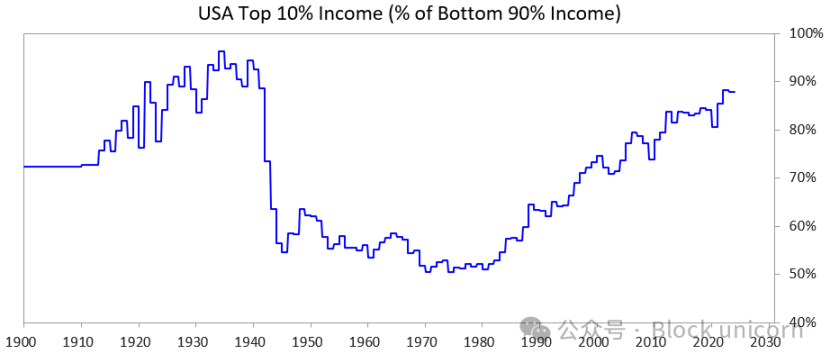
The chart below shows the share of income held by the top 10% of earners relative to the bottom 90%—you can see that the gap is now very large.
Where We Are Now
The U.S. and all other over-indebted democratic governments now face the following dilemma: a) they cannot increase debt as they did before; b) they cannot significantly raise taxes; c) they cannot significantly cut spending to avoid deficits and rising debt. They are now stuck.
To explain in more detail:
They cannot borrow enough money because the free market demand for their debt is insufficient. (This is because they are already heavily indebted, and their debt holders already hold too much debt.) In addition, debt asset holders from other countries (such as China) are worried that war or conflict may prevent them from recovering their debts, so their bond purchases are decreasing, and they are shifting debt assets to gold.
They cannot raise taxes because if they increase taxes on the wealthiest 1-10% (who own most of the wealth), a) these people will leave, taking their tax payments with them, or b) politicians will lose the support of the wealthiest 1-10% (which is crucial for funding expensive election campaigns), or c) they will burst the bubble.
They also cannot significantly cut spending and welfare, because this is politically and even morally unacceptable, especially since such cuts would disproportionately hurt the bottom 60% of the population…
So they are trapped.
For this reason, all highly indebted, highly unequal, and deeply divided democratic governments are in trouble.
Given these circumstances, and the way democratic political systems and human nature work, politicians promise quick solutions but fail to deliver satisfactory results, are soon ousted, replaced by new politicians who also promise quick solutions, fail, and are replaced again, and so on. This is why the UK and France, both of which have systems for quickly changing leaders, have each had four prime ministers in the past five years.
In other words, we are now seeing the classic pattern of this stage of the big cycle. This dynamic is extremely important and should now be obvious.
Meanwhile, the stock market and wealth boom are highly concentrated in top AI-related stocks (such as the "Magnificent 7") and a handful of super-rich individuals, while AI is replacing humans, further widening the wealth/money gap and the gap between people. This dynamic has occurred many times in history, and I believe it is very likely to trigger a strong political and social backlash, at the very least significantly changing the pattern of wealth distribution, and in the worst case, leading to serious social and political turmoil.
Now let's look at how this dynamic and the huge wealth gap together create problems for monetary policy, and how a wealth tax can burst bubbles and trigger crashes.
What the Data Looks Like
Now I will compare the top 10% of the population by wealth and income with the bottom 60%. I choose the bottom 60% because this group represents the vast majority.
In short:
- The wealthiest group (top 1-10%) owns far more wealth, income, and stocks than the majority (bottom 60%).
- Most of the wealth of the richest comes from asset appreciation, which is not taxed until the wealth is sold (unlike income, which is taxed when earned).
- With the rapid development of AI, these gaps are widening and are likely to widen at an even faster pace.
- If a wealth tax is imposed, assets will need to be sold to pay the tax, which could directly burst the bubble.
More specifically:
In the U.S., the top 10% of households by income are well-educated and highly productive, accounting for about 50% of income, owning about two-thirds of total wealth, holding about 90% of stocks, and paying about two-thirds of federal income taxes, and these numbers are growing rapidly. In other words, they live well and contribute greatly.
In contrast, the bottom 60% of the population is less educated (for example, 60% of Americans read below a sixth-grade level), less economically productive, their total income accounts for only about 30% of the national total, their wealth accounts for only 5% of total wealth, their stock holdings account for only about 5% of total stocks, and their federal tax payments are less than 5% of total taxes. Their wealth and economic prospects are relatively stagnant, so they struggle financially.
Naturally, there is enormous pressure to tax wealth and money and redistribute it from the richest 10% to the poorest 60%.
Although the U.S. has never had a wealth tax, there is now a strong call for one at both the state and federal levels. Why was there no wealth tax before, but now there is? Because the money is concentrated there—in other words, the top group mainly gets rich through asset appreciation rather than earned income, and the appreciation is currently untaxed.
There are three major problems with a wealth tax:
- The rich can emigrate, and once they do, they take their talent, productivity, income, wealth, and tax capacity with them, reducing all of these in the place they leave and increasing them in the place they move to;
- They are difficult to implement (for reasons you probably know, and I won't elaborate here as this article is already too long);
- Taking funds used for investment and productivity improvement and giving them to the government, hoping the government will use them efficiently to make the bottom 60% productive and prosperous—this assumption is highly unrealistic.
For these reasons, I am more inclined to impose an acceptable tax rate (e.g., 5-10%) on unrealized capital gains. But that's another topic for another time.
So How Would a Wealth Tax Actually Work?
I will explore this issue more fully in a future article. In short, the balance sheet of American households shows that their total wealth is about $150 trillion, but the amount of cash or deposits is less than $5 trillion. Therefore, if a 1-2% annual wealth tax were imposed, the required cash reserves would exceed $1-2 trillion per year—while the actual pool of liquid cash is far less than this.
Any such measure would burst the bubble and lead to economic collapse. Of course, the wealth tax would not be imposed on everyone, but only on the wealthy. This article is already long enough, so I won't go into specific numbers. In short, a wealth tax would: 1) trigger forced selling of private equity and public equity, depressing valuations; 2) increase demand for credit, possibly raising borrowing costs for the wealthy and the entire market; 3) prompt wealth to flow or be transferred to more favorable jurisdictions. If the government imposes a wealth tax on unrealized gains or illiquid assets (such as private equity, venture capital, or even concentrated holdings of public equity), these pressures will be even more pronounced.
Disclaimer: The content of this article solely reflects the author's opinion and does not represent the platform in any capacity. This article is not intended to serve as a reference for making investment decisions.
You may also like
Macroeconomic Distortion, Liquidity Restructuring, and the Repricing of Real Yields
Gnosis Chain Warns of Validator Penalty Post Balancer Hack Recovery Hard Fork

Today's Crypto Market: NIGHT on Cardano Plummets, ZEC and XMR Also Decline

SEC Targets Crypto Frauds: An Unyielding Crusade
Trending news
MoreCrypto prices
More





