Bitget App
Trade smarter
Buy cryptoMarketsTradeFuturesEarnSquareMore

News

Stay up to date on the latest crypto trends with our expert, in-depth coverage.

banner
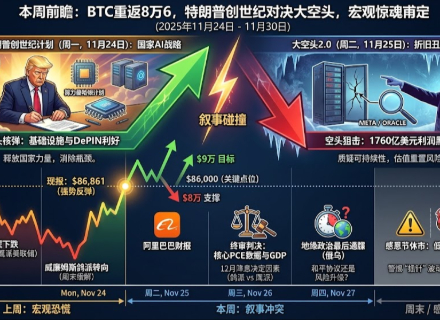
This Week's Preview: BTC Returns to 86,000, Trump’s Epic Showdown with Major Shorts, Macro Turmoil Just Settled

After last week's global market panic and subsequent recovery, bitcoin rebounded to $86,861. This week, the market will focus on new AI policies, the standoff between bears and bulls, PCE data, and geopolitical events, with intensified competition. Summary generated by Mars AI. The accuracy and completeness of this summary, produced by the Mars AI model, are still being iteratively improved.

MarsBit·2025/11/24 03:44
At risk of being removed from the index? Strategy faces a "quadruple squeeze" crisis

Strategy is facing multiple pressures, including a significant narrowing of mNAV premiums, reduced coin hoarding, executive stock sell-offs, and the risk of being removed from indexes. Market confidence is being severely tested.

BlockBeats·2025/11/24 03:41
How to plan a perfect TGE launch?

Most TGE failures are not due to poor products or inexperienced teams, but because their foundations were never prepared to face public scrutiny, competition, and shifts in narrative.

ForesightNews 速递·2025/11/24 03:33
How much wealth did the Trump family lose during the cryptocurrency crash?

The Trump family's wealth has shrunk by 1 billion US dollars, with ordinary investors becoming the biggest losers.

ForesightNews 速递·2025/11/24 03:33
Or Face Index Delisting? Strategy Caught in "Quadruple Whammy" Crisis

The Strategy is facing several pressures, including a significant mNAV premium contraction, reduced coin hoarding, executive stock selling, and index removal risk, putting market confidence to a severe test.

BlockBeats·2025/11/24 02:57
Flash
15:14
BYD tops the global electric vehicle sales chart
Golden Ten Data, January 2 – According to multiple foreign media reports, China's BYD has surpassed Tesla to become the world's top-selling electric vehicle manufacturer. On January 1, BYD announced that its pure electric vehicle sales reached 2.26 million units in 2025, an increase of nearly 28% compared to 2024. Meanwhile, Tesla disclosed on January 2 that its sales have declined for the second consecutive year, with annual deliveries dropping by 8.6% to about 1.6 million units, marking the largest annual decline in the company's history and losing its position as the global leader in electric vehicle sales. Notably, BYD has not yet entered the US market, while China remains Tesla's second-largest market globally. Despite this, BYD has still managed to surpass Tesla in sales. (Global Times)
15:05
Birentech: Amendment to Previously Released Allocation Results Announcement
Golden Ten Data reported on January 2 that a certain exchange issued a clarification announcement in Hong Kong, stating its intention to amend several typographical errors in both the Chinese and English versions of the final offer price and allotment results announcement, which was originally published with a company issue date of December 31, 2025, and to provide some additional information.
15:02
Analyst: Although manufacturers continued to increase production in December, the outlook for the United States at the beginning of the year is less optimistic.
According to Golden Ten Data on January 2, Chris Williamson, Chief Business Economist at S&P Global Market Intelligence, stated that although manufacturers continued to increase output in December—indicating that the goods production sector will contribute to further robust economic growth in the fourth quarter—the outlook for early 2026 appears less optimistic. In fact, the gap between production growth and declining orders is the largest since the 2008-2009 global financial crisis. Unless demand improves, the current level of factory output is clearly unsustainable. If production capacity has to be scaled back, employment will also be adversely affected. A key factor raising concerns about sales is the extent to which producers will have to pass on higher costs to consumers in the form of price increases, with rising costs still mainly attributed to tariffs. Input cost inflation slowed in December to its lowest level since January last year, which is somewhat encouraging. However, despite this cost trend suggesting that the impact of tariffs on inflation peaked as early as the summer, costs are still rising month by month at a relatively high rate, indicating that cost growth for U.S. businesses continues to outpace most other major economies' competitors.
News
© 2025 Bitget