
News
Stay up to date on the latest crypto trends with our expert, in-depth coverage.

- Cold Wallet (CWT) combines cashback rewards, tiered incentives, and institutional-grade security to create a sustainable crypto ecosystem. - Its 150-stage gamified model offers escalating gas rebates (up to 100%) and governance rights, with token prices projected to rise 3,423% by listing. - Deflationary tokenomics (90% presale lock, 40% liquidity allocation) and audits by Hacken/CertiK reinforce trust in a volatile market. - A 25% referral reward pool and Plus Wallet's 2M users accelerate network effect

- Succinct and Tandem partner to accelerate ZK integration on Arbitrum, addressing Ethereum's scalability challenges through modular provers. - The collaboration reduces settlement times from days to minutes while enabling institutional-grade privacy for DeFi and enterprise applications. - PROVE token gains utility as demand surges, creating a flywheel effect through expanding ZK infrastructure adoption across Arbitrum's 50% TVL ecosystem. - This strategic alignment positions ZK as blockchain's new standar

- Fed's dovish pivot, highlighted by Powell's Jackson Hole 2025 speech, triggered crypto rallies as markets priced in 89% odds of September rate cuts. - Bitcoin surged to $117,000 amid easing signals, but "buy the rumor, sell the news" risks persist due to historical patterns and overbought on-chain metrics. - Structural adoption trends (BlackRock ETFs, Ethereum upgrades) contrast with short-term volatility, urging long-term investors to balance optimism with hedging strategies. - Fed's data-dependent appr
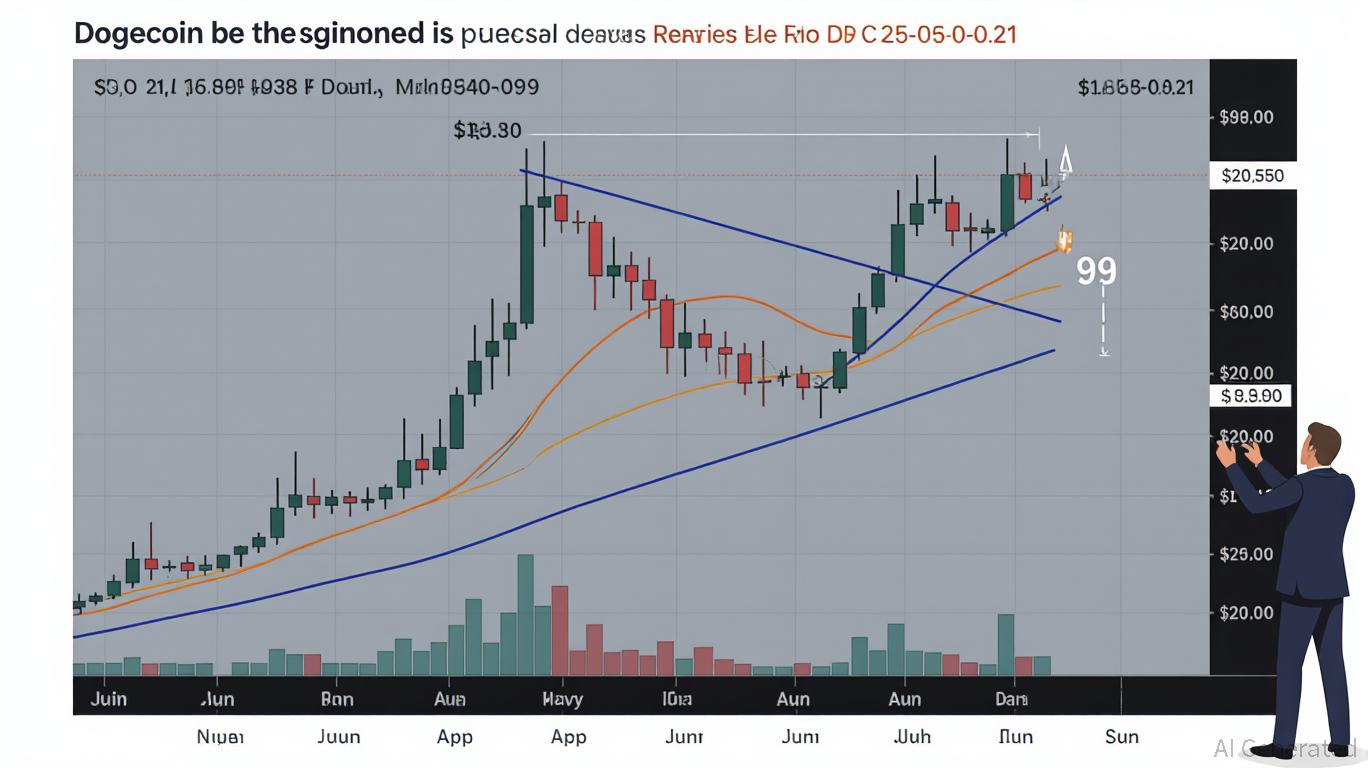
- Dogecoin (DOGE) faces a critical juncture in August 2025, with technical indicators and a multi-year cup-and-handle pattern suggesting a potential bullish breakout. - TD Sequential signals short-term bearish exhaustion, while Project Sakura's PoS upgrade aims to enhance scalability and security, positioning DOGE as a competitive payment solution. - A confirmed $0.29 breakout could trigger a 165% rally to $0.38, supported by strong buying pressure (MFI 89.12) and institutional adoption potential via the U

- Blockchain-driven tokenization is transforming OTC markets in 2025 through regulatory innovation and global liquidity networks. - U.S. regulatory clarity (OCC Letter 1184) and state-level CER frameworks enable institutional custody of cryptoassets, while Brazil/UK align on digital asset recognition. - Tokenized funds (e.g., BlackRock's $5B BUIDL) and platforms like Swarm demonstrate improved liquidity, though challenges remain in cross-market fragmentation and valuation standards. - Investors are priorit
- Eclipse Labs shifts from Layer 2 infrastructure to consumer apps, leading to 65% workforce cuts and a 65% token price drop. - The pivot mirrors industry trends but faces execution risks, contrasting with Abstract's 1M wallets and Berachain's $3.26B TVL success. - Investors weigh Eclipse's hybrid model against Solana/Sui dominance, noting underperforming $50M funding vs. $89.7B DeFi growth projections. - Token utility and market confidence remain critical challenges, with Q3 airdrops and Q4 governance act

- Sonic (S Token) introduces a Fee Monetization (FeeM) model, enabling developers to capture 90% of transaction fees, fostering sustainable ecosystem growth. - A 1.5% capped inflation rate paired with fee-driven token burns ensures supply stability, contrasting with Ethereum's variable inflation and BNB Chain's volatile emission strategies. - Sonic's dual EVM/SVM compatibility and strategic integrations (e.g., USDC, CCTP V2) enhance liquidity, attracting rapid growth in stablecoin supply and DeFi activity.

- Institutional investors increasingly adopt AI-driven crypto hedge funds, with $82.4B AUM and 37% allocation plans by mid-2025. - AI-powered funds outperformed traditional strategies by 12-15% in 2025, leveraging algorithmic precision and reinforcement learning for risk-adjusted returns. - Technological convergence (AI, blockchain, cost-efficient tools) drives 20% faster transactions and 25% DeFi returns, with platforms like Axon Trade democratizing access. - Strategic diversification across AI-integrated
- Eclipse Labs shifts from blockchain infrastructure to product-led app development, reflecting industry-wide focus on user value over speculative tech. - CEO Sydney Huang's "breakout app" strategy follows 65% token value drop and workforce cuts, aiming to drive adoption through real-world utility. - The pivot mirrors trends seen in dYdX and Uniswap but faces risks from crowded app markets, regulatory uncertainty, and reliance on single-product success. - Investors must monitor user growth, token utility e
- 06:59Michael Saylor: Major banks such as BNY Mellon and JPMorgan have started issuing loans collateralized by bitcoin.Jinse Finance reported that Michael Saylor, founder and executive chairman of Strategy, stated that several major banks, including BNY Mellon, Wells Fargo, Bank of America, Charles Schwab, JPMorgan, and Citigroup, have begun issuing credit backed by bitcoin as collateral.
- 06:56South Korea’s National Pension Service increases its MicroStrategy holdings to 93 million dollarsChainCatcher reported that Bitcoin Treasuries.NET posted on X, stating that the National Pension Service (NPS) of South Korea, which manages assets worth 1 trillion USD, has increased its holdings in MicroStrategy (MSTR), a listed company holding bitcoin, to 93 million USD.
- 06:53Matrixport: Bitcoin implied volatility continues to decline, with the market gradually lowering the likelihood of an upward movement by the end of DecemberJinse Finance reported that Matrixport's daily chart analysis indicates that bitcoin's implied volatility continues to decline, which in turn reduces the likelihood of a significant upward breakout by the end of the year. Today's Federal Open Market Committee meeting is the last major catalyst, but once the meeting concludes, volatility is likely to continue its downward trend until the holiday season. Without new bitcoin ETF inflows to drive directional momentum, the market may return to a range-bound state. This outcome is typically associated with further declines in volatility. In fact, this adjustment process is already underway, with implied volatility continuously decreasing and the market gradually lowering the probability of an upside surprise at the end of December.