
News
Stay up to date on the latest crypto trends with our expert, in-depth coverage.
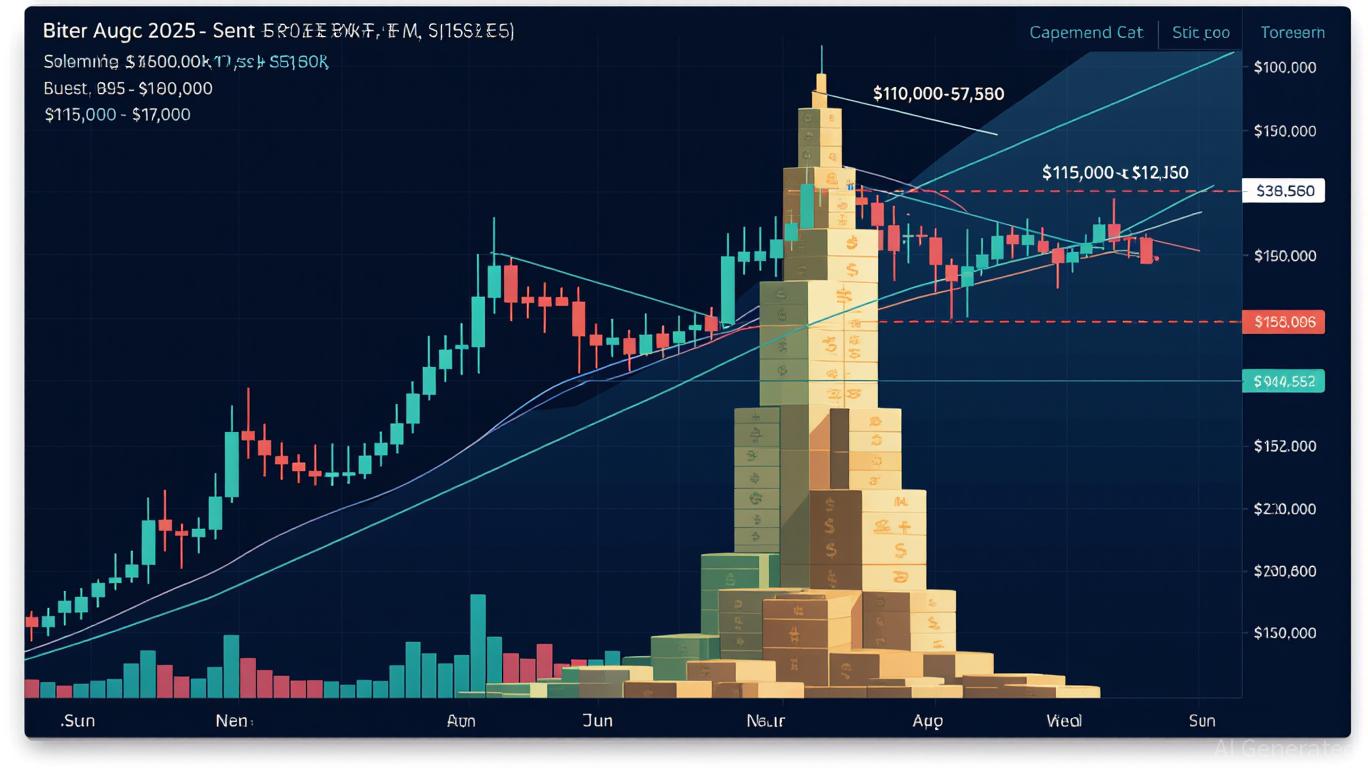
- Bitcoin's August 2025 price action shows a $124,200 peak followed by a pullback to $111,464, testing critical support levels amid volatile trading conditions. - Key technical levels include $110,000–$112,000 (primary support), $115,000–$117,000 (resistance), and $124,500 as a bullish validation threshold for institutional adoption. - Macroeconomic factors like Fed Chair Powell's Jackson Hole speech and $219M weekly ETF inflows highlight Bitcoin's growing role as an inflation hedge and store of value. - S

- Fed's 2025 rate-cut pivot lowers holding costs for Bitcoin, driving institutional adoption as inflation hedge. - MicroStrategy, Harvard, and CEA Industries allocate billions to Bitcoin/BNB, treating crypto as core corporate reserves. - Dovish policy and crypto synergy create flywheel: rate cuts → increased adoption → upward price pressure. - Investors advised to balance crypto exposure with ETFs/bonds, as volatility risks persist despite regulatory clarity.

- Aave's Total Value Locked (TVL) surpassed $41.1B in August 2025, matching the 54th largest U.S. bank by deposit size. - Strategic expansion to non-EVM chains like Aptos and institutional partnerships drove $1.3B TVL growth within months. - With 62% DeFi lending market share and $71.1B combined value, Aave challenges traditional banks through 24/7 accessibility and uncorrelated yield. - Upcoming Aave V4 Liquidity Hubs and regulatory alignment position it as a blue-chip DeFi asset amid evolving U.S. crypto

- Trump's aggressive push to control the Fed risks undermining its independence, threatening U.S. monetary policy and dollar credibility. - Market reactions show dollar weakness (9% DXY drop), rising gold prices, and 4.9% Treasury yields, signaling inflation fears and policy instability. - Dollar's global reserve share fell to 58% by 2025 as central banks diversify into gold, yuan, and regional currencies, marking a structural shift. - Investors are advised to hedge via gold, TIPS, and emerging markets, as

- XRP faces critical technical support at $2.64, where Fibonacci levels, moving averages, and liquidity accumulation converge, signaling potential for a breakout toward $3.30. - Institutional demand surges with $9.02B in derivatives volume and 1,100% higher open interest, driven by XRP's utility in cross-border payments and Ripple's ODL expansion. - SEC's 2025 commodity classification removes regulatory hurdles, accelerating ETF approvals that could inject $5–$8B in capital, mirroring Bitcoin's ETF-driven

- Crypto investors face severe emotional biases (FOMO, panic selling) causing 37% average losses during market corrections, per 2025 studies. - 2025 investors combat these traps using automated stop-loss orders, pre-defined trading plans, and dollar-cost averaging frameworks. - Behavioral nudges like sentiment analysis and portfolio diversification help identify irrational market patterns and enforce discipline. - Structured approaches reduce emotional decision-making, with 60% higher strategy adherence du

- Eclipse Labs pivoted to user-facing apps after a 65% token value drop, securing $50M funding to build a "breakout application" leveraging its Solana-on-Ethereum rollup. - The shift includes 65% workforce cuts, leadership changes, and a flywheel strategy where user growth drives infrastructure demand, mirroring Ethereum and Solana's consumer-centric transitions. - Risks include market saturation, technical execution challenges, and SEC scrutiny, contrasting with peers like Polygon and Avalanche who balanc
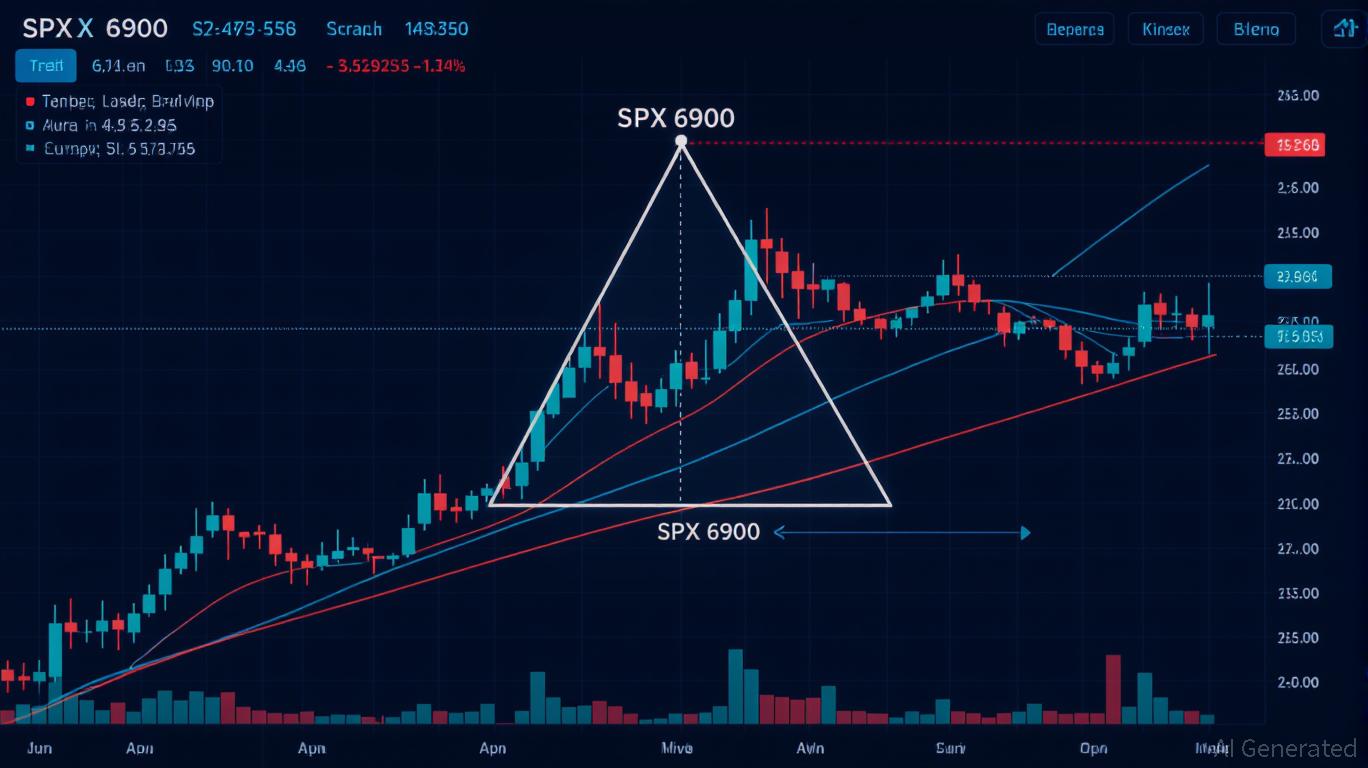
- SPX6900 (SPX) has dropped 22% to $1.97 as whale selling, weak technicals, and bearish derivatives signal a critical breakdown. - Whale activity shows profit-taking via large sales, with 134 whale transactions on June 9 and a $4.46M dump on July 20 triggering price declines. - Technical indicators (EMA, RSI, MACD) and derivatives data (12% open interest surge) confirm deteriorating momentum and short-position dominance. - Meme coin's volatility and lack of fundamentals amplify risks; investors advised to

- The $5 trillion crypto shift is driven by Ethereum’s institutional adoption, Hyperliquid’s trading infrastructure, SUI’s long-term potential, and XYZVerse’s speculative appeal. - Ethereum’s ETF inflows and staking dominance (35.7M ETH staked) solidify its role as a reserve asset for institutions. - Hyperliquid’s $29B daily volume and hybrid model bridge DeFi and institutional liquidity needs. - SUI’s 21.71% 6-month gain and institutional adoption highlight its scalable infrastructure potential. - XYZVers

- XRP gains institutional traction post-SEC legal resolution, with ETF approvals and cross-border partnerships boosting regulated adoption. - Dogecoin maintains cultural relevance through meme-driven momentum, though its high-beta profile suits risk-tolerant investors. - Pepe Coin (PEPE) embodies speculative volatility, relying on social media hype and community sentiment for price swings. - Tapzi (TAPZI) emerges as a presale utility-driven project, blending gaming innovation with blockchain to attract bot
- 06:59Michael Saylor: Major banks such as BNY Mellon and JPMorgan have started issuing loans collateralized by bitcoin.Jinse Finance reported that Michael Saylor, founder and executive chairman of Strategy, stated that several major banks, including BNY Mellon, Wells Fargo, Bank of America, Charles Schwab, JPMorgan, and Citigroup, have begun issuing credit backed by bitcoin as collateral.
- 06:56South Korea’s National Pension Service increases its MicroStrategy holdings to 93 million dollarsChainCatcher reported that Bitcoin Treasuries.NET posted on X, stating that the National Pension Service (NPS) of South Korea, which manages assets worth 1 trillion USD, has increased its holdings in MicroStrategy (MSTR), a listed company holding bitcoin, to 93 million USD.
- 06:53Matrixport: Bitcoin implied volatility continues to decline, with the market gradually lowering the likelihood of an upward movement by the end of DecemberJinse Finance reported that Matrixport's daily chart analysis indicates that bitcoin's implied volatility continues to decline, which in turn reduces the likelihood of a significant upward breakout by the end of the year. Today's Federal Open Market Committee meeting is the last major catalyst, but once the meeting concludes, volatility is likely to continue its downward trend until the holiday season. Without new bitcoin ETF inflows to drive directional momentum, the market may return to a range-bound state. This outcome is typically associated with further declines in volatility. In fact, this adjustment process is already underway, with implied volatility continuously decreasing and the market gradually lowering the probability of an upside surprise at the end of December.